

Archive position — measured, not model output
1 like on Devpost
505 of the 7,850 archived projects have more likes, and 1,758 share exactly 1 — so this project's #809 place in the like-ranked listing is a tie-break inside that group, not a ranking.
Projects (log scale)
Likes on Devpost. ▲ marks this project's group.
Show the figures
| Likes | Projects | Share of archive |
|---|---|---|
| 0 | 5,587 | 71.2% |
| 1 | 1,758 | 22.4% |
| 2 | 284 | 3.6% |
| 3–4 | 132 | 1.7% |
| 5–9 | 75 | 1.0% |
| 10+ | 14 | 0.2% |
 User Stories BotA demo video on every pull request
Get a demo video on every new feature
GitHub App that watches your pull requests and records a narrated, captioned demo.
Save time on demo prep and make informed decisions faster with a video walkthrough of every new feature.
Executive Summary
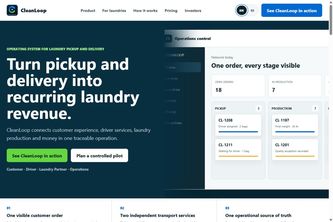
What the company appears to be: CleanLoop is a self-reported multi-actor operating platform for recurring and on-demand laundry logistics. The author describes it as a system that coordinates the promise made to the customer across multiple actors (customer, driver, laundry partner, admin) and stages of service delivery (pickup, production, delivery), with integrated financial tracking.
What changed: During Build Week, the author restructured the product to separate independent pickup and delivery services from a single customer order. Key improvements included idempotent submission rules, concurrency protection, custody evidence controls, bag reconciliation, final-weight controls, payout policies, and stronger operational validations. The mobile apps (Customer and Driver) were rebuilt, and the Laundry Partner portal was turned into a production workbench.
Single most important open question: Is there any evidence of real-world usage or customer traction beyond the author's own development work? The description states that CleanLoop existed as an early product before Build Week, but provides no data on adoption, revenue, or operational performance outside of testing and development.
What The Product Actually Is
The description states that CleanLoop is a multi-actor operating platform for recurring and on-demand laundry logistics. It handles coordination between four worlds: customer intent, driver transportation, laundry production, and money.
It supports:
- Customer order submission with pickup details, pounds, price, and payment
- Independent assignable pickup service from customer to laundry
- Laundry partner confirmation of custody, bag reconciliation, final weight recording
- Separate delivery opportunity from laundry back to customer
- Support for same or different drivers for pickup/delivery
- Financial stages connected to the operation (customer quote/charge, driver earnings, laundry partner amount, platform margin, payout readiness)
- Focused experiences for Customer, Driver, Laundry Partner, and Admin/Super Admin
The system is described as designed to keep commercial promise, physical custody, operational workflow, and movement of money connected without treating them as the same thing.
Evidence: Self-reported by author. No independent verification or third-party data provided.
Positioning & Claim Evolution
The author states that CleanLoop started with a question about why laundry pickup and delivery feels easy to customers but difficult for operators behind the scenes. The deeper they worked on the problem, the clearer it became that CleanLoop could not be just another app for requesting laundry pickup — the real challenge was coordinating the promise made to the customer across every person, handoff, payment, bag, pound, and piece of evidence involved in completing the service.
The positioning evolved from a simple laundry request app to a platform that makes the entire operation visible, coordinated, and accountable from beginning to end. The author emphasizes that CleanLoop is not just about the interface but about operational coordination across multiple actors and stages.
Evidence: Self-reported by author. No external validation or market positioning data provided.
Target Customer & ICP
The description states that CleanLoop targets small and mid-sized laundries that coordinate laundry processes through phone calls, spreadsheets, text messages, and disconnected tools. These are the "operators" who need to manage pickup, delivery, production, and financial stages across multiple actors.
It also implies a customer base of individuals who use the service for laundry pickup and delivery, though no specific demographics or usage patterns are described.
The author notes that the platform is designed to give independent laundries the operating infrastructure needed to offer a modern experience without building an entire technology company themselves.
Evidence: Self-reported by author. No data on actual customers, customer segments, or usage behavior provided.
Business Model & Pricing Evidence
There is no explicit mention of pricing models, revenue streams, or monetization strategies in the description. The author mentions financial stages such as customer quote and charge, driver earnings, laundry partner amount, platform margin, and payout readiness, but does not describe how these translate into a business model.
The author states that CleanLoop is designed to give independent laundries the infrastructure needed to offer modern services without building their own tech company — this suggests a potential SaaS or platform-based model, but no concrete details are given.
Evidence: Self-reported by author. No pricing information, revenue data, or business model details provided.
Technical & Delivery Signals
CleanLoop is built using:
- Backend: ASP.NET Core .NET 8, Clean Architecture, Entity Framework Core, PostgreSQL
- Mobile apps (Customer and Driver): Flutter for Android, iOS, and Web
- Laundry operations/administration: Blazor
- Infrastructure: Azure, Firebase Cloud Messaging, Google Maps
- Payment integration: Stripe hooks for billing and Connect
- Development tools: Codex, GPT-5.6
The author reports:
- 76 of 76 backend tests passing in Release
- 12 of 12 Customer Flutter tests passing
- 12 of 12 Driver Flutter tests passing
- Mobile apps validated on physical Samsung device
- Bilingual quality checks (English and Spanish)
- Continuous integration, repository hygiene, clear documentation
- Idempotent submission rules, concurrency protection, custody evidence, bag reconciliation, final-weight controls, payout policies
The author also notes that GPT-5.6 was used to analyze the system as a complete operating system, helping identify inconsistencies between different parts of the product and translate operational rules into enforceable software invariants.
Evidence: Self-reported by author. No independent technical audit or performance data provided.
Traction & Maturity Signals
The description states that CleanLoop already existed as an early product before Build Week, and that the author documented the baseline, commit range, architecture, setup instructions, testing path, sample data, results, and areas where Codex and GPT-5.6 accelerated work.
It also mentions:
- A live product website and guided walkthrough
- Clear and testable Build Week commit history
- Independent pickup and delivery services connected to one customer order
- Stronger custody, bag, weight, evidence, exception, and payout controls
- A Laundry Partner production workbench
- An Admin and Super Admin operations control tower
- A documented path from current product to a controlled real-world pilot
However, there is no mention of actual users, customers, or revenue. The author notes that the next step is to deploy a controlled Azure pilot environment and run one order with a known laundry partner and drivers — indicating this is still in early development.
Evidence: Self-reported by author. No traction data, customer base, or operational performance metrics provided.
Competitive Context
The description does not provide any information about competitors or competitive positioning. The author focuses on the internal problem they are solving rather than how CleanLoop fits into existing markets or platforms for laundry pickup and delivery.
Evidence: Not evidenced.
Open Questions & Risks
- No real-world usage data: The product exists only in development and testing phases, with no evidence of customer adoption or operational performance.
- Single-founder project: Only one team member (Yeison Castillo) is mentioned, which raises concerns about scalability and resource capacity.
- Unproven business model: No pricing structure, revenue streams, or monetization strategy are described.
- AI dependency: Heavy reliance on Codex and GPT-5.6 for development suggests potential risks if these tools become unavailable or unreliable.
- Operational complexity: The system handles complex coordination across multiple actors and stages, which increases risk of implementation failure or operational inefficiencies.
Evidence: Inferred from self-reported description; no external data or validation provided.
Questions the description leaves open
- What is the current status of the pre-Build Week version? Is there any evidence of prior usage or customer feedback?
- How many laundries are currently using CleanLoop, and what is their retention rate?
- What specific pricing model does CleanLoop use, and how is revenue generated?
- Has the system been tested in real-world conditions beyond the pilot phase?
- What are the key assumptions about user behavior that have not yet been validated?
- How do you plan to scale from a single laundry partner to multiple partners and drivers?
- Are there any regulatory or compliance issues related to handling financial transactions, driver data, or customer information?
- What is the timeline for full commercial deployment?
Evidence: Inferred based on gaps in self-reported description.
Overall Assessment
CleanLoop appears to be a highly technical, single-founder project focused on solving an operational coordination challenge in the laundry logistics space. The author has built a functional prototype with strong development practices and AI-assisted engineering, but there is no evidence of real-world usage, customer traction, or commercial viability beyond the developer's own testing.
The system shows signs of maturity in terms of code quality, test coverage, and architectural design, but lacks any demonstration of market demand or business success. The next step would be to validate the concept with a controlled pilot involving actual laundries and drivers — which is described as upcoming.
Confidence Level: Low. This analysis is based entirely on self-reported information without independent verification or evidence of traction, revenue, or customer adoption.
Assessment: Not ready for investment or partnership at this stage due to lack of market validation and commercial proof-of-concept.
User Stories BotA demo video on every pull request
Get a demo video on every new feature
GitHub App that watches your pull requests and records a narrated, captioned demo.
Save time on demo prep and make informed decisions faster with a video walkthrough of every new feature.
Source
Submitted to the OpenAI 2026 hackathon on Devpost. Project home on Devpost. Back to the full gallery on Devpost.
This competitive analysis was produced by top-founders.com (opens in a new tab)
Generated by a language model from this project's public Devpost page — its tagline, the author's own write-up and any built-with tags listed there — as captured in August 2026. Short quotations are the author's words. It is an opinion on the idea as a business, not on the people behind it, and it reflects the description as published then. If the project has moved on, request a correction below. The analysis is not independent research and contains no verified traction, revenue or customer data.
An independent guide by KFG International LLC — not affiliated with, endorsed by, or connected to Devpost or OpenAI.