

Archive position — measured, not model output
0 likes on Devpost
2,263 of the 7,850 archived projects have more likes, and 5,587 share exactly 0 — so this project's #4,735 place in the like-ranked listing is a tie-break inside that group, not a ranking.
Projects (log scale)
Likes on Devpost. ▲ marks this project's group.
Show the figures
| Likes | Projects | Share of archive |
|---|---|---|
| 0 | 5,587 | 71.2% |
| 1 | 1,758 | 22.4% |
| 2 | 284 | 3.6% |
| 3–4 | 132 | 1.7% |
| 5–9 | 75 | 1.0% |
| 10+ | 14 | 0.2% |
 User Stories BotA demo video on every pull request
Get a demo video on every new feature
GitHub App that watches your pull requests and records a narrated, captioned demo.
Save time on demo prep and make informed decisions faster with a video walkthrough of every new feature.
Executive Summary
What the company appears to be
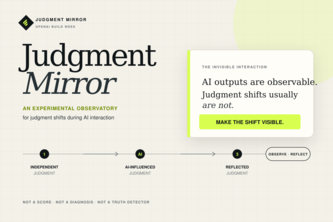
Judgment Mirror is an experimental observatory for human judgment during AI interaction, built as a prototype for the OpenAI 2026 hackathon. It guides users through a decision-making scenario with AI assistance and visualizes changes in their judgment before and after AI input.
What changed
The project description indicates this is a self-contained prototype built by one person (biasbreaker Myers) using Next.js, TypeScript, GPT-5.6, and Codex. It does not appear to have moved beyond the prototype stage or demonstrated any commercial traction.
Single most important open question
Is there evidence of a viable market need for human-AI judgment observability that would justify further development beyond this experimental prototype?
The description states that Judgment Mirror is an experimental observatory, not a product with revenue, customers, or adoption. It was built as a hackathon submission and contains no evidence of commercial viability, funding, or user base.
What The Product Actually Is
The description states that Judgment Mirror is:
- An experimental observatory for human judgment during AI interaction
- A standalone Next.js and TypeScript application
- Built with GPT-5.6 via the OpenAI Responses API
- Designed to guide users through realistic operational decision scenarios
- Not an intelligence test, psychological assessment, truth detector, or decision-grading system
- Not designed to determine whether the user or AI is correct
The product does not appear to have moved beyond a prototype stage. It stores complete sessions only in browser state and contains no authentication, database, user profile, payment system, uploads, or unrelated features.
Positioning & Claim Evolution
The description states that Judgment Mirror:
- Focuses on making invisible judgment shifts visible during AI interactions
- Started with the question: "What changed in a person's decision process after the AI answered?"
- Is not an intelligence test, psychological assessment, truth detector, or decision-grading system
- Does not determine whether the user or AI is correct
- Visualizes the decision process that occurred during one interaction
The positioning appears to be:
- An experimental tool for observing human-AI interaction dynamics
- Focused on transparency in judgment processes rather than evaluation of correctness
- Positioned as a research instrument, not a commercial product
Target Customer & ICP
The description states that Judgment Mirror:
- Guides users through one realistic operational decision scenario
- Is designed to observe the information recorded during one AI-assisted decision process
- Does not claim to evaluate intelligence, reasoning ability, or diagnose cognition/mental health
No specific target customer segment is identified. The description indicates it's an experimental tool for observing human-AI interactions, but does not specify who would use it or what their role might be.
Business Model & Pricing Evidence
The description states:
- Judgment Mirror is an experimental observatory
- It was built as a prototype for the OpenAI 2026 hackathon
- The prototype stores complete sessions only in browser state
- It contains no authentication, database, user profile, payment system, uploads, or unrelated features
- No pricing information or business model is provided
There is no evidence of any commercial business model, pricing structure, or monetization strategy.
Technical & Delivery Signals
The description states that Judgment Mirror:
- Is built as a standalone Next.js and TypeScript application
- Uses GPT-5.6 via the OpenAI Responses API
- Was implemented with Codex as an implementation partner
- Uses structured JSON outputs validated through strict schemas (Zod)
- Performs two bounded tasks: generating AI recommendation and analyzing visible differences between recorded judgment stages
- Does not control user snapshots, decision comparisons, evidence-coverage arithmetic, metric calculations, or stage attribution through the model
- Enforces these through deterministic application logic
- Stores complete session only in browser state
- Contains no authentication, database, user profile, payment system, uploads, or unrelated features
The technical implementation shows:
- Use of modern web stack (Next.js, TypeScript)
- Integration with OpenAI APIs
- Structured data validation
- Deterministic logic for integrity controls
- Automated testing (80 automated tests)
Traction & Maturity Signals
The description states:
- Judgment Mirror is an experimental observatory
- It was built as a prototype for the OpenAI 2026 hackathon
- The prototype passed 80 automated tests, TypeScript validation, ESLint with zero warnings, production build validation, original failure-pattern integration fixture, and three complete live Scenario 01 journeys
- All three live journeys rendered one complete Judgment Mirror without manual retry
- Every run preserved all four decision states independently, retained AI-generated provenance, used neutral reflection language, and correctly handled the no-claim evidence state
No evidence of revenue, customers, or adoption beyond the prototype testing phase.
Competitive Context
The description states:
- Judgment Mirror is experimental and not scientifically calibrated
- It does not evaluate intelligence, reasoning ability, diagnose cognition or mental health, determine whether a decision is correct, or replace professional decision systems
- It observes only information recorded during one AI-assisted decision process
No competitive landscape or market positioning relative to other tools is described. The description indicates this is an experimental tool without established competitors.
Open Questions & Risks
The description states:
- Judgment Mirror is experimental and not scientifically calibrated
- It does not evaluate intelligence, reasoning ability, diagnose cognition or mental health, determine whether a decision is correct, or replace professional decision systems
- It observes only information recorded during one AI-assisted decision process
- The next stage is not to add more participant-facing metrics and call them science
- Controlled pilot studies, versioned scenarios, preregistered hypotheses, reliability testing, construct validation, independent replication, and clearly bounded scientific claims are required before it could become a validated research instrument
Key risks include:
- Prototype-only status with no commercial traction
- Experimental nature without scientific calibration
- No evidence of market demand or user adoption
- No clear path to commercialization
Questions the description leaves open
- What specific problem are you trying to solve that would justify moving beyond this experimental prototype?
- Have you identified any potential users or customers who would pay for this functionality?
- What evidence do you have of market demand for human-AI judgment observability?
- How would you transition from this prototype to a commercial product?
- What are the key metrics that would indicate success beyond the current experimental phase?
- Have you considered how to validate the scientific claims and ensure reproducibility?
- What is your plan for scaling beyond the single-person development team?
Overall Assessment
The description states that Judgment Mirror:
- Is an experimental observatory for human judgment during AI interaction
- Was built as a prototype for the OpenAI 2026 hackathon
- Contains no evidence of revenue, customers, or adoption beyond the prototype testing phase
- Does not evaluate intelligence, reasoning ability, diagnose cognition or mental health, determine whether a decision is correct, or replace professional decision systems
Assessment Not evidenced. The description shows this is an experimental prototype with no commercial traction, revenue, customers, or demonstrated market need. It lacks any evidence of a viable business model, target customer base, or path to monetization. The project appears to be a proof-of-concept rather than a commercial venture.
User Stories BotA demo video on every pull request
Get a demo video on every new feature
GitHub App that watches your pull requests and records a narrated, captioned demo.
Save time on demo prep and make informed decisions faster with a video walkthrough of every new feature.
Source
Submitted to the OpenAI 2026 hackathon on Devpost. Project home on Devpost. Back to the full gallery on Devpost.
This competitive analysis was produced by top-founders.com (opens in a new tab)
Generated by a language model from this project's public Devpost page — its tagline, the author's own write-up and any built-with tags listed there — as captured in August 2026. Short quotations are the author's words. It is an opinion on the idea as a business, not on the people behind it, and it reflects the description as published then. If the project has moved on, request a correction below. The analysis is not independent research and contains no verified traction, revenue or customer data.
An independent guide by KFG International LLC — not affiliated with, endorsed by, or connected to Devpost or OpenAI.