

Archive position — measured, not model output
0 likes on Devpost
2,263 of the 7,850 archived projects have more likes, and 5,587 share exactly 0 — so this project's #6,698 place in the like-ranked listing is a tie-break inside that group, not a ranking.
Projects (log scale)
Likes on Devpost. ▲ marks this project's group.
Show the figures
| Likes | Projects | Share of archive |
|---|---|---|
| 0 | 5,587 | 71.2% |
| 1 | 1,758 | 22.4% |
| 2 | 284 | 3.6% |
| 3–4 | 132 | 1.7% |
| 5–9 | 75 | 1.0% |
| 10+ | 14 | 0.2% |
 User Stories BotA demo video on every pull request
Get a demo video on every new feature
GitHub App that watches your pull requests and records a narrated, captioned demo.
Save time on demo prep and make informed decisions faster with a video walkthrough of every new feature.
Executive Summary
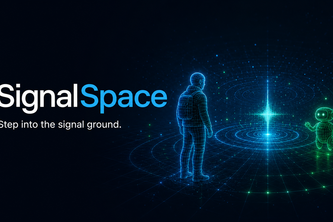
SignalSpace is a browser-based prototype that explores signal-driven communication through an interactive social space. The author describes it as a "consent-first signal ground" where users navigate a dark environment with wireframe avatars, generating visual and auditory signals from movement and intentional actions. It simulates EEG-style confidence and allows triggering of Pulse, Wave, or Glow events. The experience is built using Next.js, React, TypeScript, Canvas API, Web Audio, and OpenAI tools like Codex and GPT-5.6.
The project is presented as a conceptual prototype for exploring how presence might be represented through energy, movement, and intentional signals — not as a product with real users or revenue. It does not claim to read thoughts or collect sensor data; instead, it demonstrates interaction language, privacy boundaries, and an invitation flow in a simulated environment.
The single most important open question
What is the intended evolution from this prototype into a commercial product or platform? The description provides no evidence of traction, monetization, or customer adoption beyond its own self-reporting.
What The Product Actually Is
The description states that SignalSpace is an interactive social-space prototype. Users enter a dark, responsive environment with wireframe avatars and can move through it to generate sonar-like rings and data particles. They may enable an EEG-style simulation, trigger signals (Pulse, Wave, Glow), and interact with Echo, a guide bot.
It uses:
- Next.js, React, TypeScript
- Canvas API for rendering
- Web Audio API for sound
- Web Share API
- OpenAI Sites hosting
- Codex + GPT-5.6 for development assistance
The experience is designed to be understood in under a minute and runs entirely in the browser without requiring an API key, dataset, or specialist hardware.
Inference: The product appears to be a conceptual experiment rather than a functional platform. It does not collect real sensor data or read thoughts; it simulates interaction patterns for demonstration purposes.
Positioning & Claim Evolution
The author positions SignalSpace as:
- A consent-first signal ground
- An environment where wireframe avatars turn movement and intentional signals into visible waves and actions
- A prototype of signal-driven communication
It is described as a way to explore what presence could look like if it were represented through energy, movement, and intentional signals.
Claim: SignalSpace aims to demonstrate an alternative form of digital presence.
Not evidenced: There is no evidence that this idea has evolved into a commercial offering or that there are plans for further development beyond the prototype stage.
Target Customer & ICP
The description does not identify any specific customer segment. It refers to "visitors" who choose a name and enter the space, but gives no indication of:
- Who these visitors are
- What demographic they represent
- Whether there is an intended user base beyond exploratory engagement
Inference: The target audience seems to be early adopters or researchers interested in experimental digital interaction models.
Not evidenced: No evidence of defined personas, buyer types, or customer segments.
Business Model & Pricing Evidence
There is no mention of:
- Revenue streams
- Pricing structures
- Monetization strategy
- Customer acquisition costs
- Any business model beyond the prototype itself
The project is described as a browser simulation, not a product with sales or subscriptions.
Inference: The project has no demonstrated business model.
Not evidenced: No evidence of any commercial intent, pricing, or monetization.
Technical & Delivery Signals
The author states:
- Built using Next.js, React, TypeScript
- Utilizes Canvas API, Web Audio API, Web Share API
- Hosted via OpenAI Sites
- Developed with help from Codex and GPT-5.6
It is designed to run in the browser without external dependencies or hardware.
Inference: The technical stack suggests a lightweight, web-native approach.
Not evidenced: No evidence of scalability, performance metrics, or production deployment beyond this prototype.
Traction & Maturity Signals
The description states that SignalSpace is a prototype submitted to the OpenAI 2026 hackathon. It includes:
- A single developer (Mahmoud Dahy)
- No mention of users, customers, or adoption
- No evidence of revenue, ARR, or funding rounds
Inference: The project has not yet reached a mature or scalable stage.
Not evidenced: No traction data, user base, or market validation.
Competitive Context
There is no reference to existing competitors or similar products in the description. It does not compare SignalSpace to other platforms or tools that explore presence, movement, or signal-based interaction.
Inference: The competitive landscape is unknown.
Not evidenced: No evidence of market analysis or competitive positioning.
Open Questions & Risks
- No commercial traction or revenue — the project remains a prototype
- Unproven business model — no indication of monetization strategy
- Single-person team — limited capacity for scaling or iteration
- Self-reported only — no independent verification of claims
- Conceptual nature — not yet a product with real-world application
Inference: The risk of failure is high due to lack of commercial viability and market validation.
Not evidenced: No evidence of any mitigating factors or strategic advantages.
Questions the description leaves open
- What is the intended evolution from this prototype into a product or platform?
- Are there plans for user testing, feedback loops, or iterative development beyond this version?
- How does SignalSpace differentiate itself from existing digital presence or interaction tools?
- Is there any plan to monetize or scale this concept?
- What are the key assumptions underlying the idea of signal-driven communication in a social space?
Overall Assessment
Not evidenced: There is no evidence of commercial readiness, traction, or financial viability.
The project is presented as a conceptual prototype, not a product with customers or revenue. It lacks any indication of:
- Market demand
- Business model
- Scalability
- Commercial intent
Assessment: This is an early-stage idea with no demonstrated path to commercialization or return on investment.
Confidence level: Low — based entirely on self-reported information, with no external corroboration.
User Stories BotA demo video on every pull request
Get a demo video on every new feature
GitHub App that watches your pull requests and records a narrated, captioned demo.
Save time on demo prep and make informed decisions faster with a video walkthrough of every new feature.
Source
Submitted to the OpenAI 2026 hackathon on Devpost. Project home on Devpost. Back to the full gallery on Devpost.
This competitive analysis was produced by top-founders.com (opens in a new tab)
Generated by a language model from this project's public Devpost page — its tagline, the author's own write-up and any built-with tags listed there — as captured in August 2026. Short quotations are the author's words. It is an opinion on the idea as a business, not on the people behind it, and it reflects the description as published then. If the project has moved on, request a correction below. The analysis is not independent research and contains no verified traction, revenue or customer data.
An independent guide by KFG International LLC — not affiliated with, endorsed by, or connected to Devpost or OpenAI.