

Archive position — measured, not model output
0 likes on Devpost
2,263 of the 7,850 archived projects have more likes, and 5,587 share exactly 0 — so this project's #6,699 place in the like-ranked listing is a tie-break inside that group, not a ranking.
Projects (log scale)
Likes on Devpost. ▲ marks this project's group.
Show the figures
| Likes | Projects | Share of archive |
|---|---|---|
| 0 | 5,587 | 71.2% |
| 1 | 1,758 | 22.4% |
| 2 | 284 | 3.6% |
| 3–4 | 132 | 1.7% |
| 5–9 | 75 | 1.0% |
| 10+ | 14 | 0.2% |
 User Stories BotA demo video on every pull request
Get a demo video on every new feature
GitHub App that watches your pull requests and records a narrated, captioned demo.
Save time on demo prep and make informed decisions faster with a video walkthrough of every new feature.
Executive Summary
What the company appears to be
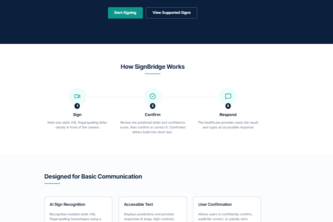
SignBridge is a self-reported project developed by two individuals (Eva Ghadban and Rawan Fawaz) for the OpenAI 2026 hackathon. It claims to use AI-powered sign recognition to help Deaf ASL users communicate basic needs with healthcare providers.
What changed
The project was submitted to a hackathon, suggesting it is in early development or prototype stage. No evidence of commercial traction, revenue, or customer adoption exists.
The single most important open question
Is there any evidence that SignBridge has moved beyond a hackathon prototype and into real-world use by Deaf ASL users or healthcare providers?
Note
This analysis is based entirely on the self-reported project description supplied by the caller. No external verification, archived data, or third-party sources are available. All claims are unverified.
What The Product Actually Is
The description states that SignBridge is an AI-powered sign recognition tool designed to help Deaf ASL users communicate basic needs with healthcare providers.
Evidence
- The project was submitted to the OpenAI 2026 hackathon.
- It uses technologies such as MediaPipe, Python, FastAPI, React, and machine learning (e.g., k-nearest neighbors).
- The tagline explicitly describes its purpose: “Helping Deaf ASL users communicate basic needs with healthcare providers through accessible AI-powered sign recognition.”
Inference The product likely involves real-time video input processing to recognize ASL signs and translate them into text or speech for healthcare communication.
Confidence Low — the description is minimal, and no functional details or screenshots are provided.
Positioning & Claim Evolution
The author positions SignBridge as a solution for accessibility in healthcare settings, specifically targeting Deaf ASL users who need to communicate basic needs with providers.
Evidence
- Tagline: “Helping Deaf ASL users communicate basic needs with healthcare providers through accessible AI-powered sign recognition.”
- The project is described as being built for the OpenAI 2026 hackathon, indicating a focus on innovation and problem-solving in a specific domain.
Inference The positioning appears to be rooted in accessibility and healthcare technology, but there is no evidence of prior market research or user feedback.
Confidence Low — the claim is self-reported with no external validation or demonstration.
Target Customer & ICP
The description states that SignBridge targets Deaf ASL users who need to communicate basic needs with healthcare providers.
Evidence
- Tagline: “Helping Deaf ASL users communicate basic needs with healthcare providers.”
Inference The target customer segment is likely Deaf individuals in healthcare environments, but no evidence of user interviews, personas, or market segmentation exists.
Confidence Low — the description does not elaborate on how this target was identified or validated.
Business Model & Pricing Evidence
No information is provided about a business model or pricing strategy.
Evidence
- The project is described as a hackathon submission.
- No mention of monetization, licensing, or customer acquisition strategies.
Inference If the product is commercialized, it might be sold to healthcare institutions or integrated into existing platforms, but this is speculative.
Confidence Not evidenced — no data on business model or pricing.
Technical & Delivery Signals
The project uses a range of technologies including MediaPipe, Python, FastAPI, React, and machine learning methods like k-nearest neighbors.
Evidence
- Built with: api, computer, css3, fastapi, figma, html5, k-nearest, learning, machine, mediapipe, neighbors, python, react, replit, rest, speech, typescript, vision, vite, web
Inference The project likely involves a web-based interface with AI backend for sign recognition, possibly using MediaPipe for gesture detection and Python for ML processing.
Confidence Medium — the tech stack is described but not demonstrated or validated.
Traction & Maturity Signals
There is no evidence of traction, adoption, or maturity beyond the hackathon submission.
Evidence
- The project was submitted to a hackathon.
- No mention of users, customers, revenue, or product usage.
Inference It is likely in early development or prototype stage, with no commercial deployment or user feedback.
Confidence Very low — no signs of real-world use or product traction.
Competitive Context
No information is provided about existing competitors or market landscape.
Evidence
- No mention of similar products or services.
- No evidence of competitive analysis or differentiation strategy.
Inference There may be other AI-powered sign language recognition tools, but this is not stated or confirmed.
Confidence Not evidenced — no competitive context provided.
Open Questions & Risks
Several key risks and open questions are present due to the lack of evidence:
- No commercial traction: The project is a hackathon submission with no signs of real-world use.
- Limited team size: Only two members, which may limit development capacity or scalability.
- Unverified claims: All descriptions are self-reported without external validation.
- No pricing or monetization model: No indication of how the product would be monetized.
Confidence Medium to high — these are inherent risks in early-stage hackathon projects with no follow-up evidence.
Questions the description leaves open
- What is the current stage of development beyond the hackathon?
- Have you conducted any user testing with Deaf ASL users or healthcare providers?
- How do you plan to scale this solution beyond a prototype?
- What are your plans for monetization or commercial deployment?
- Are there any existing partnerships or pilot programs in healthcare settings?
Overall Assessment
Not evidenced.
There is no evidence of revenue, customers, traction, or product-market fit to support an investment or partnership decision.
Confidence Very low — the project appears to be a prototype with no demonstrated commercial viability or market validation.
Final Note
This analysis is based solely on the self-reported description provided by the caller. No external verification or historical data was used.
User Stories BotA demo video on every pull request
Get a demo video on every new feature
GitHub App that watches your pull requests and records a narrated, captioned demo.
Save time on demo prep and make informed decisions faster with a video walkthrough of every new feature.
Source
Submitted to the OpenAI 2026 hackathon on Devpost. Project home on Devpost. Back to the full gallery on Devpost.
This competitive analysis was produced by top-founders.com (opens in a new tab)
Generated by a language model from this project's public Devpost page — its tagline and any built-with tags listed there, since the author published no write-up — as captured in August 2026. Short quotations are the author's words. It is an opinion on the idea as a business, not on the people behind it, and it reflects the description as published then. If the project has moved on, request a correction below. The analysis is not independent research and contains no verified traction, revenue or customer data.
An independent guide by KFG International LLC — not affiliated with, endorsed by, or connected to Devpost or OpenAI.