

Archive position — measured, not model output
0 likes on Devpost
2,263 of the 7,850 archived projects have more likes, and 5,587 share exactly 0 — so this project's #6,701 place in the like-ranked listing is a tie-break inside that group, not a ranking.
Projects (log scale)
Likes on Devpost. ▲ marks this project's group.
Show the figures
| Likes | Projects | Share of archive |
|---|---|---|
| 0 | 5,587 | 71.2% |
| 1 | 1,758 | 22.4% |
| 2 | 284 | 3.6% |
| 3–4 | 132 | 1.7% |
| 5–9 | 75 | 1.0% |
| 10+ | 14 | 0.2% |
 User Stories BotA demo video on every pull request
Get a demo video on every new feature
GitHub App that watches your pull requests and records a narrated, captioned demo.
Save time on demo prep and make informed decisions faster with a video walkthrough of every new feature.
Executive Summary
What the company appears to be
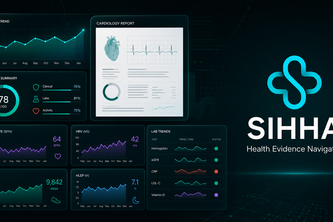
Sihha — Health Evidence Navigator is a privacy-first, browser-based tool that organizes Apple Health data into structured trends and clinician-ready briefs. It is described as a personal workflow transformed into a public demo during OpenAI Build Week.
What changed
The author states that Sihha began as a private tool used for years to organize health data. During Build Week, it was restructured using Codex and GPT-5.6 into a reproducible, synthetic-demo version with no user account or data upload required.
Single most important open question
Is there any evidence of product-market fit or traction beyond the author’s personal use and a synthetic demo?
What The Product Actually Is
The description states that Sihha is a browser-based application that:
- Imports an Apple Health export.zip file and reads export.xml locally in the browser.
- Normalizes recent activity data (steps, sleep, heart-rate, etc.) from the last seven days.
- Displays this data through eight activity views with charts.
- Combines wearable signals with lab results to generate a structured cardiology conversation brief.
- Renders a synthetic PDF preview of the clinician brief inside the app.
- Supports both English and Arabic interfaces with automatic RTL/LTR direction.
It does not upload or store user data, nor does it diagnose or prescribe. The author claims that GPT-5.6 and Codex were used during Build Week to implement the product architecture and synthetic dataset.
Evidence
- The description states Sihha imports Apple Health ZIPs and parses export.xml locally.
- It normalizes supported wearable signals into React state for eight activity views.
- It generates a structured cardiology brief with clinician questions.
- It uses synthetic data for public demo purposes.
- It supports English and Arabic UI languages.
Inference The product is described as a local-first, privacy-focused tool that does not require an account or API key. This implies no backend infrastructure is used for processing health data.
Positioning & Claim Evolution
The author positions Sihha as:
- A "privacy-first health evidence navigator."
- A tool to help users organize scattered health data into trends and better clinical conversations.
- Not a diagnostic or prescriptive tool, but a way to prepare for professional discussions.
The product evolved from a personal workflow to a public demo during OpenAI Build Week. The author emphasizes that the public version is synthetic and does not expose real user data.
Evidence
- The tagline: “Private Apple Health insights that turn activity, labs, and supplements into motivating trends and better clinical conversations.”
- The description states Sihha began as a private personal workflow.
- It was rebuilt using Codex and GPT-5.6 for the public demo.
- No real health data is used in the demo.
Inference The positioning is centered on privacy, user empowerment, and clinical preparation — not medical decision-making or health product commercialization.
Target Customer & ICP
The description states that Sihha is intended to help users who:
- Collect health data via Apple Health.
- Want to organize this data for better clinical discussions.
- Are interested in seeing trends across activity, lab results, and supplements.
It does not state a specific customer segment or persona beyond the general user of Apple Health. The author notes that the demo is synthetic and does not involve real users or accounts.
Evidence
- The product targets people who use Apple Health and want to make sense of their data.
- It is designed for personal use, not enterprise or healthcare systems.
Inference The ICP appears to be individuals with Apple Health data who are preparing for clinical consultations. No evidence of a defined customer segment beyond this.
Business Model & Pricing Evidence
There is no evidence in the description of:
- A pricing model.
- Revenue streams.
- Monetization strategy.
- Customer acquisition or retention plans.
The product is described as a demo built during a hackathon, with no mention of a paid version or monetization.
Evidence
- The demo works without an account or API key.
- No pricing or business model is mentioned.
- The author states that the public version uses synthetic data only.
Inference There is no evidence of a commercial model beyond the demo. It is unclear if Sihha intends to become a paid product or service.
Technical & Delivery Signals
The description indicates:
- Built with React, TypeScript, Cloudflare Workers, and GPT-5.6 via Codex.
- Processes Apple Health ZIPs locally in browser memory.
- Uses synthetic data for the public demo.
- Has a production build that passes 4 tests with 0 failures.
- Supports English and Arabic UI languages.
Evidence
- The tech stack includes React, TypeScript, Cloudflare Workers, and GPT-5.6.
- Apple Health ZIPs are processed in-browser without uploading.
- The app is built to be local-first and privacy-safe.
- It renders a synthetic cardiology brief with clinician questions.
Inference The technical architecture is browser-based and privacy-focused. No backend or cloud infrastructure is used for processing health data.
Traction & Maturity Signals
There is no evidence of:
- Customers or users.
- Revenue or monetization.
- Product adoption or usage metrics.
- Product iterations beyond the demo version.
- Any traction beyond the author’s personal use and a synthetic demo.
Evidence
- The product was built during OpenAI Build Week.
- It is described as a demo with no real user data.
- No mention of users, customers, or adoption.
Inference No traction or maturity signals are evident. The product remains in a demo phase.
Competitive Context
The description does not mention:
- Competitors.
- Market positioning relative to other health data tools.
- Similar products or platforms in the market.
Evidence
- No competitor names or references.
- No mention of existing tools for organizing Apple Health data or generating clinical briefs.
Inference No competitive context is provided. It is unclear how Sihha fits into the broader health tech landscape.
Open Questions & Risks
Key risks and open questions include:
- The product is described as a demo with no real-world usage.
- No evidence of revenue, customers, or monetization.
- The author is the sole team member.
- No indication of scalability or long-term strategy.
- The use of synthetic data may not reflect real-world utility.
Evidence
- The product is a demo built for a hackathon.
- It does not collect or store user data.
- No evidence of traction, customers, or revenue.
Inference The lack of real-world usage and monetization signals raises questions about viability as a commercial product.
Questions the description leaves open
- What is the intended path from demo to product?
- Are there any plans for monetization or customer acquisition?
- How does Sihha plan to scale beyond the current demo?
- Is there any interest in partnering with healthcare providers or institutions?
- What are the long-term goals for privacy and data handling?
- Has the author considered how to validate real-world utility of the tool?
Overall Assessment
The description indicates that Sihha is a demo product built during a hackathon, with no evidence of traction, customers, or monetization. It is described as a privacy-focused, browser-based tool for organizing Apple Health data into clinical briefs.
Evidence
- No revenue, customers, or adoption metrics.
- The product is synthetic and not used in real-world settings.
- No business model or pricing strategy is evident.
- The author is the only team member.
Inference This is a proof-of-concept with no demonstrated commercial viability. It may be an early-stage idea or prototype, but there is no evidence of a scalable or monetizable product yet.
Assessment Not evidenced as a viable investment or partnership opportunity at this stage.
User Stories BotA demo video on every pull request
Get a demo video on every new feature
GitHub App that watches your pull requests and records a narrated, captioned demo.
Save time on demo prep and make informed decisions faster with a video walkthrough of every new feature.
Source
Submitted to the OpenAI 2026 hackathon on Devpost. Project home on Devpost. Back to the full gallery on Devpost.
This competitive analysis was produced by top-founders.com (opens in a new tab)
Generated by a language model from this project's public Devpost page — its tagline, the author's own write-up and any built-with tags listed there — as captured in August 2026. Short quotations are the author's words. It is an opinion on the idea as a business, not on the people behind it, and it reflects the description as published then. If the project has moved on, request a correction below. The analysis is not independent research and contains no verified traction, revenue or customer data.
An independent guide by KFG International LLC — not affiliated with, endorsed by, or connected to Devpost or OpenAI.