

Archive position — measured, not model output
0 likes on Devpost
2,263 of the 7,850 archived projects have more likes, and 5,587 share exactly 0 — so this project's #4,737 place in the like-ranked listing is a tie-break inside that group, not a ranking.
Projects (log scale)
Likes on Devpost. ▲ marks this project's group.
Show the figures
| Likes | Projects | Share of archive |
|---|---|---|
| 0 | 5,587 | 71.2% |
| 1 | 1,758 | 22.4% |
| 2 | 284 | 3.6% |
| 3–4 | 132 | 1.7% |
| 5–9 | 75 | 1.0% |
| 10+ | 14 | 0.2% |
 User Stories BotA demo video on every pull request
Get a demo video on every new feature
GitHub App that watches your pull requests and records a narrated, captioned demo.
Save time on demo prep and make informed decisions faster with a video walkthrough of every new feature.
Executive Summary
What the company appears to be
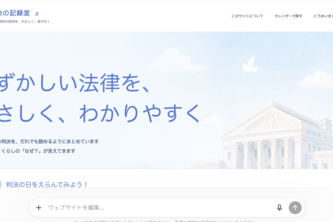
Judgment Record Room β is a self-reported prototype application that presents selected Japanese Supreme Court judgments through a calendar-based interface. The author states it aims to make legal information more accessible to non-experts, particularly students, by offering plain-language summaries and direct links to official sources.
What changed
This is a single-developer project submitted as part of an OpenAI hackathon. It does not appear to have evolved from prior work or received external validation beyond its own description.
Single most important open question
Is there any evidence that the product has traction, revenue, or users beyond the author’s prototype?
What The Product Actually Is
The description states that Judgment Record Room β is a visitor-facing application built with Next.js, React, and TypeScript. It presents selected Supreme Court judgments from March 2024 through a calendar interface.
- The product allows users to:
- Find dates with judgments via a calendar
- View judgment summaries and details
- Access official court pages and full-text PDFs
- It includes five real judgments manually selected from the Supreme Court of Japan’s public website.
- The prototype uses local structured sample data, not scraping or runtime APIs.
- It was built using GPT-5.6 and Codex for content generation and code implementation.
Inference The product is a static, non-interactive prototype with no user accounts or database integration.
Positioning & Claim Evolution
The author claims the project is not just another legal database but a “safe and approachable gateway” to primary legal information. It aims to help anyone—including students—understand Supreme Court judgments and then verify official sources themselves.
Claim
The product positions itself as an educational tool that prioritizes accessibility over technical complexity or legal authority.
Inference This is a self-described mission statement, not evidence of adoption or impact.
Target Customer & ICP
The description states the intended audience includes “anyone—including students” who may find Supreme Court documents intimidating without legal knowledge.
Claim
The target customer is individuals seeking to understand Japanese legal decisions but lacking formal training in law.
Inference No explicit segmentation beyond general user groups; no evidence of specific personas or buyer personas.
Business Model & Pricing Evidence
The description does not mention any pricing model, monetization strategy, or business model. It describes a prototype with no commercial infrastructure.
Claim
There is no stated business model or pricing structure.
Inference The project appears to be a non-commercial prototype submitted for a hackathon.
Technical & Delivery Signals
- Built with Next.js, React, TypeScript
- Uses GPT-5.6 and Codex for development assistance
- No external databases or APIs used in the prototype
- Local sample data only
- Automated tests, documentation, and GitHub Actions validation included
- Responsive UI and bilingual documentation
Inference The technical stack is standard for frontend web applications, but the prototype lacks runtime functionality or scalability features.
Traction & Maturity Signals
The description states that this is a “Build Week” prototype. It includes five judgments from March 2024 and does not reference any user base, usage metrics, or live deployment beyond its own codebase.
Claim
There is no evidence of traction, revenue, or active users.
Inference The project is at the early-stage prototype phase with no signs of product-market fit or commercial viability.
Competitive Context
The description does not provide information about competitors or similar products in the market. It does not reference existing legal databases or educational platforms for judicial content.
Claim
No competitive landscape is described.
Inference Absence of evidence means no known comparable offerings are mentioned.
Open Questions & Risks
- The prototype uses only local sample data and does not integrate with real-time sources.
- No user accounts, authentication, or persistent storage.
- No indication of how the product would scale beyond its current scope.
- Reliance on AI tools (GPT-5.6, Codex) raises questions about long-term sustainability if those tools change or become unavailable.
- The project is a solo effort with no team or external validation.
Inference These are risks related to scalability, technical dependencies, and lack of product maturity.
Questions the description leaves open
- What is the plan for expanding beyond five judgments?
- How will the project evolve from a prototype into a scalable product?
- Are there any plans to integrate with official APIs or databases?
- Has the author considered how to maintain neutrality in AI-generated summaries?
- Is there any intention to monetize or grow this beyond a hackathon submission?
Overall Assessment
Not evidenced.
The project is described as a solo-developer prototype submitted for an OpenAI hackathon. There is no evidence of traction, revenue, customers, or commercialization efforts. The author does not claim any business model or funding status. This is a self-reported, unverified description with no external corroboration.
Inference Based on the available information, there is insufficient basis to assess investment or partnership potential.
User Stories BotA demo video on every pull request
Get a demo video on every new feature
GitHub App that watches your pull requests and records a narrated, captioned demo.
Save time on demo prep and make informed decisions faster with a video walkthrough of every new feature.
Source
Submitted to the OpenAI 2026 hackathon on Devpost. Project home on Devpost. Back to the full gallery on Devpost.
This competitive analysis was produced by top-founders.com (opens in a new tab)
Generated by a language model from this project's public Devpost page — its tagline, the author's own write-up and any built-with tags listed there — as captured in August 2026. Short quotations are the author's words. It is an opinion on the idea as a business, not on the people behind it, and it reflects the description as published then. If the project has moved on, request a correction below. The analysis is not independent research and contains no verified traction, revenue or customer data.
An independent guide by KFG International LLC — not affiliated with, endorsed by, or connected to Devpost or OpenAI.