

Archive position — measured, not model output
0 likes on Devpost
2,263 of the 7,850 archived projects have more likes, and 5,587 share exactly 0 — so this project's #6,696 place in the like-ranked listing is a tie-break inside that group, not a ranking.
Projects (log scale)
Likes on Devpost. ▲ marks this project's group.
Show the figures
| Likes | Projects | Share of archive |
|---|---|---|
| 0 | 5,587 | 71.2% |
| 1 | 1,758 | 22.4% |
| 2 | 284 | 3.6% |
| 3–4 | 132 | 1.7% |
| 5–9 | 75 | 1.0% |
| 10+ | 14 | 0.2% |
 User Stories BotA demo video on every pull request
Get a demo video on every new feature
GitHub App that watches your pull requests and records a narrated, captioned demo.
Save time on demo prep and make informed decisions faster with a video walkthrough of every new feature.
Executive Summary
What the company appears to be: SignalReview is a self-reported system that claims to offer a governed workflow for generating analytical code using AI (specifically Codex with GPT-5.6), designed for sports intelligence teams. The system is described as a "premium sports-intelligence War Room" where generated analytics modules are sandboxed, validated, and sealed before review, but never automatically deployed into production.
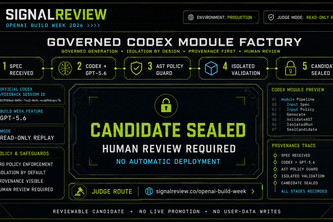
What changed: During OpenAI Build Week, the project added a “Governed Codex Module Factory” that converts constrained analytical specifications into isolated, tested, auditable, and cryptographically identified candidate modules. This new feature introduces structured steps from specification to validation using tools like AST guards, Docker containers, and schema validators.
The single most important open question: Is there any evidence of actual use or adoption beyond the author's own development work? The description contains no data on customers, revenue, or real-world deployment — only claims about architecture and workflow.
What The Product Actually Is
The description states that SignalReview is a “premium sports-intelligence War Room” for analysts who need to understand not only what an analytical system reports but also:
- Which evidence was available
- Which evidence was missing
- Which numerical claims were grounded
- Whether assumptions were challenged
- Why confidence was preserved or reduced
It combines several components including:
- Daily Match Board
- 30-index Quant Passport
- Statistician review and Skeptic challenge
- Orchestrator adjudication
- Provider Evidence diagnostics
- Artifact Binding Integrity
- Confidence Bands and Risk Flags
- Watchlist and Saved Debate History
The core innovation introduced during Build Week is the Governed Codex Module Factory, which:
- Accepts constrained objectives or templates
- Generates only declared implementation and test files inside an ephemeral workspace
- Enforces schema validation, AST policy guards, and Docker-based isolation
- Seals candidates with SHA-256 hashes for auditability
Not evidenced: No mention of actual users, customer feedback, or product adoption beyond internal development.
Positioning & Claim Evolution
The author positions SignalReview as a third option between rigid dashboards and unrestricted AI systems that can produce persuasive but unreviewable outputs. The goal is to make AI-assisted software generation reviewable, reproducible, and safe enough to participate in a controlled engineering process, without allowing automatic deployment.
Key claims:
- Generated code must never enter production simply because an LLM produced it or its tests passed.
- The system ensures deterministic analytics, visible evidence diagnostics, structured multi-agent review, and generated software operate under explicit trust boundaries.
- Codex is used not as a chatbot but as a governed component within a controlled pipeline.
Inferred: This suggests SignalReview aims to address concerns around AI hallucination, lack of auditability, and unsafe automation in high-stakes analytical environments like sports intelligence.
Not evidenced: No evidence of market positioning beyond self-description; no mention of competitors or differentiation strategy.
Target Customer & ICP
The description identifies the primary audience as sports intelligence teams who require:
- Deterministic analytics
- Evidence diagnostics
- Structured multi-agent review
- Safe AI-assisted code generation
These users are likely analysts working in environments where accuracy, traceability, and compliance matter — e.g., professional sports organizations, betting firms, or data-driven decision-making units.
Not evidenced: No explicit customer segmentation, user personas, or sales funnel details. No mention of whether the product is sold directly to teams or through partners.
Business Model & Pricing Evidence
The description does not provide any information about:
- Revenue streams
- Pricing models
- Subscription tiers
- Sales cycles
- Customer acquisition costs
It mentions that public quick-start replays are available without accounts, checkout, or model credits — implying a free tier or demo mode. However, custom or edited requests return to an authenticated, server-authoritative Pro generation workflow.
Inferred: There may be a freemium model with paid access for advanced features, but no concrete business model is described.
Not evidenced: No pricing data, monetization strategy, or commercial traction.
Technical & Delivery Signals
The system uses:
- Frontend: Next.js, React, TypeScript, Tailwind CSS, Playwright
- Backend: FastAPI, Python, Pydantic, Supabase
- AI Tools: GPT-5.6 via Codex, GitHub Actions
- Security & Validation: Docker containers with read-only filesystems, non-root execution, AST policy guards, schema validation, Ruff, pytest
Key technical elements:
- Ephemeral workspaces for code generation
- Schema-constrained output from Codex
- AST guard rejects forbidden imports and unsafe APIs
- Isolated Docker validation with bounded resources
- SHA-256 sealing of candidates
- Immutable replay receipts
Not evidenced: No details on scalability, infrastructure costs, or operational performance metrics.
Traction & Maturity Signals
The description includes:
- A baseline commit before Build Week (d1958d69037393efd0643612068b1ebb3976b2ae)
- A feature release during Build Week (94863b5ac2f9eb1a9d5b872c7d3692a46c6f6c03)
- Repository-verifiable Evidence Pack (d124e30f2b4d5da34f1f38cc7e68dd10c39556f1)
- Public dashboard with no-cost quick-start replays
- Playwright visual audit covering 220 screens with zero critical defects
However, there is no evidence of actual users, revenue, or commercial adoption.
Inferred: The project appears to be in early development stage, likely focused on proof-of-concept and demonstration rather than market readiness.
Not evidenced: No customer data, usage statistics, or product-market fit indicators.
Competitive Context
The description does not mention:
- Direct competitors
- Market size estimates
- Competitive advantages
- Industry trends
It implies that existing solutions fall into two categories:
- Rigid dashboards difficult to extend
- Unrestricted AI systems producing unreviewable outputs
SignalReview positions itself as offering a middle ground — a governed, reviewable, and safe approach to AI-assisted code generation in analytical environments.
Inferred: The competitive space may include other AI-augmented analytics platforms or enterprise-grade AI governance tools, but no specific names or market positioning are given.
Not evidenced: No competitive analysis or benchmarking data.
Open Questions & Risks
- Lack of commercial traction: No evidence of revenue, customers, or adoption beyond the authors' own development.
- Unproven market demand: The system is described as a "third option" but no indication that users actually prefer this approach over existing alternatives.
- High technical complexity without real-world validation: While the architecture is detailed, there's no evidence of how well it scales or performs in practice.
- Unclear monetization path: The free tier exists, but no clear plan for converting demos into paying customers.
- Self-reported only: All claims are unverified; no third-party audits or independent verification.
Not evidenced: No risk assessments, failure modes, or mitigation strategies beyond internal controls.
Questions the description leaves open
- What specific problems in sports intelligence teams does SignalReview solve that current tools don’t?
- How many actual users or pilot customers exist, and what feedback have they provided?
- What is the roadmap for monetization and scaling beyond Build Week?
- Can you demonstrate how the system handles edge cases or unexpected inputs in real-world scenarios?
- Are there any known limitations of the current architecture that could hinder adoption?
- How does SignalReview compare to other AI-augmented analytics platforms currently on the market?
Overall Assessment
Not evidenced: No financials, traction, or commercial viability data are provided.
Based solely on the self-reported description:
- The project shows strong technical execution and clear intent.
- It addresses a niche but potentially valuable problem in AI governance for analytical environments.
- However, it lacks any evidence of real-world use, revenue, or customer validation.
- It appears to be an early-stage prototype or proof-of-concept.
Confidence level: Low — this is a pre-commercial product with no verified commercial signals. The description reflects a well-thought-out architecture and workflow but offers no indication of market traction or business viability.
Inferences:
- If the founders can demonstrate real-world use cases, early adopters, or a clear path to monetization, this could be an interesting opportunity.
- As-is, it is more of a technical showcase than a commercial proposition.
User Stories BotA demo video on every pull request
Get a demo video on every new feature
GitHub App that watches your pull requests and records a narrated, captioned demo.
Save time on demo prep and make informed decisions faster with a video walkthrough of every new feature.
Source
Submitted to the OpenAI 2026 hackathon on Devpost. Project home on Devpost. Back to the full gallery on Devpost.
This competitive analysis was produced by top-founders.com (opens in a new tab)
Generated by a language model from this project's public Devpost page — its tagline, the author's own write-up and any built-with tags listed there — as captured in August 2026. Short quotations are the author's words. It is an opinion on the idea as a business, not on the people behind it, and it reflects the description as published then. If the project has moved on, request a correction below. The analysis is not independent research and contains no verified traction, revenue or customer data.
An independent guide by KFG International LLC — not affiliated with, endorsed by, or connected to Devpost or OpenAI.