

Archive position — measured, not model output
0 likes on Devpost
2,263 of the 7,850 archived projects have more likes, and 5,587 share exactly 0 — so this project's #6,697 place in the like-ranked listing is a tie-break inside that group, not a ranking.
Projects (log scale)
Likes on Devpost. ▲ marks this project's group.
Show the figures
| Likes | Projects | Share of archive |
|---|---|---|
| 0 | 5,587 | 71.2% |
| 1 | 1,758 | 22.4% |
| 2 | 284 | 3.6% |
| 3–4 | 132 | 1.7% |
| 5–9 | 75 | 1.0% |
| 10+ | 14 | 0.2% |
 User Stories BotA demo video on every pull request
Get a demo video on every new feature
GitHub App that watches your pull requests and records a narrated, captioned demo.
Save time on demo prep and make informed decisions faster with a video walkthrough of every new feature.
Executive Summary
What the company appears to be
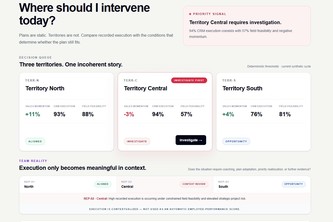
SignalRoom AI is a self-described "Reality Layer for Decision Intelligence" that claims to help managers evaluate whether recorded CRM activity aligns with field reality, market conditions, operational constraints, and strategic priorities. It is described as not replacing CRMs or managers but instead offering a structured way to assess coherence in decision-making.
What changed
The author states they built this product using AI-assisted development (Codex + GPT-5.6) over ~7 hours, with no prior software engineering experience. They claim the system uses deterministic logic and an "Epistemic Firewall" to distinguish between observed facts, inferences, unknowns, and actions requiring human judgment.
Single most important open question
Is there evidence of real-world traction or use cases beyond a synthetic demo? The description does not indicate any actual customers, revenue, or adoption — only a prototype built for a hackathon competition.
What The Product Actually Is
The description states that SignalRoom AI is a proposed "Reality Layer for Decision Intelligence." It is described as:
- Not intended to replace CRMs, account-planning systems, project-management tools, or managers.
- A tool designed to compare recorded execution with field reality, market pressure, operational constraints, and strategic priorities.
- A system that separates possible explanations into four epistemic states:
- OBSERVED — directly supported by available evidence;
- INFERRED — reasonable interpretation but not demonstrated fact;
- UNKNOWN — something the available evidence cannot establish;
- ACTION — a proposed next step requiring human decision.
It includes an "Epistemic Firewall" to ensure claims are only presented as observed facts if structural consistency exists in supporting evidence.
The application also:
- Contextualizes field execution without scoring or blaming employees.
- Distinguishes nominal project progress from real-world viability.
- Highlights a "Priority–Reality Gap."
- Compares alternative explanatory hypotheses.
- Changes recommendations when operational situations change.
- Keeps final decisions with the manager.
The product is built using Next.js, TypeScript, Tailwind CSS, Vitest, and deployed via Vercel. The demo uses synthetic data only.
Evidence Self-reported by author; no independent verification or demonstration of functionality outside of a hackathon prototype.
Positioning & Claim Evolution
The author positions SignalRoom AI as a solution to a specific problem in pharmaceutical field operations: that CRM activity can be accurate but still mislead managers due to disconnects between recorded execution and actual field conditions.
Key claims:
- The product does not replace CRMs or managers.
- It helps assess whether a decision is coherent based on multiple data sources.
- It introduces an Epistemic Firewall to prevent false assertions.
- It avoids employee ranking or blame, focusing instead on structured reasoning.
- It supports managers in making better-informed decisions by presenting what evidence supports vs. what remains unknown.
The positioning evolved from a domain expert’s intuition about field operations into a software system using AI-assisted development tools like Codex and GPT-5.6.
Evidence Self-reported; no external validation or market positioning data provided.
Target Customer & ICP
The description implies the primary user is field managers, particularly in industries such as pharmaceuticals where CRM activity may not reflect real-world performance.
It targets:
- Area Managers reviewing territories.
- Decision-makers who need to evaluate coherence between strategic plans and field realities.
- Organizations that rely heavily on CRM data but struggle with misaligned KPIs or interpretations.
The author notes that the system was built from a problem they personally experienced in pharmaceutical field operations, suggesting a niche focus.
Evidence Self-reported; no customer list, persona details, or segmentation data provided.
Business Model & Pricing Evidence
Not evidenced. The description does not mention any pricing model, monetization strategy, or business model.
The author describes the product as a prototype built for a hackathon and explicitly states that it uses synthetic data only — there is no indication of commercial viability or revenue streams.
Evidence Not evidenced.
Technical & Delivery Signals
The system was built using:
- Tools: Codex + GPT-5.6, Next.js, TypeScript, Tailwind CSS, Vitest, Vercel.
- Development approach: AI-assisted development by a non-developer domain expert.
- Architecture: Deterministic decision logic; no runtime API calls to OpenAI.
- Tests: 25/25 passing deterministic tests.
- Deployment: Production-ready version deployed on Vercel.
The author claims the system includes:
- A deterministic decision engine;
- Evidence-aware hypothesis assessment;
- Structurally verifiable Epistemic Firewall;
- Team Reality without employee ranking;
- Strategic Project Reality;
- Priority–Reality Gap;
- Deterministic Manager Brief;
- Interactive field-reality scenario.
Evidence Self-reported; no independent technical review or performance metrics available.
Traction & Maturity Signals
Not evidenced. The description states that:
- All data used in the demo is synthetic.
- The product was built for a hackathon competition.
- There are no customers, revenue, or adoption metrics beyond the author’s own account.
- It is described as a prototype, not a production-ready solution.
Evidence Not evidenced.
Competitive Context
Not evidenced. The description does not reference any competitors, existing solutions in the market, or competitive landscape.
The author focuses on their own domain expertise and problem-solving approach rather than situating SignalRoom AI within a broader industry context.
Evidence Not evidenced.
Open Questions & Risks
- Unproven commercial viability: No evidence of customers, revenue, or product-market fit.
- Prototype-only status: The system is described as a hackathon demo with synthetic data.
- AI dependency risk: While the final product uses deterministic logic, it was developed using generative AI tools (Codex + GPT-5.6), which raises questions about scalability and reproducibility without those tools.
- Limited scope: The author deliberately excluded CRM replacement, route planning, or other features — this may signal a narrow vision or lack of ambition.
- No external validation: No third-party reviews, user feedback, or product testing beyond the author’s own experience.
Evidence Inferred from self-reported claims and absence of supporting data.
Questions the description leaves open
- What specific industries or use cases have you identified for SignalRoom AI beyond pharmaceuticals?
- How do you plan to integrate real-world data sources (e.g., CRM, mobility logs, market intelligence) into the system?
- Can you demonstrate how the Epistemic Firewall works in practice with actual data inputs?
- Have you validated the assumptions behind the four epistemic states with potential users or domain experts?
- What is your roadmap for moving from a prototype to a scalable product?
- How do you intend to monetize this solution, and what pricing model are you considering?
- Are there any legal or ethical considerations around how decisions are framed in the system?
Evidence Inferred from lack of clarity in self-reporting.
Overall Assessment
Not evidenced. The description does not contain any information about funding rounds, valuation, or investment interest. It also lacks evidence of traction, customer engagement, or commercial readiness to support an investment or partnership decision.
The project is presented as a hackathon prototype built by one person using AI-assisted development tools. There is no indication that it has moved beyond the experimental phase or has any demonstrated market demand.
Evidence Not evidenced.
User Stories BotA demo video on every pull request
Get a demo video on every new feature
GitHub App that watches your pull requests and records a narrated, captioned demo.
Save time on demo prep and make informed decisions faster with a video walkthrough of every new feature.
Source
Submitted to the OpenAI 2026 hackathon on Devpost. Project home on Devpost. Back to the full gallery on Devpost.
This competitive analysis was produced by top-founders.com (opens in a new tab)
Generated by a language model from this project's public Devpost page — its tagline, the author's own write-up and any built-with tags listed there — as captured in August 2026. Short quotations are the author's words. It is an opinion on the idea as a business, not on the people behind it, and it reflects the description as published then. If the project has moved on, request a correction below. The analysis is not independent research and contains no verified traction, revenue or customer data.
An independent guide by KFG International LLC — not affiliated with, endorsed by, or connected to Devpost or OpenAI.