

Archive position — measured, not model output
0 likes on Devpost
2,263 of the 7,850 archived projects have more likes, and 5,587 share exactly 0 — so this project's #6,694 place in the like-ranked listing is a tie-break inside that group, not a ranking.
Projects (log scale)
Likes on Devpost. ▲ marks this project's group.
Show the figures
| Likes | Projects | Share of archive |
|---|---|---|
| 0 | 5,587 | 71.2% |
| 1 | 1,758 | 22.4% |
| 2 | 284 | 3.6% |
| 3–4 | 132 | 1.7% |
| 5–9 | 75 | 1.0% |
| 10+ | 14 | 0.2% |
 User Stories BotA demo video on every pull request
Get a demo video on every new feature
GitHub App that watches your pull requests and records a narrated, captioned demo.
Save time on demo prep and make informed decisions faster with a video walkthrough of every new feature.
Executive Summary
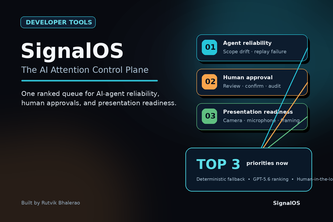
What the company appears to be: SignalOS is a self-reported local-first attention control plane for AI agents, designed to consolidate signals from agent reliability, human approvals, and presentation readiness into one ranked queue. It is built as a developer tool for managing AI-agent workflows in a privacy-preserving way.
What changed: The project is presented as a hackathon submission, with no evidence of prior traction or commercial activity beyond the author’s own description. It does not appear to have moved beyond prototype or demo stage.
Single most important open question: Is SignalOS intended for developers using AI agents in their own workflows, or is it targeting a broader market? The positioning and target customer are unclear from the self-report.
Analysis basis: This report is based entirely on the author’s own description of SignalOS. No external verification, revenue data, customer names, or traction evidence is available. All claims are self-reported and unverified.
What The Product Actually Is
The description states that SignalOS is:
- A local-first attention control plane for AI agents.
- It ranks signals from agent reliability, human approvals, and presentation-readiness into a single "Top Attention queue".
- It surfaces issues such as:
- Unverified agent completion
- Repeated replay failure
- Permission blockers
- Microphone clipping or sustained silence
- Poor camera framing
- Each incident includes source, severity, score, evidence, reason for urgency, and a recommended safe action.
- No corrective command is executed automatically; human confirmation is required.
- It distinguishes between:
- Live GPT-5.6 Terra
- Stored GPT-5.6 decision
- Deterministic fallback
- Real Codex wrapper evidence
- Live sensor
- Simulation
- Local Ollama analysis
- Resolved
Inference: The product is a developer tool that aggregates and ranks AI-agent-related issues into a prioritized queue, with a strong emphasis on human control and local processing.
Positioning & Claim Evolution
The author states:
- SignalOS is not another autonomous agent, but an attention control plane.
- It aims to solve the problem of human attention bottleneck in multi-agent workflows.
- It is built for developer workflows, not end-users or enterprise systems.
- The system emphasizes:
- Local-first processing
- Human-in-the-loop design
- Privacy-preserving sensor data
- Deterministic fallbacks
Inference: The positioning is that SignalOS is a developer tool to manage AI-agent attention and workflow reliability, with a focus on safety, control, and privacy. It does not claim to be a general-purpose AI platform or marketplace.
Target Customer & ICP
The description states:
- SignalOS is built for developers.
- It addresses the bottleneck of human attention in multi-agent workflows.
- It is intended to help developers manage:
- Agent reliability
- Human approvals
- Presentation readiness
Inference: The target customer is likely a developer or small team working with AI agents, particularly those using tools like GPT-5.6, Codex, and agent frameworks.
Not evidenced: No specific ICP (Ideal Customer Profile) defined beyond "developers". No evidence of personas, use cases, or adoption patterns.
Business Model & Pricing Evidence
The description states:
- The system is built as a local-first tool, with no mention of pricing.
- It uses:
- Local processing
- SQLite for storage
- JSONL exports
- No cloud infrastructure
- It is presented as a static demo for judges, not a commercial product.
Inference: There is no evidence of a business model or pricing structure. The tool appears to be a prototype or proof-of-concept.
Technical & Delivery Signals
The description states:
- Built with:
- Frontend: React, TypeScript, Vite, MediaDevices APIs, Web Audio, MediaPipe Tasks Vision
- Backend: Python 3.12, FastAPI, Pydantic, SQLite, JSONL, OpenAI SDK
- Uses GPT-5.6 Terra for ranking, with fallback to deterministic rules.
- Processes media locally (camera/microphone data is not stored or transmitted).
- No WebSockets, message brokers, or cloud databases used.
- Uses a canonical event schema and one shared ranking pipeline.
Inference: The system is built with a local-first, privacy-preserving architecture, using deterministic fallbacks and structured validation. It avoids complex infrastructure for simplicity and control.
Traction & Maturity Signals
The description states:
- This is a hackathon submission (OpenAI 2026).
- It includes:
- A static demo
- A replayable, no-rebuild judge mode
- No live backend or API key required for judges
- The author mentions:
- Challenges in model output trustworthiness
- Privacy preservation techniques
- Simulated events
Inference: There is no evidence of traction, revenue, or customer adoption. It is a prototype or demo project.
Competitive Context
The description does not mention any competitors or market context.
Not evidenced: No competitive analysis, no mention of similar tools or platforms in the AI-agent space.
Open Questions & Risks
- No commercial traction or revenue evidence — it’s a hackathon submission.
- No pricing or monetization strategy is evident.
- No customer or user data — no adoption, usage, or feedback.
- Unproven market demand — the author does not describe any real-world use case beyond the demo.
- Limited scope — it’s a developer tool for managing agent workflows, but not clear if this is a large enough market.
Questions the description leaves open
- What specific AI-agent workflows are you targeting? Is there a known set of developers or teams using such tools?
- How do you plan to scale beyond the current local-first, single-developer prototype?
- Are there any real-world use cases or feedback from developers who might use this?
- How would you monetize this tool if it were to become a product?
- What is your long-term vision for SignalOS — is it meant to be a standalone tool or part of a larger platform?
Overall Assessment
Not evidenced: No evidence of revenue, customers, or traction. The project is presented as a hackathon submission with no indication of commercial viability or market readiness.
Inference: At this stage, SignalOS appears to be an early-stage prototype, likely intended for developer feedback or future product development. It does not yet show signs of a scalable or monetizable business model.
The author states that the system is built for developers and focuses on attention control in AI-agent workflows — but there is no evidence of adoption, market demand, or commercial intent beyond the demo.
User Stories BotA demo video on every pull request
Get a demo video on every new feature
GitHub App that watches your pull requests and records a narrated, captioned demo.
Save time on demo prep and make informed decisions faster with a video walkthrough of every new feature.
Source
Submitted to the OpenAI 2026 hackathon on Devpost. Project home on Devpost. Back to the full gallery on Devpost.
This competitive analysis was produced by top-founders.com (opens in a new tab)
Generated by a language model from this project's public Devpost page — its tagline, the author's own write-up and any built-with tags listed there — as captured in August 2026. Short quotations are the author's words. It is an opinion on the idea as a business, not on the people behind it, and it reflects the description as published then. If the project has moved on, request a correction below. The analysis is not independent research and contains no verified traction, revenue or customer data.
An independent guide by KFG International LLC — not affiliated with, endorsed by, or connected to Devpost or OpenAI.