

Archive position — measured, not model output
1 like on Devpost
505 of the 7,850 archived projects have more likes, and 1,758 share exactly 1 — so this project's #805 place in the like-ranked listing is a tie-break inside that group, not a ranking.
Projects (log scale)
Likes on Devpost. ▲ marks this project's group.
Show the figures
| Likes | Projects | Share of archive |
|---|---|---|
| 0 | 5,587 | 71.2% |
| 1 | 1,758 | 22.4% |
| 2 | 284 | 3.6% |
| 3–4 | 132 | 1.7% |
| 5–9 | 75 | 1.0% |
| 10+ | 14 | 0.2% |
 User Stories BotA demo video on every pull request
Get a demo video on every new feature
GitHub App that watches your pull requests and records a narrated, captioned demo.
Save time on demo prep and make informed decisions faster with a video walkthrough of every new feature.
Executive Summary
What the company appears to be
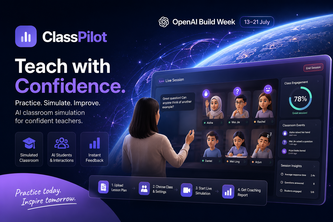
ClassPilot is an AI-powered classroom simulation tool designed for teachers to rehearse lessons in a virtual environment before teaching real students.
What changed
The project was built as a hackathon submission, with no evidence of prior development or commercial traction. It represents a single-person effort to explore how AI might support educators through practice and coaching.
The single most important open question
Is there a viable market need for this type of tool among teachers, and if so, what is the path to adoption?
Analysis basis
Self-reported only. The description is from the author’s own submission to a hackathon on Devpost. No third-party verification or historical data available.
What The Product Actually Is
The description states that ClassPilot is an AI classroom simulator where teachers can rehearse lessons in a virtual environment. It allows users to upload lesson plans, select classroom settings and student profiles, then begin a live teaching session.
During the simulation:
- AI students ask spontaneous questions
- Raise hands
- Take notes
- Become bored or distracted
- Respond differently based on personalities
The system includes:
- A live class engagement meter
- Coaching insights at the end of sessions
- Real-time voice interactions via the Gemini Live API
- An event-driven classroom simulation engine with unique student profiles
Inference The product appears to be a prototype or proof-of-concept built for demonstration purposes, not yet a commercial offering.
Positioning & Claim Evolution
The author positions ClassPilot as an AI-powered tool that empowers educators rather than replaces them. It aims to help teachers "practice with AI" and "teach with confidence."
Key claims:
- Teachers spend countless hours preparing lesson plans but struggle to practice the actual teaching experience.
- While AI helps generate content, few tools allow teachers to rehearse the real classroom interaction.
- ClassPilot enables teachers to receive coaching before entering a real classroom.
Claim vs Fact
These are self-stated intentions and perceived problems. No evidence of market validation or user feedback exists beyond the author’s account.
Target Customer & ICP
The description identifies teachers as the primary users of ClassPilot.
It implies that:
- Teachers want to prepare for real-world classroom dynamics
- They seek tools that simulate unpredictable student behavior
- The tool should help improve teaching effectiveness through practice and coaching
Inference Based on the author’s stated goal, the ICP seems to be educators who are looking for ways to build confidence in their teaching practices.
Business Model & Pricing Evidence
There is no evidence of pricing, monetization strategy or business model in the description. The project was submitted as a hackathon entry and has not been commercialized.
Not evidenced No indication of how ClassPilot would be sold, whether it's freemium, subscription-based, or otherwise priced.
Technical & Delivery Signals
The author built ClassPilot using:
- Next.js
- Tailwind CSS
- Supabase
- WebSockets
- Gemini Live API for real-time conversations
Key technical elements:
- Event-driven classroom simulation engine
- AI students with personality and behavior profiles
- Real-time voice interaction capabilities
- Live engagement tracking system
Inference The tool appears to be a functional prototype, likely built quickly due to its hackathon origin.
Traction & Maturity Signals
The project was completed within a single week as part of a hackathon. There is no evidence of:
- Revenue generation
- Customer adoption
- Product usage metrics
- Prior versions or iterations
Not evidenced No signs of traction, growth, or user engagement beyond the author’s own account.
Competitive Context
No mention of existing competitors in the description. The author does not reference similar tools or platforms that address teacher training or classroom simulation.
Not evidenced No competitive landscape analysis is provided.
Open Questions & Risks
- Single-person development: Limited team capacity may hinder scalability.
- Unproven market demand: No evidence of customer validation or interest beyond the author’s intent.
- Prototype nature: The tool is described as a hackathon project, not a mature product.
- Lack of commercialization: No indication of monetization plans or go-to-market strategy.
Inference Without traction or clear business model, ClassPilot may face challenges in transitioning from concept to viable product.
Questions the description leaves open
- What specific feedback have you received from teachers about the value of this tool?
- How do you plan to validate market demand for this solution?
- Are there any existing partnerships or pilot programs with schools or educational institutions?
- What is your roadmap for moving beyond the current prototype into a scalable product?
- Have you considered how to integrate ClassPilot into existing lesson planning workflows used by educators?
Overall Assessment
ClassPilot is currently a hackathon project with no demonstrated traction, revenue or customer base. It reflects an idea that aligns with educational technology trends but lacks evidence of viability or market readiness.
Assessment Not ready for investment or partnership at this stage. Further validation and development are required to assess commercial potential.
User Stories BotA demo video on every pull request
Get a demo video on every new feature
GitHub App that watches your pull requests and records a narrated, captioned demo.
Save time on demo prep and make informed decisions faster with a video walkthrough of every new feature.
Source
Submitted to the OpenAI 2026 hackathon on Devpost. Project home on Devpost. Back to the full gallery on Devpost.
This competitive analysis was produced by top-founders.com (opens in a new tab)
Generated by a language model from this project's public Devpost page — its tagline, the author's own write-up and any built-with tags listed there — as captured in August 2026. Short quotations are the author's words. It is an opinion on the idea as a business, not on the people behind it, and it reflects the description as published then. If the project has moved on, request a correction below. The analysis is not independent research and contains no verified traction, revenue or customer data.
An independent guide by KFG International LLC — not affiliated with, endorsed by, or connected to Devpost or OpenAI.