

Archive position — measured, not model output
0 likes on Devpost
2,263 of the 7,850 archived projects have more likes, and 5,587 share exactly 0 — so this project's #6,554 place in the like-ranked listing is a tie-break inside that group, not a ranking.
Projects (log scale)
Likes on Devpost. ▲ marks this project's group.
Show the figures
| Likes | Projects | Share of archive |
|---|---|---|
| 0 | 5,587 | 71.2% |
| 1 | 1,758 | 22.4% |
| 2 | 284 | 3.6% |
| 3–4 | 132 | 1.7% |
| 5–9 | 75 | 1.0% |
| 10+ | 14 | 0.2% |
 User Stories BotA demo video on every pull request
Get a demo video on every new feature
GitHub App that watches your pull requests and records a narrated, captioned demo.
Save time on demo prep and make informed decisions faster with a video walkthrough of every new feature.
Executive Summary
What the company appears to be
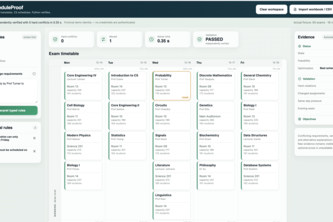
ScheduleProof is a self-reported scheduling application designed to generate conflict-free timetables for academic institutions by combining natural-language input with formal constraint solving and independent validation. The author describes it as a tool that accepts structured institutional data and human-readable requirements, translates them into formal logic, uses an SMT solver (Z3) to compute schedules, and validates results independently.
What changed
The project evolved from a personal academic pain point — scheduling exams at Florida State University — into a prototype system integrating language models, constraint solvers, and validation layers. It was built for the OpenAI 2026 hackathon and is presented as a proof-of-concept with no commercial traction or revenue evidence.
Single most important open question
Is ScheduleProof capable of reliably producing valid timetables under real-world constraints, or does its architecture fail to scale beyond small examples due to computational complexity or encoding issues?
Note
This analysis is based solely on the self-reported project description provided by the author. No external verification, revenue data, customer feedback, or performance metrics are available.
What The Product Actually Is
- The description states that ScheduleProof accepts structured institutional data such as exams, rooms, capacities, time periods, instructor availability, and conflict information.
- Users can also enter additional requirements in ordinary language (e.g., “Professor Ibrahim can only supervise on Friday”).
- A language model translates these sentences into formal rule types; users review interpretations before activating them.
- Confirmed rules are converted into logical formulas and passed to Z3 (an automated theorem prover), which returns a timetable if constraints are satisfiable.
- An independent Python validator checks the final schedule without relying on Z3’s internal model.
- If no valid solution exists, ScheduleProof identifies conflicting sets and suggests low-cost repairs.
- The system aims to preserve existing timetables during repair processes.
Inference The product is described as a hybrid system combining NLP, formal logic, and constraint solving. It is not merely an optimization engine but one that emphasizes explainability and trustworthiness.
Positioning & Claim Evolution
- The author positions ScheduleProof as a solution to the “everyday pain” of academic scheduling — particularly in higher education.
- Key claims include:
- Fast timetable generation (seconds).
- Conflict explanation and repair suggestions.
- Independent validation of results.
- Support for natural-language input.
- The project evolved from a hackathon submission into a more complete workflow, emphasizing usability and correctness over visual appeal.
- The author notes that the system is not just about solving constraints but presenting solutions in a way that users understand.
Claim vs Fact
These are self-reported claims. There is no evidence of actual deployment, user testing, or performance benchmarks beyond the author’s own account.
Target Customer & ICP
- The primary target audience appears to be academic institutions (e.g., universities) facing scheduling challenges.
- Specific use cases mentioned include:
- Exam scheduling.
- Room allocation.
- Instructor availability management.
- The system is tailored for institutional needs, including privacy controls and tenant-scoped access.
Not evidenced No explicit customer list, size of target market, or segmentation data. The ICP is inferred from the stated use case and domain-specific features.
Business Model & Pricing Evidence
- Not evidenced.
Absence of evidence
There is no mention of pricing models, monetization strategies, or business model assumptions in the description.
Technical & Delivery Signals
- Built with:
- Backend: Python, FastAPI.
- Frontend: React, TypeScript.
- Solver: Z3 (SMT solver).
- Language processing: GPT-5.6.
- Testing tools: pytest, Selenium.
- Deployment: Docker.
- Architecture separates responsibilities:
- NLP layer translates requirements.
- Z3 handles scheduling logic.
- Python validator ensures correctness.
- Includes automated tests, benchmarks, import fixtures, privacy controls, and release-validation scripts.
- The author emphasizes adversarial review and documentation of rule translations using LaTeX.
Inference The architecture suggests a modular approach to handling complexity, though it lacks evidence of production readiness or scalability beyond prototype-level use.
Traction & Maturity Signals
- Not evidenced.
Absence of evidence
No data on users, adoption rates, revenue, or product maturity is provided. The project is described as a hackathon submission and prototype.
Competitive Context
- Not evidenced.
Absence of evidence
No mention of competitors, market positioning, or competitive landscape. The description does not reference existing scheduling tools or platforms.
Open Questions & Risks
- Scalability concerns: SMT solving is computationally difficult; large or dense constraint sets may require decomposition techniques.
- Dependency on NLP accuracy: Natural-language input must map to supported formal rules — unsupported or ambiguous inputs are rejected, but this could limit usability.
- Limited scope: The system assumes single-room exams and does not support split rooms, student-specific accommodations, or cross-campus scheduling.
- Prototype nature: Described as a hackathon project with no commercial traction or deployment history.
- Privacy assumptions: While privacy controls are included, their effectiveness in real-world environments is unproven.
Inference These risks stem from the described limitations and lack of validation in production settings.
Questions the description leaves open
- What specific types of constraints have been tested successfully in practice?
- How does the system handle edge cases like overlapping exams with no valid solution?
- Has the NLP layer been validated against real-world inputs from actual users?
- Are there any known performance bottlenecks when scaling to larger datasets?
- What is the current status of the validation process — how often does it detect errors in Z3 outputs?
- Have you considered integrating with existing institutional systems (e.g., LMS, HR databases)?
- How do you plan to address the computational complexity of large-scale scheduling problems?
Overall Assessment
- Not evidenced.
Absence of evidence
No financials, valuation, funding history, or partnership discussions are available. The project is presented as a prototype with no indication of commercial viability or strategic interest from investors or partners.
User Stories BotA demo video on every pull request
Get a demo video on every new feature
GitHub App that watches your pull requests and records a narrated, captioned demo.
Save time on demo prep and make informed decisions faster with a video walkthrough of every new feature.
Source
Submitted to the OpenAI 2026 hackathon on Devpost. Project home on Devpost. Back to the full gallery on Devpost.
This competitive analysis was produced by top-founders.com (opens in a new tab)
Generated by a language model from this project's public Devpost page — its tagline, the author's own write-up and any built-with tags listed there — as captured in August 2026. Short quotations are the author's words. It is an opinion on the idea as a business, not on the people behind it, and it reflects the description as published then. If the project has moved on, request a correction below. The analysis is not independent research and contains no verified traction, revenue or customer data.
An independent guide by KFG International LLC — not affiliated with, endorsed by, or connected to Devpost or OpenAI.