

Archive position — measured, not model output
1 like on Devpost
505 of the 7,850 archived projects have more likes, and 1,758 share exactly 1 — so this project's #667 place in the like-ranked listing is a tie-break inside that group, not a ranking.
Projects (log scale)
Likes on Devpost. ▲ marks this project's group.
Show the figures
| Likes | Projects | Share of archive |
|---|---|---|
| 0 | 5,587 | 71.2% |
| 1 | 1,758 | 22.4% |
| 2 | 284 | 3.6% |
| 3–4 | 132 | 1.7% |
| 5–9 | 75 | 1.0% |
| 10+ | 14 | 0.2% |
 User Stories BotA demo video on every pull request
Get a demo video on every new feature
GitHub App that watches your pull requests and records a narrated, captioned demo.
Save time on demo prep and make informed decisions faster with a video walkthrough of every new feature.
Executive Summary
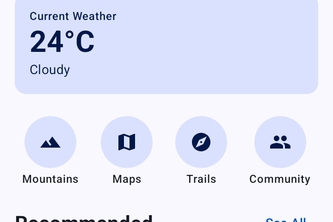
Bakudapa-Adventure is a self-reported mobile application project developed by a single individual (Jeonjoe2004 Luas) for the OpenAI 2026 hackathon. The author describes it as an app for mountain climbers to find friends, hiking routes, porter or guide information, and general climbing knowledge. It was built using AI tools without formal programming experience, with no verified revenue, customer base, or traction data.
What changed: The project is a personal initiative by one developer aiming to solve a local problem — connecting climbers in their region — through an AI-assisted development process. There is no evidence of prior product iteration, market validation, or commercial activity beyond the hackathon submission.
Key open question: Is there any evidence that this app has moved beyond the prototype stage or gained user adoption? If not, what are the implications for scalability and long-term viability?
What The Product Actually Is
The description states:
- Bakudapa-Adventure is an application for mountain climbers.
- It aims to help users find friends, hiking routes, porter or guide information, and general climbing knowledge.
Inference: Based on the author's own words, it appears to be a mobile app (likely Android) that aggregates social and informational content for climbers. However, no technical architecture, UI/UX details, or functional specifications are provided.
Not evidenced:
- Whether the app is live or functional.
- What features it includes beyond what is described.
- If there’s any backend or database structure.
Positioning & Claim Evolution
The author states:
- The app is for climbers in their local area to gather and connect.
- It was built to solve a personal problem — finding climbing partners and information.
Inference: The positioning seems to be local, niche, and community-driven, with no indication of broader market ambition or commercial intent at this stage.
Not evidenced:
- Any prior version or evolution of the app.
- Whether the author has updated or refined the idea since submission.
- Any marketing claims or branding beyond the hackathon context.
Target Customer & ICP
The description states:
- The app is for climbers, particularly beginners.
- It aims to help users find friends, routes, and guides.
Inference: The primary user segment appears to be local climbers, especially those new to mountain climbing who seek community and guidance.
Not evidenced:
- Specific demographics or geographic scope beyond the author’s location.
- Any segmentation strategy or customer persona development.
- Evidence of actual users or feedback from target customers.
Business Model & Pricing Evidence
The description states:
- No explicit mention of a business model or pricing structure.
- The app is described as a personal project, not a commercial product.
Inference: There is no evidence of monetization, subscription plans, or revenue streams. It appears to be a non-commercial prototype.
Not evidenced:
- Any pricing tiers, in-app purchases, or advertising mechanisms.
- Revenue model or monetization strategy.
Technical & Delivery Signals
The description states:
- The app was built by one person using AI tools.
- The developer had no prior experience with Android programming.
- They used AI to assist in building the application.
Inference: The technical delivery is minimal, relying on AI assistance rather than traditional development practices. There is no evidence of scalability or robustness.
Not evidenced:
- Whether the app is functional or deployed.
- Any codebase, architecture, or deployment details.
- Technical performance or user experience data.
Traction & Maturity Signals
The description states:
- The project was submitted to a hackathon (OpenAI 2026).
- It is described as a prototype built by one person.
- No mention of users, downloads, or usage metrics.
Inference: There is no evidence of traction or maturity beyond the initial concept and hackathon submission.
Not evidenced:
- Any user base or active adoption.
- Metrics like downloads, retention, or engagement.
- Product iterations or feedback loops.
Competitive Context
The description states:
- No mention of competitors or market analysis.
- The app is described as solving a local problem.
Inference: There is no evidence of awareness of existing platforms for climbers (e.g., social media groups, route planning apps, guide services). The project seems isolated from competitive intelligence.
Not evidenced:
- Any competitive landscape or benchmarking.
- Existing solutions in the climbing community.
Open Questions & Risks
The description states:
- The app is a solo effort with no team.
- It was built without formal programming knowledge.
- It relies heavily on AI tools, which may limit control and scalability.
Inference:
- Scalability risk: No team or technical expertise to support growth.
- Sustainability risk: Reliance on AI tools may not be viable long-term.
- Market risk: No evidence of user validation or product-market fit.
Not evidenced:
- Any mitigation strategies for these risks.
- Evidence of planning for long-term development or commercialization.
Questions the description leaves open
- Is the app currently functional and accessible to users?
- What is the plan for expanding beyond the local community?
- How does the founder intend to scale the product without a team or formal development experience?
- Are there any plans for monetization or revenue generation?
- Has the founder tested the app with actual climbers, and what feedback was received?
Overall Assessment
The description states:
- This is a hackathon submission by one individual.
- No evidence of traction, revenue, or commercial viability.
Inference: At this stage, there is no basis for investment or partnership consideration. The project appears to be an early-stage idea with no demonstrated product-market fit or scalability.
Not evidenced:
- Any financials, customer data, or growth metrics.
- Evidence of a viable business model or long-term vision.
User Stories BotA demo video on every pull request
Get a demo video on every new feature
GitHub App that watches your pull requests and records a narrated, captioned demo.
Save time on demo prep and make informed decisions faster with a video walkthrough of every new feature.
Source
Submitted to the OpenAI 2026 hackathon on Devpost. Project home on Devpost. Back to the full gallery on Devpost.
This competitive analysis was produced by top-founders.com (opens in a new tab)
Generated by a language model from this project's public Devpost page — its tagline, the author's own write-up and any built-with tags listed there — as captured in August 2026. Short quotations are the author's words. It is an opinion on the idea as a business, not on the people behind it, and it reflects the description as published then. If the project has moved on, request a correction below. The analysis is not independent research and contains no verified traction, revenue or customer data.
An independent guide by KFG International LLC — not affiliated with, endorsed by, or connected to Devpost or OpenAI.