

Archive position — measured, not model output
0 likes on Devpost
2,263 of the 7,850 archived projects have more likes, and 5,587 share exactly 0 — so this project's #2,630 place in the like-ranked listing is a tie-break inside that group, not a ranking.
Projects (log scale)
Likes on Devpost. ▲ marks this project's group.
Show the figures
| Likes | Projects | Share of archive |
|---|---|---|
| 0 | 5,587 | 71.2% |
| 1 | 1,758 | 22.4% |
| 2 | 284 | 3.6% |
| 3–4 | 132 | 1.7% |
| 5–9 | 75 | 1.0% |
| 10+ | 14 | 0.2% |
 User Stories BotA demo video on every pull request
Get a demo video on every new feature
GitHub App that watches your pull requests and records a narrated, captioned demo.
Save time on demo prep and make informed decisions faster with a video walkthrough of every new feature.
Executive Summary
What the company appears to be
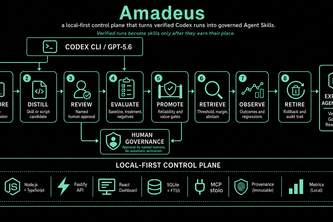
Amadeus Skill is a self-reported local-first control plane for procedural memory in coding agents. It captures human-approved Codex runs, compiles them into compact "Agent Skills", and governs their lifecycle through review, evaluation, and promotion gates.
What changed
The project description indicates that Amadeus was built as a hackathon submission with an initial focus on capturing and evaluating agent behavior in a controlled, local environment. It evolved from a demo fixture to a system that tests real-world use cases like migrating legacy Node Sass or handling asynchronous UI races, with the goal of validating whether procedural knowledge should be made permanent.
The single most important open question
Is there evidence of any actual adoption or usage beyond the authors' own testing and evaluation? The description states no revenue, customers, or traction data are available — only internal validation and a lack of promoted skills.
What The Product Actually Is
- The description states that Amadeus is a local-first control plane for procedural memory.
- It captures opt-in, session-scoped Codex runs, distills verified work into Agent Skills or deterministic scripts, and governs their lifecycle through review and promotion gates.
- The system uses:
- A Codex CLI (no API key needed).
- SQLite + FTS5 for local state and retrieval.
- A Fastify dashboard server with React frontend.
- An MCP stdio server connecting Codex sessions to Amadeus evidence.
- Agent Skills packages with SKILL.md and agents/openai.yaml.
- It is described as a single npm-distributable TypeScript product.
- The system does not activate skills automatically; all candidate packages must be reviewed and approved by humans before promotion.
Note: This is self-reported. No evidence of actual customers, revenue or usage beyond internal testing.
Positioning & Claim Evolution
- The description states that Amadeus is not another prompt library nor long-term chat memory.
- It positions itself as:
- Outcome-first (grades whether the task was verified).
- Reliability-first (must pass capability, safety, and economic gates).
- Value-aware (procedures must improve or retain success with material efficiency).
- Human-governed (candidate creation, testing, and promotion are explicit human decisions).
- Local-first (data stays local).
- The authors claim that Amadeus is not a tool for saving every successful answer, but instead focuses on reusable knowledge that has been validated.
- It evolved from a demo to a system that tests real-world code migration and race condition fixes, demonstrating a shift from "what works" to "what should be reused".
Inference: The positioning reflects an attempt to differentiate from generic agent libraries by emphasizing governance, safety, and value-awareness.
Target Customer & ICP
- Not evidenced.
- The description does not name specific customer types or personas.
- It implies use by developers working with coding agents (e.g., Codex), but no explicit target segment is defined.
Absence of evidence: No clear indication of who the intended users are beyond developers using Codex.
Business Model & Pricing Evidence
- Not evidenced.
- The description does not mention any pricing, monetization strategy, or business model.
- It describes a local-first tool with no API key requirement and an npm package distribution mechanism.
Absence of evidence: No indication of how the product would be sold or whether it’s intended for commercial use.
Technical & Delivery Signals
- Built using:
- TypeScript
- Node.js
- Fastify (local API server)
- React (dashboard UI)
- SQLite + FTS5 (local storage and retrieval)
- Codex CLI
- MCP stdio server
- npm package workflow for distribution
- The system is described as:
- A single npm-distributable TypeScript product
- Uses native Codex CLI with existing ChatGPT login
- Does not require OpenAI API keys
- Has a local-first architecture
- Supports deterministic similarity, safe regex filters, and abstention logic
- The authors mention:
- A machine-verified v1.1 implementation
- Manual exercise from installation through controlled evaluation
- Use of MCP receipts to verify candidate ID, content hash, and prepared path
- Bounded Codex process-group timeout for safety
Inference: The technical stack suggests a developer-focused tool built for local use with strong emphasis on control and auditability.
Traction & Maturity Signals
- Not evidenced.
- The description states:
- No current candidate has passed every promotion gate.
- Active skill count remains zero.
- The npm tarball works for private distribution; registry publication is pending.
- All three governed candidates were blocked due to economic regressions or value issues.
- There is no mention of:
- Customers
- Revenue
- Usage metrics
- Product adoption beyond internal testing
Absence of evidence: No signs of traction, adoption, or commercial use.
Competitive Context
- Not evidenced.
- The description does not name competitors or reference existing tools in the space.
- It implies Amadeus is distinct from prompt libraries and long-term memory systems.
- It references Codex as the first harness adapter but does not discuss other agent platforms or tools.
Absence of evidence: No competitive landscape or positioning relative to similar tools.
Open Questions & Risks
- No commercial traction: The system has not been promoted beyond internal testing and no skills are active.
- Limited scope: Only Codex is supported as a harness; no other agent platforms are mentioned.
- Self-reported maturity: The project is described as a hackathon submission with no external validation or user feedback.
- No monetization strategy: No indication of how the product would be sold or scaled.
- High human governance overhead: Every skill must go through multiple gates and human approvals, which may limit scalability.
- Local-first design may limit adoption: A local-only system might not appeal to teams seeking centralized control or collaboration features.
Inference: The project is in early development with no evidence of real-world usage or commercial viability.
Questions the description leaves open
- What specific use cases have you identified for Amadeus beyond the internal testing?
- How do you plan to scale governance without human bottlenecks?
- Are there any plans to support other agent platforms beyond Codex?
- What is your roadmap for monetization or commercial deployment?
- Have you tested Amadeus in production environments with real teams?
- How do you handle edge cases where a skill fails after promotion?
- What are the key metrics you track to evaluate whether a skill should be promoted?
Overall Assessment
- Confidence: Low
- This is a self-reported, unverified project submitted as a hackathon entry.
- There is no evidence of traction, revenue, customers, or commercial adoption.
- The system is described as in early development with no active skills promoted.
- It has strong technical foundations but lacks any indication of market readiness or commercial viability.
Inference: While technically promising and well-designed for its stated purpose, Amadeus Skill appears to be an experimental tool without demonstrated product-market fit or commercial traction.
User Stories BotA demo video on every pull request
Get a demo video on every new feature
GitHub App that watches your pull requests and records a narrated, captioned demo.
Save time on demo prep and make informed decisions faster with a video walkthrough of every new feature.
Source
Submitted to the OpenAI 2026 hackathon on Devpost. Project home on Devpost. Back to the full gallery on Devpost.
This competitive analysis was produced by top-founders.com (opens in a new tab)
Generated by a language model from this project's public Devpost page — its tagline, the author's own write-up and any built-with tags listed there — as captured in August 2026. Short quotations are the author's words. It is an opinion on the idea as a business, not on the people behind it, and it reflects the description as published then. If the project has moved on, request a correction below. The analysis is not independent research and contains no verified traction, revenue or customer data.
An independent guide by KFG International LLC — not affiliated with, endorsed by, or connected to Devpost or OpenAI.