

Archive position — measured, not model output
0 likes on Devpost
2,263 of the 7,850 archived projects have more likes, and 5,587 share exactly 0 — so this project's #2,631 place in the like-ranked listing is a tie-break inside that group, not a ranking.
Projects (log scale)
Likes on Devpost. ▲ marks this project's group.
Show the figures
| Likes | Projects | Share of archive |
|---|---|---|
| 0 | 5,587 | 71.2% |
| 1 | 1,758 | 22.4% |
| 2 | 284 | 3.6% |
| 3–4 | 132 | 1.7% |
| 5–9 | 75 | 1.0% |
| 10+ | 14 | 0.2% |
 User Stories BotA demo video on every pull request
Get a demo video on every new feature
GitHub App that watches your pull requests and records a narrated, captioned demo.
Save time on demo prep and make informed decisions faster with a video walkthrough of every new feature.
Executive Summary
The company appears to be a solo project named "Amazon in Quicken", built by Allen Cypher as part of an OpenAI hackathon submission. The author states that it uses Vibe Coding and ChatGPT/Codex tools on a MacBook Air to automate tasks such as identifying Amazon purchases in Quicken and populating purchase details into the Notes section. It is described as a proof-of-concept for agentic automation, with ambitions to expand into broader personal productivity use cases.
What changed: The project represents an author's attempt to demonstrate how AI agents can perform repetitive, non-programming tasks using tools like ChatGPT and Vibe Coding. It reflects a shift toward self-service automation for individuals rather than traditional software development or enterprise SaaS.
The single most important open question: Is there any evidence of actual user adoption, revenue, or traction beyond the author's own use case? The description contains no data on customers, usage metrics, pricing, or commercial viability — only claims about intent and capability.
What The Product Actually Is
- The description states that "Amazon in Quicken" is a skill built using Vibe Coding and ChatGPT/Codex.
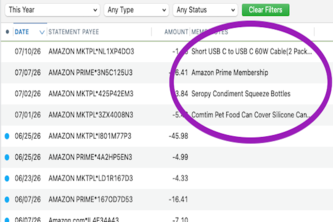
- It accesses Quicken, identifies Amazon charges, opens the corresponding Amazon page, extracts purchase details, and pastes them into the Notes field of the Quicken entry.
- The author claims it was created by making a narrated video demo for ChatGPT to learn from, which then automated the process.
Inference: This is an agentic automation tool designed for personal use, not a commercial product. It does not appear to be available as a service or product to others.
Positioning & Claim Evolution
- The author positions this as a demonstration of how AI agents can perform complex tasks without programming.
- It is framed as part of a broader effort to "create their own apps which solve their unique repetitive tasks."
- The project builds on the idea that ChatGPT/Codex offers a simple one-step onboarding for non-programmers to create custom software.
Claim: This tool enables users to automate personal financial tracking using AI agents.
Inference: The author sees this as a stepping stone toward more general-purpose automation tools, but no commercial positioning beyond the hackathon submission is evident.
Target Customer & ICP
- The description does not identify any specific customer segment or target market.
- It is described as a personal tool used by the founder to automate his own Quicken entries.
- No evidence of a broader ICP or persona beyond the individual user who has access to Quicken and Amazon accounts.
Not evidenced: No indication of who else might use this, whether it's intended for consumers, small businesses, or enterprise users.
Business Model & Pricing Evidence
- There is no mention of pricing, monetization, or any business model.
- The project is described as a hackathon submission and personal automation tool.
- No evidence of revenue streams, subscriptions, or paid features.
Not evidenced: No commercial structure or financial model is presented.
Technical & Delivery Signals
- Built using Vibe Coding, ChatGPT/Codex, macOS, Chrome, and computer-use tools.
- The author used a narrated video to teach the agent how to perform the first task, then automated it.
- It interacts with web pages (Quicken, Amazon), opens links, copies text, and enters data into spreadsheets.
Inference: This suggests an early-stage agentic automation system that leverages AI for UI interaction and task execution.
Traction & Maturity Signals
- The project was submitted to a hackathon.
- It is described as a proof-of-concept with no evidence of deployment or usage beyond the author’s own workflow.
- No data on user engagement, retention, or adoption is provided.
Not evidenced: No signs of traction, growth, or product maturity beyond the initial prototype.
Competitive Context
- The description does not reference any existing competitors or similar tools.
- It appears to be a standalone personal automation tool with no known market context.
- The author mentions ambitions to automate other tasks (e.g., wine lists, eBay statements), but no comparison to existing solutions is made.
Not evidenced: No competitive landscape or market positioning beyond the author’s own claims.
Open Questions & Risks
- The project is self-reported and unverified; there is no independent validation of its functionality.
- It is described as a hackathon submission, suggesting it may be experimental or incomplete.
- The author notes challenges with "Guardrails for Agentic actions," indicating potential limitations in current AI agent capabilities.
- No evidence of scalability, security, or long-term viability beyond the author’s personal use case.
Inference: This is likely an early-stage prototype, not a commercial product. Risks include lack of traction, unclear monetization, and technical limitations.
Questions the description leaves open
- What is the actual scope of automation you're trying to achieve? Is this limited to Quicken or intended for broader applications?
- Have you tested this with other users or in different environments?
- How do you plan to scale beyond a single user’s workflow?
- What are the technical limitations you've encountered with current AI agent frameworks?
- Are there any plans to monetize or commercialize this tool?
Overall Assessment
- The project is described as a personal hackathon submission, not a commercial venture.
- There is no evidence of revenue, customers, or traction.
- It appears to be an experimental exploration of agentic automation for personal use.
Assessment: Not ready for investment or partnership. This is a proof-of-concept with no demonstrated market or commercial viability. The author’s ambitions are clear but unproven in terms of execution or impact.
User Stories BotA demo video on every pull request
Get a demo video on every new feature
GitHub App that watches your pull requests and records a narrated, captioned demo.
Save time on demo prep and make informed decisions faster with a video walkthrough of every new feature.
Source
Submitted to the OpenAI 2026 hackathon on Devpost. Project home on Devpost. Back to the full gallery on Devpost.
This competitive analysis was produced by top-founders.com (opens in a new tab)
Generated by a language model from this project's public Devpost page — its tagline, the author's own write-up and any built-with tags listed there — as captured in August 2026. Short quotations are the author's words. It is an opinion on the idea as a business, not on the people behind it, and it reflects the description as published then. If the project has moved on, request a correction below. The analysis is not independent research and contains no verified traction, revenue or customer data.
An independent guide by KFG International LLC — not affiliated with, endorsed by, or connected to Devpost or OpenAI.