

Archive position — measured, not model output
0 likes on Devpost
2,263 of the 7,850 archived projects have more likes, and 5,587 share exactly 0 — so this project's #2,633 place in the like-ranked listing is a tie-break inside that group, not a ranking.
Projects (log scale)
Likes on Devpost. ▲ marks this project's group.
Show the figures
| Likes | Projects | Share of archive |
|---|---|---|
| 0 | 5,587 | 71.2% |
| 1 | 1,758 | 22.4% |
| 2 | 284 | 3.6% |
| 3–4 | 132 | 1.7% |
| 5–9 | 75 | 1.0% |
| 10+ | 14 | 0.2% |
 User Stories BotA demo video on every pull request
Get a demo video on every new feature
GitHub App that watches your pull requests and records a narrated, captioned demo.
Save time on demo prep and make informed decisions faster with a video walkthrough of every new feature.
Executive Summary
What the company appears to be
Ambiguity Compiler is a self-reported tool that aims to intervene in AI-assisted software development by identifying and resolving ambiguous requirements before code implementation begins. It uses large language models (LLMs) to generate competing behavioral contracts from vague natural-language inputs, prompts human review, and then materializes testable specifications for implementation.
What changed
The project was submitted as a hackathon entry to the OpenAI 2026 hackathon. The author describes it as a prototype built in a short timeframe with limited production-grade features or integrations.
Single most important open question
Is there evidence of real-world usage, traction, or customer feedback that would validate whether this problem is significant enough to warrant investment or partnership?
Note
This analysis is based entirely on the self-reported project description provided by the author. No external verification, revenue data, customer names, or adoption metrics are available.
What The Product Actually Is
The description states:
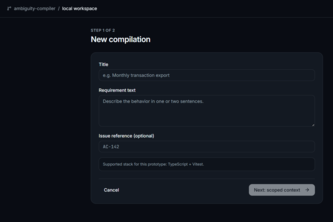
- Ambiguity Compiler transforms underspecified software requirements into decision-ready workflows.
- It uses GPT-5.6 to produce multiple plausible behavioral contracts from a requirement.
- A human selects the intended interpretation among alternatives.
- The system generates traceable contract-test specifications and integrates with Codex for implementation.
- It includes:
- A responsive web application
- An MCP server exposing lifecycle tools
- A reusable Codex plugin/skill
Inference The product appears to be a developer tool aimed at reducing ambiguity in AI-assisted development workflows, particularly where LLMs might silently interpret requirements incorrectly.
Claim
The author claims the system prevents incorrect implementation by placing human approval at a high-leverage point.
Evidence Yes, from the project write-up.
Confidence Low — this is self-reported and unverified.
Positioning & Claim Evolution
The description states:
- The tool intervenes between natural-language requirements and code generation.
- It seeks to “turn vague software requirements into human-approved, testable behavioral contracts.”
- The goal is not to approve every line of generated code but to place approval at the decision boundary before implementation.
Inference This positions Ambiguity Compiler as a safety layer in AI-assisted development, similar to how type checking prevents runtime errors. It frames itself as a solution to misaligned AI behavior due to ambiguous requirements.
Claim
The author positions it as a way to reduce software failures caused by unconfirmed interpretations.
Evidence Yes, from the project write-up.
Confidence Low — no third-party validation or market feedback.
Target Customer & ICP
The description states:
- The tool is built for developers working with AI coding agents (e.g., Codex).
- It supports a workflow where developers submit requirements and get help resolving ambiguity before implementation.
- It includes a web UI, an MCP server, and a Codex skill.
Inference The primary target appears to be software engineers or teams using AI coding tools who want to reduce risk from ambiguous requirements.
Claim
The tool targets developers in AI-assisted development workflows.
Evidence Yes, from the project write-up.
Confidence Low — no explicit customer segmentation or use cases beyond the hackathon demo.
Business Model & Pricing Evidence
The description states:
- There is a no-key demonstration path included.
- A golden timezone fixture demonstrates how UTC vs local interpretation can lead to different outcomes.
- The author mentions future features like hosted workspaces, team approval policies, and pull-request checks.
Inference There is no clear indication of pricing or monetization strategy in the current version. Future plans suggest potential SaaS or hosted offerings.
Claim
No business model or pricing data provided.
Evidence Not evidenced.
Confidence Very low — only speculative future features mentioned.
Technical & Delivery Signals
The description states:
- Built with React, TypeScript, TanStack Start, TanStack Router, Vite.
- Uses GPT-5.6 for reasoning-intensive compilation stage.
- Implements MCP (Model Control Protocol) lifecycle over local stdio transport.
- Schema validation via Zod.
- Codex plugin and skill integrated into the workflow.
- Includes a demonstration path without requiring configuration.
Inference The tool is technically grounded in modern web stack and LLM integration, with some developer tooling components like MCP and Codex plugins.
Claim
The system uses modern frontend/backend stacks and integrates with AI coding tools.
Evidence Yes, from the project write-up.
Confidence Low — no production deployment details or scalability data.
Traction & Maturity Signals
The description states:
- Submitted as a hackathon entry to the OpenAI 2026 hackathon.
- Includes a demonstration path and fixture for judges.
- No mention of users, customers, revenue, or adoption metrics.
Inference This is a prototype with no evidence of traction or real-world usage beyond the hackathon.
Claim
No traction or maturity signals are evident.
Evidence Not evidenced.
Confidence Very low — only self-reported prototype status.
Competitive Context
The description states:
- The author references AI coding agents like Codex and compares Ambiguity Compiler to type checking.
- No direct competitors are named.
- The tool is positioned as a safety layer in AI-assisted development.
Inference It operates in the space of AI-assisted development tools, but no competitive landscape or differentiation from existing tools is described.
Claim
No competitive analysis or market positioning beyond self-description.
Evidence Not evidenced.
Confidence Very low — no external data or comparisons provided.
Open Questions & Risks
- The tool is presented as a hackathon prototype with no production-grade features.
- No evidence of real-world usage, customers, or feedback.
- LLM dependency (GPT-5.6) introduces risk around availability and cost.
- Integration with Codex suggests limited adoption unless Codex becomes widely used.
- Lack of pricing, monetization, or business model details raises questions about viability.
Risk
Prototype-only status and lack of traction raise concerns about commercial readiness.
Evidence Not evidenced — inferred from absence of real-world data.
Confidence Medium to high — based on self-reporting limitations.
Questions the description leaves open
- What specific problems in AI-assisted development are you seeing today that led to this idea?
- Have you tested this with actual developers or teams using AI coding tools?
- How do you plan to scale beyond the current hackathon prototype?
- Are there any early adopters or pilot users who have provided feedback?
- What is your roadmap for monetization and product development?
- How do you handle privacy and security when scoping repository context?
- What are the technical limitations of using GPT-5.6 in this workflow?
Overall Assessment
Assessment Not ready for investment or partnership at this stage.
Reasoning
The project is a hackathon prototype with no evidence of traction, revenue, customers, or real-world usage. While the idea has potential, there is insufficient signal to assess commercial viability or scalability.
Claim
Not suitable for investment or partnership.
Evidence Not evidenced — based on lack of real-world data and prototype status.
Confidence High — due to clear absence of key indicators of maturity.
User Stories BotA demo video on every pull request
Get a demo video on every new feature
GitHub App that watches your pull requests and records a narrated, captioned demo.
Save time on demo prep and make informed decisions faster with a video walkthrough of every new feature.
Source
Submitted to the OpenAI 2026 hackathon on Devpost. Project home on Devpost. Back to the full gallery on Devpost.
This competitive analysis was produced by top-founders.com (opens in a new tab)
Generated by a language model from this project's public Devpost page — its tagline, the author's own write-up and any built-with tags listed there — as captured in August 2026. Short quotations are the author's words. It is an opinion on the idea as a business, not on the people behind it, and it reflects the description as published then. If the project has moved on, request a correction below. The analysis is not independent research and contains no verified traction, revenue or customer data.
An independent guide by KFG International LLC — not affiliated with, endorsed by, or connected to Devpost or OpenAI.