

Archive position — measured, not model output
0 likes on Devpost
2,263 of the 7,850 archived projects have more likes, and 5,587 share exactly 0 — so this project's #2,635 place in the like-ranked listing is a tie-break inside that group, not a ranking.
Projects (log scale)
Likes on Devpost. ▲ marks this project's group.
Show the figures
| Likes | Projects | Share of archive |
|---|---|---|
| 0 | 5,587 | 71.2% |
| 1 | 1,758 | 22.4% |
| 2 | 284 | 3.6% |
| 3–4 | 132 | 1.7% |
| 5–9 | 75 | 1.0% |
| 10+ | 14 | 0.2% |
 User Stories BotA demo video on every pull request
Get a demo video on every new feature
GitHub App that watches your pull requests and records a narrated, captioned demo.
Save time on demo prep and make informed decisions faster with a video walkthrough of every new feature.
Executive Summary
What the company appears to be
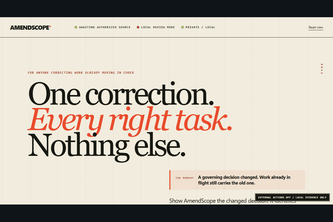
AmendScope is a self-reported tool designed to manage corrections in AI-generated content, particularly within Codex workflows. It claims to identify affected tasks, show untouched work, block invalid actions, and independently verify results after human approval.
What changed
The author describes a four-question lens used while working with Codex that evolved into a correction controller. The tool is said to support synthetic corrections, minimal context packets, and local AI drafting without external API keys.
Single most important open question
Is there evidence of actual usage or adoption beyond the author’s own development work?
What The Product Actually Is
The description states that AmendScope is a system for managing corrections in AI-generated tasks. It identifies affected Codex recipients, previews edits, blocks invalid actions, and verifies results post-approval.
- Claimed function: To find every affected Codex task, show what stays untouched, require approval, block invalid actions, and independently verify the result.
- Mechanism: Uses a local Ollama model for optional drafting; requires human approval before any update packet is produced; includes a separate verification process.
- Not evidenced Whether this system has been used beyond the author’s own development or integrated into existing workflows.
Positioning & Claim Evolution
The author positions AmendScope as a solution to the problem of "context mud" in AI workflows, where corrections made in one task can leave others acting on outdated truths.
- Original framing: A four-question lens: what is visible, what was said, which source governs, and what action is actually allowed.
- Evolution into product: This lens turned into a live correction controller using GPT-5.6 through Codex.
- Not evidenced How this positioning has evolved from concept to market-ready tool, or whether it addresses real customer needs beyond the author’s own use case.
Target Customer & ICP
The description implies that AmendScope targets users working with AI tools like Codex who need to manage corrections across multiple dependent tasks.
- Inferred audience: Developers or content creators using Codex or similar AI-assisted coding platforms.
- Not evidenced Specific customer segments, personas, or evidence of demand from others in the market.
Business Model & Pricing Evidence
There is no mention of pricing, monetization strategy, or business model in the description.
- Not evidenced How the product would be sold, whether it’s a SaaS offering, freemium, or one-time tool.
- Inferred The author suggests optional localhost-only AI drafting with no external billing paths — possibly implying a low-cost or self-hosted approach.
Technical & Delivery Signals
The project is built with TypeScript and uses local Ollama models for AI drafting.
- Technology stack: TypeScript, Ollama.
- Key features: Synthetic correction engine, approval manifests, denial boundaries, verifier checks.
- Not evidenced Scalability, integration capabilities, or performance metrics beyond the author’s own tests.
Traction & Maturity Signals
The description includes details about testing and development but lacks evidence of real-world usage or customer traction.
- Accomplishments listed:
- A complete synthetic correction transaction with multiple affected/untouched tasks.
- 28 passing focused tests plus one intentional skip.
- Short-lived approval and zero-effect denial behavior.
- Local-only AI drafting without API keys.
- Not evidenced Customers, revenue, usage data, or adoption beyond the author’s own development.
Competitive Context
No mention of competitors or market positioning is provided in the description.
- Not evidenced Who else is solving similar problems, how AmendScope compares to existing tools, or whether there are analogous solutions in the marketplace.
Open Questions & Risks
Several aspects raise questions about viability and traction:
- Risk of over-engineering: The system appears highly technical and may not be suitable for general use.
- No external validation: No evidence of adoption, feedback, or real-world testing beyond the author’s own work.
- Self-contained nature: The tool is described as localhost-only with no cloud components — potentially limiting scalability or collaboration features.
- Not evidenced Any market demand or competitive differentiation.
Questions the description leaves open
- What specific workflows or use cases does AmendScope aim to solve for users beyond your own?
- Have you tested the tool with others in your target audience?
- How do you plan to scale beyond a single developer’s local environment?
- Is there any intention to integrate with other AI platforms or tools beyond Codex?
- What is the long-term vision for monetization or product development?
Overall Assessment
The description presents AmendScope as a technical prototype built by one person, focused on solving an internal workflow challenge.
- Not evidenced Traction, revenue, or customer demand.
- Inferred The tool may be useful in niche developer environments but lacks clear commercial viability or market validation.
- Confidence level: Low — based entirely on self-reported claims and author’s own development work.
User Stories BotA demo video on every pull request
Get a demo video on every new feature
GitHub App that watches your pull requests and records a narrated, captioned demo.
Save time on demo prep and make informed decisions faster with a video walkthrough of every new feature.
Source
Submitted to the OpenAI 2026 hackathon on Devpost. Project home on Devpost. Back to the full gallery on Devpost.
This competitive analysis was produced by top-founders.com (opens in a new tab)
Generated by a language model from this project's public Devpost page — its tagline, the author's own write-up and any built-with tags listed there — as captured in August 2026. Short quotations are the author's words. It is an opinion on the idea as a business, not on the people behind it, and it reflects the description as published then. If the project has moved on, request a correction below. The analysis is not independent research and contains no verified traction, revenue or customer data.
An independent guide by KFG International LLC — not affiliated with, endorsed by, or connected to Devpost or OpenAI.