

Archive position — measured, not model output
0 likes on Devpost
2,263 of the 7,850 archived projects have more likes, and 5,587 share exactly 0 — so this project's #2,637 place in the like-ranked listing is a tie-break inside that group, not a ranking.
Projects (log scale)
Likes on Devpost. ▲ marks this project's group.
Show the figures
| Likes | Projects | Share of archive |
|---|---|---|
| 0 | 5,587 | 71.2% |
| 1 | 1,758 | 22.4% |
| 2 | 284 | 3.6% |
| 3–4 | 132 | 1.7% |
| 5–9 | 75 | 1.0% |
| 10+ | 14 | 0.2% |
 User Stories BotA demo video on every pull request
Get a demo video on every new feature
GitHub App that watches your pull requests and records a narrated, captioned demo.
Save time on demo prep and make informed decisions faster with a video walkthrough of every new feature.
Executive Summary
What the company appears to be
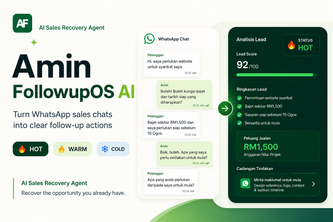
Amin FollowupOS AI is a self-reported AI-powered tool designed to process WhatsApp sales conversations and convert them into structured follow-up actions for microbusiness owners. It uses GPT-5.6 Terra via OpenAI's API, with deterministic business rules to classify leads and generate next steps.
What changed
The project was submitted as part of the OpenAI 2026 hackathon. No evidence suggests prior commercial activity or product development beyond this prototype.
Single most important open question
Is there any evidence of actual microbusiness adoption or traction with real WhatsApp conversations?
What The Product Actually Is
The description states that Amin FollowupOS AI converts pasted WhatsApp sales conversations into:
- Structured lead snapshots;
- Hot, Warm, or Cold classification;
- Reason for classification;
- Opportunity value (when supported);
- Recommended follow-up timing;
- One clear next action;
- Concise, ready-to-send follow-up message.
The system analyzes prospect intent, need, budget signal, urgency, and objections. It uses a frontend built with HTML5, CSS, JavaScript hosted on Netlify, and a serverless function that sends data to OpenAI’s Responses API using GPT-5.6 Terra.
Evidence The author states the product does these things. No independent verification or demonstration of functionality beyond the hackathon submission exists.
Positioning & Claim Evolution
The project positions itself as a solution for microbusiness owners who lose sales opportunities due to scattered WhatsApp conversations and inconsistent follow-ups.
It claims to help sellers recover value from existing leads instead of constantly seeking new ones.
Evidence The author states this positioning. No evidence of market feedback, customer interviews, or competitive positioning beyond the self-description.
Target Customer & ICP
The target customer is described as microbusiness owners who receive sales enquiries through WhatsApp but struggle with follow-up consistency and lead management.
Evidence The author states this. No evidence of actual customers, personas, or segmentation data.
Business Model & Pricing Evidence
No business model or pricing information is provided in the description.
Evidence Not evidenced. The author does not describe any monetization strategy or pricing structure.
Technical & Delivery Signals
The application uses:
- HTML5, CSS, JavaScript frontend;
- Netlify hosting;
- Serverless function for API communication;
- OpenAI GPT-5.6 Terra via Responses API;
- Structured JSON output from AI;
- Deterministic business rules to reinforce sales states;
- Synthetic test data used during development.
The API key is kept server-side and not exposed in frontend code.
Evidence The author describes the technical stack and architecture. No evidence of production deployment, scalability, or performance metrics.
Traction & Maturity Signals
There is no evidence of traction, revenue, or customer adoption beyond the hackathon submission.
The product is described as an MVP built for a hackathon, with future features planned such as persistent accounts, scheduled reminders, and analytics.
Evidence The author states it's an MVP. No evidence of usage, retention, or growth metrics.
Competitive Context
No competitive analysis or market context is provided in the description.
Evidence Not evidenced. The author does not reference competitors or industry trends.
Open Questions & Risks
- Unverified claims: All features and functionality are self-reported without external validation.
- No traction: No evidence of real-world usage, customers, or revenue.
- Limited scope: MVP built for a hackathon; no indication of commercial viability or scalability.
- AI dependency: Heavy reliance on GPT-5.6 Terra and structured outputs may not generalize well without further testing.
- Lack of business model clarity: No pricing, monetization, or go-to-market strategy described.
Inference The lack of any real-world data or customer feedback raises concerns about product-market fit and commercial viability.
Questions the description leaves open
- What specific WhatsApp conversations were used in testing? Were they synthetic or real?
- How many microbusinesses have you engaged with to validate the need for this tool?
- Have you tested the system with actual users, or is it based on assumptions?
- What are your plans to monetize this product beyond the MVP phase?
- How do you plan to integrate with WhatsApp in a way that complies with platform policies?
- What is the expected lifecycle of a lead through this system?
- Are there any legal or compliance concerns around handling customer data?
Overall Assessment
Not evidenced.
There is no evidence of revenue, customers, traction, or business model beyond the author’s self-reported MVP for a hackathon.
The project appears to be an experimental prototype with no commercial validation or market proof.
Confidence level Low — based entirely on unverified self-reporting.
User Stories BotA demo video on every pull request
Get a demo video on every new feature
GitHub App that watches your pull requests and records a narrated, captioned demo.
Save time on demo prep and make informed decisions faster with a video walkthrough of every new feature.
Source
Submitted to the OpenAI 2026 hackathon on Devpost. Project home on Devpost. Back to the full gallery on Devpost.
This competitive analysis was produced by top-founders.com (opens in a new tab)
Generated by a language model from this project's public Devpost page — its tagline, the author's own write-up and any built-with tags listed there — as captured in August 2026. Short quotations are the author's words. It is an opinion on the idea as a business, not on the people behind it, and it reflects the description as published then. If the project has moved on, request a correction below. The analysis is not independent research and contains no verified traction, revenue or customer data.
An independent guide by KFG International LLC — not affiliated with, endorsed by, or connected to Devpost or OpenAI.