

Archive position — measured, not model output
0 likes on Devpost
2,263 of the 7,850 archived projects have more likes, and 5,587 share exactly 0 — so this project's #6,563 place in the like-ranked listing is a tie-break inside that group, not a ranking.
Projects (log scale)
Likes on Devpost. ▲ marks this project's group.
Show the figures
| Likes | Projects | Share of archive |
|---|---|---|
| 0 | 5,587 | 71.2% |
| 1 | 1,758 | 22.4% |
| 2 | 284 | 3.6% |
| 3–4 | 132 | 1.7% |
| 5–9 | 75 | 1.0% |
| 10+ | 14 | 0.2% |
 User Stories BotA demo video on every pull request
Get a demo video on every new feature
GitHub App that watches your pull requests and records a narrated, captioned demo.
Save time on demo prep and make informed decisions faster with a video walkthrough of every new feature.
Executive Summary
Project: ScholarVault AI
Self-reported basis only — no independent verification, archived history, or third-party corroboration.
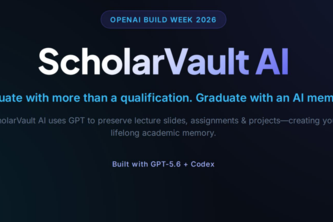
Author's claim: ScholarVault AI is an AI-powered academic vault that preserves and organizes university coursework using GPT to create a searchable, lifelong academic memory.
What changed: The project description reflects a focused, early-stage product concept built for students, emphasizing personal knowledge management through AI. It does not indicate any prior traction, revenue, or customer base.
Single most important open question: Is there evidence of user need or adoption beyond the author’s own experience and hypothesis?
Confidence level: Low — based on a single self-reported write-up with no external validation.
What The Product Actually Is
The description states that ScholarVault AI is an AI-powered academic vault for university students. It allows users to upload various academic files (slides, documents, videos, code, etc.) into one secure place.
Using the OpenAI API, it automatically generates metadata such as:
- Titles
- Summaries
- Keywords
- Topics
- Academic modules
- Programming languages
It enables natural language search across these files and includes an Academic Timeline feature to revisit academic progress over time.
The product is built using:
- Next.js 15
- React
- TypeScript
- Tailwind CSS
- Framer Motion
- OpenAI API (GPT)
- Codex
It is described as a frontend drag-and-drop experience, with backend processing powered by GPT to analyze content and generate structured metadata.
Inference: The product appears to be a prototype or MVP built for personal academic use, not yet commercialized or scaled.
Positioning & Claim Evolution
The author positions ScholarVault AI as:
- Not another cloud storage platform
- Not a learning management system
- A tool that creates a personalized AI vault of academic work
- An academic memory that preserves and organizes knowledge for lifelong use
It is described as solving the problem of scattered academic files by creating a searchable, intelligent archive.
The project’s claim evolution:
- Initial inspiration: Students leave university with only a qualification, not an organized record of their learning.
- Core value proposition: AI-powered organization and search of academic content.
- Future vision: A permanent academic memory that continues beyond graduation, including features like OCR, revision guides, and team collaboration.
Inference: The positioning is focused on personal knowledge management for students, not a broader enterprise or institutional use case.
Target Customer & ICP
The description states that ScholarVault AI is built specifically for university students. It targets:
- Students who create large volumes of academic content (slides, assignments, projects, research papers)
- Users looking to organize and search their own academic history
- Individuals seeking a lifelong academic memory tool
No further segmentation or ICP details are provided.
Inference: The target is likely undergraduate or graduate students, but no evidence of specific demographics, usage patterns, or institutional affiliations is given.
Business Model & Pricing Evidence
The description does not mention:
- Any pricing model
- Revenue streams
- Monetization strategy
- Subscription plans or freemium tiers
It only describes the product’s functionality and future roadmap.
Inference: No evidence of a business model or pricing structure exists in the provided text.
Technical & Delivery Signals
The project is built with:
- Frontend: Next.js 15, React, TypeScript, Tailwind CSS, Framer Motion
- Backend: OpenAI API (GPT), Codex
- Features: Drag-and-drop upload, semantic search, metadata generation, timeline view
It was developed during the OpenAI Build Week, with Codex used for rapid prototyping and code scaffolding.
Inference: The product is a technical prototype built quickly using modern tools and AI APIs. No evidence of production deployment or scalability planning is provided.
Traction & Maturity Signals
The description states:
- It was submitted to the OpenAI 2026 hackathon
- Built by a single team member (Lisa Zweni)
- No mention of users, customers, or adoption metrics
- No revenue, funding, or market traction data
Inference: The project is in an early stage — likely a prototype or MVP. There is no evidence of real-world usage or product-market fit.
Competitive Context
The description does not reference:
- Competitors
- Existing solutions in the academic knowledge management space
- Market size or competitive positioning
It only states that ScholarVault AI is not another cloud storage platform or LMS.
Inference: No competitive analysis or market differentiation is evident. The project appears to be self-contained and unanchored in a known competitive landscape.
Open Questions & Risks
- No traction or user validation: The product is described as a prototype with no evidence of adoption.
- Single founder: A team of one may limit execution capacity.
- Unproven business model: No pricing, monetization, or revenue strategy is evident.
- Highly personal use case: Academic memory tools may not scale beyond individual users without institutional partnerships.
- Dependency on AI APIs: Reliance on OpenAI GPT and Codex introduces risk of API changes or cost increases.
Inference: The project lacks commercial viability signals and is likely in a pre-product-market-fit phase.
Questions the description leaves open
- What specific academic challenges do you observe students facing today, and how does ScholarVault AI solve them?
- Have you tested the product with real students? If so, what feedback did you receive?
- How do you plan to monetize this tool at scale?
- Are there any institutional or university partnerships in the pipeline?
- What are the technical limitations of relying on OpenAI APIs for core functionality?
- How do you plan to differentiate ScholarVault AI from existing tools like Notion, Evernote, or Google Drive?
Overall Assessment
Not evidenced — no data on revenue, traction, or commercial viability is provided.
The project appears to be a conceptual prototype built by one person for a hackathon. It does not demonstrate:
- Product-market fit
- User adoption
- Revenue model
- Scalability
- Competitive positioning
Inference: At this stage, ScholarVault AI is not ready for investment or partnership consideration without further evidence of traction, user validation, or business development.
User Stories BotA demo video on every pull request
Get a demo video on every new feature
GitHub App that watches your pull requests and records a narrated, captioned demo.
Save time on demo prep and make informed decisions faster with a video walkthrough of every new feature.
Source
Submitted to the OpenAI 2026 hackathon on Devpost. Project home on Devpost. Back to the full gallery on Devpost.
This competitive analysis was produced by top-founders.com (opens in a new tab)
Generated by a language model from this project's public Devpost page — its tagline, the author's own write-up and any built-with tags listed there — as captured in August 2026. Short quotations are the author's words. It is an opinion on the idea as a business, not on the people behind it, and it reflects the description as published then. If the project has moved on, request a correction below. The analysis is not independent research and contains no verified traction, revenue or customer data.
An independent guide by KFG International LLC — not affiliated with, endorsed by, or connected to Devpost or OpenAI.