

Archive position — measured, not model output
0 likes on Devpost
2,263 of the 7,850 archived projects have more likes, and 5,587 share exactly 0 — so this project's #6,564 place in the like-ranked listing is a tie-break inside that group, not a ranking.
Projects (log scale)
Likes on Devpost. ▲ marks this project's group.
Show the figures
| Likes | Projects | Share of archive |
|---|---|---|
| 0 | 5,587 | 71.2% |
| 1 | 1,758 | 22.4% |
| 2 | 284 | 3.6% |
| 3–4 | 132 | 1.7% |
| 5–9 | 75 | 1.0% |
| 10+ | 14 | 0.2% |
 User Stories BotA demo video on every pull request
Get a demo video on every new feature
GitHub App that watches your pull requests and records a narrated, captioned demo.
Save time on demo prep and make informed decisions faster with a video walkthrough of every new feature.
Executive Summary
Company: Schoolscreen
Tagline: Digital Signage System with AI campaign generation
Self-reported basis: The analysis is based entirely on the author's own description of Schoolscreen, submitted as part of an OpenAI 2026 hackathon project. No external verification or historical data is available.
Commercial due-diligence read: Schoolscreen appears to be a proof-of-concept digital signage platform that uses AI to assist in generating multilingual campaign content for schools. It is built as a full-stack web application with AI integration, role-based access control, and media handling capabilities. The author states it was developed over two days during a hackathon. There is no evidence of revenue, customers, or traction beyond the demo account provided. The most important open question is whether this concept can scale into a viable product for school districts, particularly around adoption, operational complexity, and integration with existing systems.
What The Product Actually Is
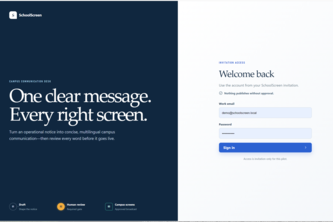
The description states that Schoolscreen is a digital signage system designed to help schools manage announcements across multiple campuses. It allows staff to input plain-language notices and generate structured, multilingual digital-signage campaigns using AI.
Key features include:
- AI-generated display copy, translations, scheduling, and targeting
- Human review and approval before publishing
- Support for text, images, videos, and PDFs
- Browser-based screen player with playlist management
- Role-based access control (owners, admins, editors, viewers)
- Private media storage and tenant isolation
The system is built as a full-stack TypeScript application using Next.js 16, React 19, Tailwind CSS, Supabase, OpenAI APIs, and PDF.js.
Inference: The product is not a commercial-grade solution but a prototype or MVP developed in a hackathon setting. It includes core functionality for content generation, scheduling, and playback, but lacks enterprise features like multi-zone layouts, offline support, or native app integration.
Positioning & Claim Evolution
The author positions Schoolscreen as an AI-assisted tool to reduce manual effort in school communications, emphasizing that AI is used as a drafting assistant rather than an autonomous publisher. The system maintains human oversight at every step.
Key claims:
- AI helps convert informal notices into structured messages
- It supports multilingual content and timezone-aware scheduling
- Human judgment remains central to publishing decisions
Inference: This positioning suggests a niche market focus on school districts, where communication consistency and timeliness are important but automation is limited by regulatory or operational constraints.
Target Customer & ICP
The description states that Schoolscreen was inspired by challenges in school/school district communications. It targets school staff responsible for announcements, particularly those managing multiple campuses or languages.
It does not specify:
- Whether the target includes school districts, individual schools, or other educational institutions
- The size of the intended user base (e.g., number of campuses or staff)
- Specific use cases beyond basic announcements
Inference: The ICP likely centers on small to mid-sized school districts, with a need for centralized communication tools that support multilingual and multi-campus operations.
Business Model & Pricing Evidence
There is no evidence in the description of:
- A pricing model
- Revenue streams
- Monetization strategy
- Customer acquisition or retention plans
The demo account provided is for testing purposes only, with no indication of paid access or subscription tiers.
Inference: The business model remains undefined. It appears to be a prototype without commercial intent at this stage.
Technical & Delivery Signals
The system is built using:
- Frontend: Next.js 16, React 19, Tailwind CSS
- Backend: Node.js, Supabase (PostgreSQL, authentication, RLS)
- AI Integration: OpenAI GPT-5.6 with schema-constrained outputs
- Media Handling: PDF.js for document rendering, browser-based player
- Deployment: Not specified beyond local demo mode
Key technical elements:
- Tenant-aware policies for isolation
- Role-based access control
- Structured AI output validation
- Timezone-aware scheduling
- Private media storage
Inference: The architecture shows a clear understanding of modern web development and data security. However, the prototype nature suggests limited production readiness.
Traction & Maturity Signals
The description indicates that Schoolscreen was built in two days during a hackathon, with no mention of:
- Customers or users
- Revenue or monetization
- Product adoption metrics
- Long-term roadmap execution
- Beta testing or feedback loops
A demo account is provided, but it is for demonstration purposes only.
Inference: There is no evidence of traction or product maturity beyond a hackathon prototype. The system has not been tested in real-world environments.
Competitive Context
The description does not mention:
- Competitors
- Market size or landscape
- Existing solutions in the digital signage space for schools
- Differentiation from other tools
Inference: No competitive analysis is evident. The product appears to be a standalone concept with no known market context or positioning relative to existing platforms.
Open Questions & Risks
- Prototype Limitations: Built in 2 days, likely lacks scalability or production-grade features.
- No Revenue Model: No evidence of monetization strategy or customer base.
- Unproven Market Fit: No data on user needs, adoption, or feedback.
- AI Integration Risks: Reliance on AI for content generation raises concerns about accuracy and safety without human oversight in production.
- Operational Complexity: Scheduling, timezone handling, and media delivery are complex tasks that may not be fully resolved in this version.
Questions the description leaves open
- What is the intended user base beyond schools? Is there a plan to expand beyond educational institutions?
- How does the AI model handle edge cases or ambiguous inputs?
- Are there any plans for integration with existing school systems (e.g., LMS, communication platforms)?
- What are the key assumptions about user behavior and adoption in real-world settings?
- Has the team considered compliance requirements (e.g., accessibility, data privacy) in educational environments?
- How will the platform evolve to support larger districts or more complex layouts?
Overall Assessment
Not evidenced: There is no evidence of revenue, customers, or traction to assess investment potential or partnership viability.
Inference: As a hackathon prototype, Schoolscreen shows early signs of concept validation but lacks the maturity, market traction, or business model to justify significant investment or strategic partnership. It may be a promising idea for further development, but current evidence does not support a commercial due-diligence conclusion.
User Stories BotA demo video on every pull request
Get a demo video on every new feature
GitHub App that watches your pull requests and records a narrated, captioned demo.
Save time on demo prep and make informed decisions faster with a video walkthrough of every new feature.
Source
Submitted to the OpenAI 2026 hackathon on Devpost. Project home on Devpost. Back to the full gallery on Devpost.
This competitive analysis was produced by top-founders.com (opens in a new tab)
Generated by a language model from this project's public Devpost page — its tagline, the author's own write-up and any built-with tags listed there — as captured in August 2026. Short quotations are the author's words. It is an opinion on the idea as a business, not on the people behind it, and it reflects the description as published then. If the project has moved on, request a correction below. The analysis is not independent research and contains no verified traction, revenue or customer data.
An independent guide by KFG International LLC — not affiliated with, endorsed by, or connected to Devpost or OpenAI.