

Archive position — measured, not model output
0 likes on Devpost
2,263 of the 7,850 archived projects have more likes, and 5,587 share exactly 0 — so this project's #6,566 place in the like-ranked listing is a tie-break inside that group, not a ranking.
Projects (log scale)
Likes on Devpost. ▲ marks this project's group.
Show the figures
| Likes | Projects | Share of archive |
|---|---|---|
| 0 | 5,587 | 71.2% |
| 1 | 1,758 | 22.4% |
| 2 | 284 | 3.6% |
| 3–4 | 132 | 1.7% |
| 5–9 | 75 | 1.0% |
| 10+ | 14 | 0.2% |
 User Stories BotA demo video on every pull request
Get a demo video on every new feature
GitHub App that watches your pull requests and records a narrated, captioned demo.
Save time on demo prep and make informed decisions faster with a video walkthrough of every new feature.
Executive Summary
What the company appears to be
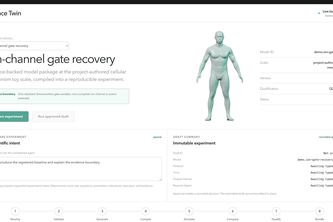
Science Twin is a developer tool that compiles supported physiological models into reproducible simulations using GPT-5.6 for experiment planning and deterministic code for execution. It aims to improve scientific reproducibility by generating traceable, user-approved experiments with evidence bundles.
What changed
The project description indicates a proof-of-concept build week effort focused on a toy cellular mechanism. It demonstrates how GPT-5.6 can interpret plain English questions and generate executable code for simulation within a sandboxed environment, while maintaining an immutable evidence graph.
Single most important open question
Is there sufficient scientific or technical validation to support the claim that this tool can reliably reproduce complex physiological models beyond a toy example?
What The Product Actually Is
The description states that Science Twin is a developer tool for supported physiological models, where users describe a bounded experiment in plain English. GPT-5.6 interprets the request through constrained tools and prepares an immutable draft, which is then executed deterministically by code.
Key components include:
- A CellML source importer
- Rust-based simulation pipeline
- Docker sandboxed execution
- Evidence comparison against numerical references
- Five-axis qualification report generation
The system uses GPT-5.6 via the OpenAI Agents SDK for planning and diagnostics, but not for authoring equations or choosing parameters.
Not evidenced: whether this is a standalone product, SaaS offering, or internal tool; no mention of UI/UX beyond browser workflow.
Positioning & Claim Evolution
The description states that Science Twin turns “reproducing a scientific result” into a developer workflow. It positions itself as a tool for computational model developers who want to ensure their simulations are traceable and rerunnable.
It claims to:
- Turn plain English questions into inspectable experiments
- Provide user-approved, deterministic execution
- Generate reproducibility packages
The author also notes that the tool separates implementation fidelity from biological validation or regulatory context — implying a focus on technical correctness over clinical utility.
Inferred: The tool is positioned as a reproducibility engine, not a full modeling platform or clinical decision support system.
Not evidenced: No claims about market positioning, competitive differentiation, or target adoption rate.
Target Customer & ICP
The description states that Science Twin targets computational model developers who need to know whether their implementation can be traced, rerun, and checked against independent references.
It is implied that these users are likely:
- Researchers working with physiological models
- Developers in computational biology or biomedical engineering
- Teams needing reproducible simulation workflows
Not evidenced: No explicit customer segments, personas, or use cases beyond the toy example. No indication of whether the tool is aimed at academic, industry, or regulatory users.
Business Model & Pricing Evidence
The description does not provide any information about:
- Revenue streams
- Pricing model
- Monetization strategy
- Customer acquisition plans
Not evidenced: No evidence of a business model or pricing structure.
Technical & Delivery Signals
The system uses:
- Rust for simulation pipeline
- CellML and libCellML for model import
- Docker for sandboxed execution
- GPT-5.6 via OpenAI Agents SDK for planning and diagnostics
- React, TypeScript, Vite, Bun, SQLite, OpenAPI, Zod for frontend and backend
The build week proof used a toy cellular gate-recovery mechanism with:
- 21 of 21 comparison points matching a closed-form reference
- 35 immutable artifacts
- Evidence graph tied to exact completed runs
Inferred: The tool is built on a reproducible, deterministic architecture, with strong emphasis on traceability and immutability.
Not evidenced: No details about scalability, deployment infrastructure, or long-term maintainability beyond the proof-of-concept.
Traction & Maturity Signals
The description states that this is a Build Week proof from an OpenAI hackathon. It includes:
- A working prototype
- A toy example with numerical fidelity
- 35 immutable artifacts
- Evidence graph tied to execution
Not evidenced: No customer data, revenue, or usage metrics. No indication of product-market fit or user feedback.
Competitive Context
The description does not mention any competitors or market context.
Not evidenced: No competitive landscape, pricing, or positioning relative to other tools in computational modeling or reproducibility.
Open Questions & Risks
- Unverified claims: The tool is described as proving numerical implementation fidelity for one bounded cellular mechanism, but not biological validation or clinical utility.
- Limited scope: Only a toy example was tested; no indication of broader applicability.
- Dependency on GPT-5.6: While constrained, the use of an AI model raises questions about consistency and control over outputs.
- No commercialization plan: No mention of monetization, customer acquisition, or product roadmap beyond the proof-of-concept.
Inferred: The tool is in a very early stage, with no clear path to market traction or commercial viability.
Questions the description leaves open
- What are the specific constraints and limitations of GPT-5.6 integration? Can it be replaced or extended?
- How does Science Twin handle model versioning and updates in a production environment?
- Are there any plans to expand beyond toy examples into more complex physiological models?
- What is the long-term vision for the tool — is it intended as a standalone product or part of a larger ecosystem?
- Has the team considered regulatory or compliance implications of using AI-assisted scientific tools?
Overall Assessment
The description indicates that Science Twin is an early-stage proof-of-concept built during a hackathon. It shows technical capability in a limited domain but lacks evidence of traction, revenue, or commercial viability.
Confidence level: Low — based on self-reported, unverified information only.
Not evidenced: No indication of market demand, customer validation, or scalability beyond the toy example.
Inferred: This is a research-grade prototype, not a product ready for investment or partnership.
User Stories BotA demo video on every pull request
Get a demo video on every new feature
GitHub App that watches your pull requests and records a narrated, captioned demo.
Save time on demo prep and make informed decisions faster with a video walkthrough of every new feature.
Source
Submitted to the OpenAI 2026 hackathon on Devpost. Project home on Devpost. Back to the full gallery on Devpost.
This competitive analysis was produced by top-founders.com (opens in a new tab)
Generated by a language model from this project's public Devpost page — its tagline, the author's own write-up and any built-with tags listed there — as captured in August 2026. Short quotations are the author's words. It is an opinion on the idea as a business, not on the people behind it, and it reflects the description as published then. If the project has moved on, request a correction below. The analysis is not independent research and contains no verified traction, revenue or customer data.
An independent guide by KFG International LLC — not affiliated with, endorsed by, or connected to Devpost or OpenAI.