

Archive position — measured, not model output
0 likes on Devpost
2,263 of the 7,850 archived projects have more likes, and 5,587 share exactly 0 — so this project's #6,565 place in the like-ranked listing is a tie-break inside that group, not a ranking.
Projects (log scale)
Likes on Devpost. ▲ marks this project's group.
Show the figures
| Likes | Projects | Share of archive |
|---|---|---|
| 0 | 5,587 | 71.2% |
| 1 | 1,758 | 22.4% |
| 2 | 284 | 3.6% |
| 3–4 | 132 | 1.7% |
| 5–9 | 75 | 1.0% |
| 10+ | 14 | 0.2% |
 User Stories BotA demo video on every pull request
Get a demo video on every new feature
GitHub App that watches your pull requests and records a narrated, captioned demo.
Save time on demo prep and make informed decisions faster with a video walkthrough of every new feature.
Executive Summary
What the company appears to be
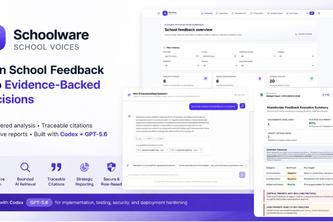
Schoolware is a self-reported system that converts paper-based school feedback documents into structured, searchable insights using AI. The author describes it as a tool for educators, leaders, and learners, built with AI-assisted development practices.
What changed
The project evolved from an AI-assisted prototype to a more structured system with authentication, dashboards, document processing, RAG search, citations, source navigation, and report generation. It migrated from Firebase to Supabase and adopted a more production-standard workflow.
Single most important open question
Is there any evidence of actual use or adoption by schools, educators, or students beyond the author’s own development?
What The Product Actually Is
The description states that Schoolware is a system that turns feedback and documents into structured, searchable insights. It includes:
- Document import and AI analysis (OCR, LLM-based extraction of expectations, suggestions, sentiment, urgency, confidence)
- Automatic document type classification
- Interactive dashboard for filtering and exploring insights
- RAG-based AI chatbot for natural language queries with citations to evidence
- Strategic reports generated from structured data
The system uses technologies such as Express.js, React, Vite, Supabase, PostgreSQL, pgvector, Google Drive API, OCR web service, and Gemini for processing.
Inference This is a prototype or early-stage product built by one developer using AI-assisted tools. It has not been independently verified for functionality or user adoption.
Positioning & Claim Evolution
The author positions Schoolware as a tool that helps educators, school leaders, and learners make better decisions by turning unstructured feedback into clear insights.
It claims to support:
- Structured data extraction from paper forms
- Natural language querying via chatbot
- Evidence-based reporting
- Reduced time and cost in parent engagement
The author also notes that the system supports a human-in-the-loop approach, where AI organizes information but teachers make final decisions.
Inference Positioning is centered on solving inefficiencies in school feedback management. The claim of “better decisions” is not substantiated with data or customer validation.
Target Customer & ICP
The description states that Schoolware is built for:
- Educators
- School leaders
- Every learner’s future (as per tagline)
It also mentions a future expansion to support teachers in analyzing student work and classroom evidence.
Inference The primary ICP appears to be school administrators or leadership teams. Teachers are mentioned as a future target, but not yet part of the core user base.
Business Model & Pricing Evidence
No information is provided about pricing, monetization, or business model in the description.
Not evidenced
Technical & Delivery Signals
The system was built using:
- Frontend: React, Vite
- Backend: Express.js, Node.js
- Database: Supabase (PostgreSQL), pgvector
- AI tools: Gemini, Google AI Studio, ChatGPT, Codex
- OCR: OCR web service
- Authentication and storage: Supabase
The author describes a migration from Firebase to Supabase due to scaling needs and performance issues.
Inference The technical stack suggests a modern, scalable architecture. However, the system is described as a single-developer project with no evidence of enterprise-grade deployment or security practices beyond self-reported improvements.
Traction & Maturity Signals
There is no evidence of revenue, customers, or adoption beyond the author’s own development and testing.
The author mentions:
- Performance improvements made through manual and automated testing
- Migration from prototype to structured system
- Use of AI-assisted tools for rapid development
Not evidenced
Competitive Context
No mention of competitors or market positioning in the description.
Not evidenced
Open Questions & Risks
- Single developer: The project is built by one person (Alfadil Puti), raising concerns about scalability, support, and long-term maintenance.
- Unverified claims: All features and benefits are self-reported without independent validation or user feedback.
- No commercial traction: No evidence of revenue, customers, or product-market fit beyond the author’s own use case.
- Privacy concerns: The system handles sensitive data (e.g., health info, family details), but no clear privacy policies or controls are described beyond role-based access.
Questions the description leaves open
- Has Schoolware been tested with actual schools or educators?
- What is the current user feedback on its utility and usability?
- Are there any plans to monetize or scale the product beyond personal use?
- How does the system handle data governance, compliance, and privacy at scale?
- What are the technical limitations of the current architecture that could hinder growth?
Overall Assessment
Not evidenced
The description is entirely self-reported and unverified. There is no evidence of revenue, customers, or traction. The system appears to be a prototype developed by one individual using AI-assisted tools. It lacks commercial due-diligence signals such as market validation, product-market fit, or scalability indicators.
This is a pre-product-stage project with no demonstrated commercial viability or adoption. Any investment or partnership would require further evidence of traction, user feedback, and business model development.
User Stories BotA demo video on every pull request
Get a demo video on every new feature
GitHub App that watches your pull requests and records a narrated, captioned demo.
Save time on demo prep and make informed decisions faster with a video walkthrough of every new feature.
Source
Submitted to the OpenAI 2026 hackathon on Devpost. Project home on Devpost. Back to the full gallery on Devpost.
This competitive analysis was produced by top-founders.com (opens in a new tab)
Generated by a language model from this project's public Devpost page — its tagline, the author's own write-up and any built-with tags listed there — as captured in August 2026. Short quotations are the author's words. It is an opinion on the idea as a business, not on the people behind it, and it reflects the description as published then. If the project has moved on, request a correction below. The analysis is not independent research and contains no verified traction, revenue or customer data.
An independent guide by KFG International LLC — not affiliated with, endorsed by, or connected to Devpost or OpenAI.