

Archive position — measured, not model output
1 like on Devpost
505 of the 7,850 archived projects have more likes, and 1,758 share exactly 1 — so this project's #678 place in the like-ranked listing is a tie-break inside that group, not a ranking.
Projects (log scale)
Likes on Devpost. ▲ marks this project's group.
Show the figures
| Likes | Projects | Share of archive |
|---|---|---|
| 0 | 5,587 | 71.2% |
| 1 | 1,758 | 22.4% |
| 2 | 284 | 3.6% |
| 3–4 | 132 | 1.7% |
| 5–9 | 75 | 1.0% |
| 10+ | 14 | 0.2% |
 User Stories BotA demo video on every pull request
Get a demo video on every new feature
GitHub App that watches your pull requests and records a narrated, captioned demo.
Save time on demo prep and make informed decisions faster with a video walkthrough of every new feature.
Executive Summary
Company: Because, Therefore
Self-reported basis: Author-supplied project description from Devpost submission for OpenAI 2026 hackathon
Commercial due-diligence read: This is a self-contained multiplayer party game built as a hackathon project that teaches causal reasoning through play. The author states it uses GPT-5.6 to generate content and runs fully offline with zero dependencies. There is no evidence of revenue, customers, or traction beyond the project’s own description.
Key open question: Is there any indication that this project has moved beyond a prototype or hackathon demo — or whether it has any commercial viability or path to adoption?
What The Product Actually Is
The description states:
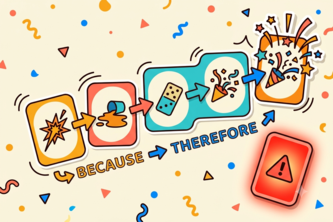
- It is a multiplayer party game about cause and effect, using real historical disasters as content.
- Players are presented with scrambled cause-and-effect cards from events like the Boston Molasses flood, Tacoma Narrows Bridge collapse, etc.
- Players must rebuild the true causal chain while avoiding a trap card that only correlates but does not cause anything.
- The game includes a feature where users can type any topic and have GPT-5.6 generate a new scrambled causal chain with a hidden trap.
- It is built using Node.js, vanilla JavaScript, and runs fully offline without API keys or external dependencies.
Inference: The product appears to be a single-player or small-group educational game that uses gamification to teach the concept of correlation vs. causation, with an emphasis on interactive learning through play.
Positioning & Claim Evolution
The author states:
- The game is designed to counter the claim that AI is eroding human thinking skills.
- It teaches a transferable reasoning skill — “correlation ≠ causation” — in a way that feels like play, not instruction.
- The core idea is that AI cannot do causal reasoning, so this game helps people develop it.
Inference: The positioning is framed as an educational tool that uses gamification to teach a critical thinking skill, with a narrative around AI’s limitations and human cognitive strengths.
Target Customer & ICP
The description states:
- It is a multiplayer party game, suggesting a social or group setting.
- Content is based on real historical disasters, implying an audience interested in history or education.
- The author mentions a classroom mode as a future feature, indicating potential for educational use.
Inference: The primary ICP may be educators or students, and possibly social gamers who enjoy collaborative problem-solving. However, the description does not specify any defined customer segments beyond general interest in learning or games.
Business Model & Pricing Evidence
The description states:
- It is a single-person project (1 team member).
- No pricing model, monetization strategy, or revenue streams are mentioned.
- The game is described as fully offline, with no mention of subscription, in-app purchases, or paid features.
Inference: There is no evidence of any business model or pricing structure. The project appears to be a prototype or demo, not a commercial offering.
Technical & Delivery Signals
The description states:
- Built with zero-dependency Node.js server + vanilla client, no build step.
- Runs fully offline, with no API key needed.
- Uses GPT-5.6 for generating new rounds, with a graceful fallback to built-in content when offline.
- The game was built using Codex (presumably OpenAI’s code generation tool).
Inference: The technical stack is minimal and self-contained, suggesting a lightweight prototype or proof-of-concept. The use of GPT-5.6 for content generation implies some level of AI integration, but no evidence of scalability or infrastructure beyond the demo.
Traction & Maturity Signals
The description states:
- It was submitted to the OpenAI 2026 hackathon.
- It is a single-person project, with one founder (Natalia Mawyin).
- No mention of users, downloads, or adoption.
- The author mentions future features like classroom mode, scoring pass, and leaderboards — but these are not yet implemented.
Inference: There is no evidence of traction, customers, or real-world usage beyond the hackathon submission. It appears to be a preliminary prototype with no commercial deployment or user base.
Competitive Context
The description states:
- The game teaches causal reasoning, which is a niche but important skill.
- It is framed as a party game, not a traditional educational app or platform.
- No direct competitors are named.
Inference: There is no evidence of existing products in this exact space — the author’s framing suggests a unique niche for combining causal reasoning with multiplayer party games. However, there is no indication of market size or competitive landscape.
Open Questions & Risks
The description states:
- It is a single-person project, which raises questions about scalability and long-term maintenance.
- The game uses GPT-5.6 for content generation — this may be a dependency on an external API that could break or become expensive.
- No evidence of user testing, feedback loops, or product-market fit beyond the author’s own claims.
Inference:
- Single-founder risk: The project lacks team support, which is an open question for long-term viability.
- Dependency on GPT-5.6: If this API becomes unavailable or costly, the core functionality may break.
- No traction or feedback: No evidence of real-world use or user engagement.
Questions the description leaves open
- What is your plan for scaling beyond a single-person hackathon project?
- How do you intend to monetize this product, if at all?
- Have you tested the game with actual users (e.g., students or teachers)?
- How do you plan to maintain and update content (e.g., new disasters or topics)?
- What is your long-term vision for the product — is it a standalone game or part of a larger platform?
Overall Assessment
The description states:
- It is a hackathon project with no revenue, customers, or traction.
- The author has not described any commercial strategy or path to monetization.
- The product is not yet deployed, and the features mentioned are future plans.
Inference:
- This is a preliminary prototype with no evidence of commercial viability or market traction.
- It may be an interesting idea for educational or game development, but it is not ready for investment or partnership at this stage.
- The project lacks any indication of a business model, user base, or scalable infrastructure.
Assessment: Not evidenced as a viable commercial opportunity. Likely a demo or prototype with potential for future development, but no current signs of traction or monetization.
User Stories BotA demo video on every pull request
Get a demo video on every new feature
GitHub App that watches your pull requests and records a narrated, captioned demo.
Save time on demo prep and make informed decisions faster with a video walkthrough of every new feature.
Source
Submitted to the OpenAI 2026 hackathon on Devpost. Project home on Devpost. Back to the full gallery on Devpost.
This competitive analysis was produced by top-founders.com (opens in a new tab)
Generated by a language model from this project's public Devpost page — its tagline, the author's own write-up and any built-with tags listed there — as captured in August 2026. Short quotations are the author's words. It is an opinion on the idea as a business, not on the people behind it, and it reflects the description as published then. If the project has moved on, request a correction below. The analysis is not independent research and contains no verified traction, revenue or customer data.
An independent guide by KFG International LLC — not affiliated with, endorsed by, or connected to Devpost or OpenAI.