

Archive position — measured, not model output
1 like on Devpost
505 of the 7,850 archived projects have more likes, and 1,758 share exactly 1 — so this project's #680 place in the like-ranked listing is a tie-break inside that group, not a ranking.
Projects (log scale)
Likes on Devpost. ▲ marks this project's group.
Show the figures
| Likes | Projects | Share of archive |
|---|---|---|
| 0 | 5,587 | 71.2% |
| 1 | 1,758 | 22.4% |
| 2 | 284 | 3.6% |
| 3–4 | 132 | 1.7% |
| 5–9 | 75 | 1.0% |
| 10+ | 14 | 0.2% |
 User Stories BotA demo video on every pull request
Get a demo video on every new feature
GitHub App that watches your pull requests and records a narrated, captioned demo.
Save time on demo prep and make informed decisions faster with a video walkthrough of every new feature.
Executive Summary
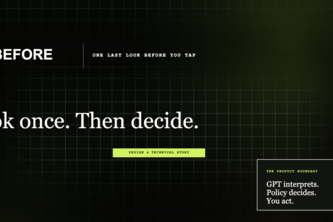
The company appears to be a solo-built project named "Before", self-described as a safety layer for AI interactions that pauses risky actions (e.g., BUY, PAY, SEND) and provides clear assessments (GO / FIX / PAUSE). It is positioned as a tool to help users make safer digital choices by offering explanations and control over AI-assisted decisions. The project was submitted to the OpenAI 2026 hackathon.
The most important open question is: What is the actual commercial viability or scalability of this concept, given that it is currently presented as a prototype built in a hackathon setting with no evidence of revenue, customers, or product-market fit beyond the author’s own claims?
What The Product Actually Is
- The description states that BEFORE is a safety layer for AI interactions.
- It detects dangerous intent patterns such as BUY, PAY, SEND, CLICK, SIGN, and POST.
- It runs a six-check pipeline and returns one of three assessments: GO / FIX / PAUSE.
- It provides explanations of what was checked, what was missing, and what safer step to take next.
- The system is described as policy-driven, with model analysis, deterministic validation, domain checks, and server-side enforcement.
- It was built in a hackathon setting (Devpost submission), not as a production-ready product.
Note: No evidence of actual product functionality or user experience beyond the author’s description.
Positioning & Claim Evolution
- The project is positioned to address the problem of people trusting AI too much in high-risk moments.
- It claims to give users control back by making risky actions pause, explain themselves, and ask for confirmation.
- The positioning evolves from a general safety concern (AI misuse) to a specific tool that makes digital decisions safer through transparency and control.
- The author states that BEFORE is not about blocking everything but about making every risky action pause and explain itself.
Inference: The positioning reflects a shift from AI-as-risk to AI-as-trustable assistant, based on the author’s own claims.
Target Customer & ICP
- The description does not name specific customer segments or personas.
- It implies that users who are in a hurry and trust AI-assisted actions (e.g., drafting messages, making payments) are the target.
- The product is described as useful for everyday copilots across domains like banking, shopping, scheduling, document signing, and account actions.
Not evidenced: No explicit ICP or customer segmentation beyond vague descriptions of user behavior.
Business Model & Pricing Evidence
- No pricing information, monetization strategy, or business model is provided.
- The description does not mention any revenue streams, subscriptions, or commercial partnerships.
- It is described as a tool that could be integrated into other platforms or used standalone, but no commercial structure is outlined.
Not evidenced: No evidence of how the product would generate value or income.
Technical & Delivery Signals
- Built with: codex, gpt-5.6sol-ultra, gstack, openai, typescript.
- The system uses a policy-driven pipeline including model analysis, deterministic validation, domain checks, and server-side enforcement.
- It includes evaluator tests for various cases (clear, concern, unknown, adversarial) to ensure consistent behavior.
- UX was tuned to avoid annoyance while maintaining clarity.
- Challenges included avoiding “fake confidence” and pacing the UX appropriately.
Inference: The technical stack suggests a strong AI integration with a focus on safety and user experience tuning.
Traction & Maturity Signals
- The project was submitted to the OpenAI 2026 hackathon.
- It is described as a working flow, but no evidence of real-world usage or adoption.
- No mention of users, customers, or any form of traction beyond the author’s own account.
- The product is described as a prototype built in a short timeframe (a buildathon), not a mature product.
Not evidenced: No data on usage, retention, or product maturity beyond self-reporting.
Competitive Context
- The description does not mention competitors or similar tools.
- It positions itself as a safety layer for AI interactions, which could overlap with AI governance, digital trust platforms, or cybersecurity tools.
- No evidence of existing solutions in the market or competitive differentiation is provided.
Not evidenced: No competitive landscape or positioning relative to other tools.
Open Questions & Risks
- The project is described as a hackathon prototype with no commercial traction or product-market fit.
- It lacks any evidence of revenue, customers, or real-world usage.
- The author’s own claims are unverified and self-reported.
- No clear path to monetization or scalability is evident.
- The system relies heavily on AI models and deterministic validation — a potential risk if model performance degrades or becomes unreliable.
Inference: The lack of evidence for traction, revenue, or product-market fit raises significant commercial viability concerns.
Questions the description leaves open
- What is the actual user behavior you’ve observed in prototype testing?
- How do you plan to scale this from a hackathon prototype to a usable product?
- Have you tested the UX with real users, and how did they respond?
- What are your plans for monetization or commercial partnerships?
- How do you intend to handle edge cases where model confidence is low but deterministic checks are insufficient?
Overall Assessment
- The project is described as a solo-built hackathon prototype with no evidence of traction, revenue, or product-market fit.
- It is positioned as a safety tool for AI interactions, but lacks any commercial or technical validation beyond the author’s own claims.
- The concept may be promising in theory, but there is no evidence that it has moved beyond an idea or prototype stage.
Confidence: Low. This is a self-reported, unverified account of a project built in a short timeframe with no external validation or commercial data.
User Stories BotA demo video on every pull request
Get a demo video on every new feature
GitHub App that watches your pull requests and records a narrated, captioned demo.
Save time on demo prep and make informed decisions faster with a video walkthrough of every new feature.
Source
Submitted to the OpenAI 2026 hackathon on Devpost. Project home on Devpost. Back to the full gallery on Devpost.
This competitive analysis was produced by top-founders.com (opens in a new tab)
Generated by a language model from this project's public Devpost page — its tagline, the author's own write-up and any built-with tags listed there — as captured in August 2026. Short quotations are the author's words. It is an opinion on the idea as a business, not on the people behind it, and it reflects the description as published then. If the project has moved on, request a correction below. The analysis is not independent research and contains no verified traction, revenue or customer data.
An independent guide by KFG International LLC — not affiliated with, endorsed by, or connected to Devpost or OpenAI.