

Archive position — measured, not model output
0 likes on Devpost
2,263 of the 7,850 archived projects have more likes, and 5,587 share exactly 0 — so this project's #2,643 place in the like-ranked listing is a tie-break inside that group, not a ranking.
Projects (log scale)
Likes on Devpost. ▲ marks this project's group.
Show the figures
| Likes | Projects | Share of archive |
|---|---|---|
| 0 | 5,587 | 71.2% |
| 1 | 1,758 | 22.4% |
| 2 | 284 | 3.6% |
| 3–4 | 132 | 1.7% |
| 5–9 | 75 | 1.0% |
| 10+ | 14 | 0.2% |
 User Stories BotA demo video on every pull request
Get a demo video on every new feature
GitHub App that watches your pull requests and records a narrated, captioned demo.
Save time on demo prep and make informed decisions faster with a video walkthrough of every new feature.
Executive Summary
What the company appears to be
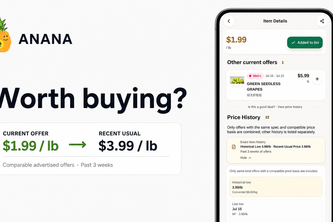
Anana is a personal grocery price intelligence tool that processes weekly flyer data into structured, explainable comparisons. The author describes it as a system that turns messy flyer information into trustworthy price insights, helping users determine if an offer is actually a deal.
What changed
The project underwent a major overhaul using GPT-5.6 as both an engineering collaborator and semantic reasoning system. This led to improvements in product categorization, search behavior, data normalization, and overall system reliability. The author states this transformation turned a prototype into a working product.
Single most important open question
Is there any evidence of actual user adoption or revenue generation beyond the author’s own development efforts?
Note: All claims are self-reported by the author and unverified. No third-party data, traction metrics, or financials are provided.
What The Product Actually Is
The description states that Anana:
- Processes weekly grocery flyers into personalized price intelligence
- Allows users to search for specific items or broader grocery concepts (e.g., milk, grapes)
- Compares current offers across multiple retailers
- Shows recent advertised-price history when trustworthy
- Supports bilingual English and Chinese searches
- Enables setting personal target prices and saving offers to shopping lists
- Displays original flyer images with source evidence
It also states that Anana:
- Separates products into safe comparison groups
- Normalizes compatible price units
- Does not hide offers merely because they cannot be compared safely; instead, it explains uncertainty
- Uses an immutable, provenance-first data pipeline: raw flyer → extracted offer → canonical product → comparable price event
Inference: The system appears to be built around structured data ingestion and semantic reasoning, with a focus on transparency in its comparisons.
Positioning & Claim Evolution
The author states:
- Anana aims to answer the question: “Is this actually a good deal?”
- It was inspired by a desire for a personal grocery price memory that remembers what shoppers care about
- The product evolved from an unreliable prototype into a working system after using GPT-5.6
Inference: The positioning has shifted from a conceptual idea to a functional tool, driven by AI-assisted engineering improvements.
Target Customer & ICP
The description states:
- Users can search for specific items or broader grocery ideas (e.g., milk, rice, cherries)
- It supports both English and Chinese searches
- Features include following regularly purchased groceries, setting target prices, discovering deals, and saving offers to shopping lists
Inference: The primary user base likely consists of individual shoppers who want to optimize their grocery spending through price tracking and comparison. There is no mention of business customers or institutional use.
Business Model & Pricing Evidence
The description does not provide any information about:
- Revenue streams
- Pricing models
- Monetization strategy
- Customer acquisition costs
- Subscription plans or freemium tiers
Not evidenced
Technical & Delivery Signals
The author states:
- Backend built with Python, FastAPI, SQLAlchemy
- Frontend is a React and Vite progressive web app
- Production runs on Cloudflare Workers with D1, KV, R2 storage
- GPT-5.6 was used as an engineering collaborator and semantic reasoning system
- System includes deterministic normalization, versioned data models, and release gates
- Over 120 commits were made in ~10 days, including over 60 implementation-oriented changes
Inference: The technical stack suggests a modern, cloud-native architecture with strong emphasis on data integrity and traceability.
Traction & Maturity Signals
The description states:
- Anana is now a live, working product—not a mockup
- It supports bilingual search parity
- 994 tests passed during integration
- Deployed as a versioned Cloudflare D1 read model with more than 14,000 search documents
- Includes full current, historical, and provenance references
Not evidenced: No data on user engagement, retention, or revenue is provided.
Competitive Context
The description does not mention:
- Direct competitors
- Market size or segment
- Competitive advantages or differentiation strategies
Not evidenced
Open Questions & Risks
Key risks identified from the self-reported account:
- The system relies heavily on GPT-5.6 for semantic reasoning, which may introduce opacity or unpredictability if not fully controlled
- No evidence of real-world usage or feedback loops
- Lack of customer data, pricing models, or monetization strategy raises questions about scalability and viability
- The entire development effort was done by one person (Josh Qin), suggesting limited team capacity for growth
Inference: While the technical approach is sound, the lack of external validation or user traction makes it difficult to assess commercial viability.
Questions the description leaves open
- What is the source of flyer data? Is there a plan to scale beyond Toronto?
- How does Anana handle data privacy and compliance (e.g., GDPR)?
- Are there any existing users or pilot programs?
- What are the projected costs for scaling the system and acquiring users?
- How will the product monetize, if at all?
- Has the team considered how to integrate with major retailers or grocery delivery platforms?
Overall Assessment
Not evidenced
Confidence Level: Low
The description is entirely self-reported and lacks any verifiable traction, revenue, or customer data. While the technical execution appears robust, there is no indication of market demand or commercial success. This project remains in early development phase with no evidence of product-market fit or scalable business model.
User Stories BotA demo video on every pull request
Get a demo video on every new feature
GitHub App that watches your pull requests and records a narrated, captioned demo.
Save time on demo prep and make informed decisions faster with a video walkthrough of every new feature.
Source
Submitted to the OpenAI 2026 hackathon on Devpost. Project home on Devpost. Back to the full gallery on Devpost.
This competitive analysis was produced by top-founders.com (opens in a new tab)
Generated by a language model from this project's public Devpost page — its tagline, the author's own write-up and any built-with tags listed there — as captured in August 2026. Short quotations are the author's words. It is an opinion on the idea as a business, not on the people behind it, and it reflects the description as published then. If the project has moved on, request a correction below. The analysis is not independent research and contains no verified traction, revenue or customer data.
An independent guide by KFG International LLC — not affiliated with, endorsed by, or connected to Devpost or OpenAI.