

Archive position — measured, not model output
1 like on Devpost
505 of the 7,850 archived projects have more likes, and 1,758 share exactly 1 — so this project's #682 place in the like-ranked listing is a tie-break inside that group, not a ranking.
Projects (log scale)
Likes on Devpost. ▲ marks this project's group.
Show the figures
| Likes | Projects | Share of archive |
|---|---|---|
| 0 | 5,587 | 71.2% |
| 1 | 1,758 | 22.4% |
| 2 | 284 | 3.6% |
| 3–4 | 132 | 1.7% |
| 5–9 | 75 | 1.0% |
| 10+ | 14 | 0.2% |
 User Stories BotA demo video on every pull request
Get a demo video on every new feature
GitHub App that watches your pull requests and records a narrated, captioned demo.
Save time on demo prep and make informed decisions faster with a video walkthrough of every new feature.
Executive Summary
What the company appears to be
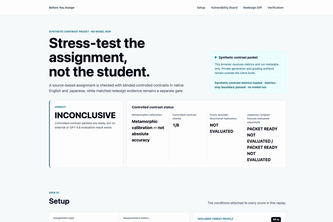
Before You Assign is a self-reported tool designed for educators or instructional designers to evaluate whether an AI model can complete a given assignment prompt before distributing it to students. The author states that it allows users to "stress-test the assignment" and inspect rubric-level AI completion potential.
What changed
The project was submitted to the OpenAI 2026 hackathon, indicating a focus on AI-assisted education or instructional design tools. No evidence of prior development, traction, or commercialization is provided.
Single most important open question
Does the tool actually perform rubric-level AI completion analysis, and if so, how does it assess quality or alignment with learning objectives? The description offers no clarity on functionality, evaluation criteria, or technical implementation.
What The Product Actually Is
The description states:
"Stress-test the assignment, not the student. Inspect rubric-level AI completion potential before a source-based assignment is distributed."
This suggests that Before You Assign is a tool intended to allow educators to evaluate whether an AI model (presumably using a large language model like Codex or GPT) can complete a given assignment prompt in a way that aligns with rubric criteria, prior to assigning it to students.
However, the description does not define what "rubric-level AI completion potential" means. It also does not describe how this evaluation is performed — whether through prompt engineering, model fine-tuning, or some form of automated rubric matching.
Evidence
- The author states that the tool inspects rubric-level AI completion potential.
- The tool is described as stress-testing assignments before distribution.
- No further technical detail is provided.
Inference It appears to be a pre-assessment tool for educators using AI models, but the mechanism of evaluation is not detailed.
Positioning & Claim Evolution
The author states:
"Stress-test the assignment, not the student. Inspect rubric-level AI completion potential before a source-based assignment is distributed."
This positioning implies that the tool is intended to help educators avoid assigning tasks that can be easily completed by AI, or to ensure that assignments are appropriately challenging for students.
It also suggests a concern about AI-assisted cheating or over-reliance on AI in education — a growing issue in educational settings.
Evidence
- The tagline and description frame the tool as a way to evaluate AI readiness of assignments.
- No mention of how it differentiates from existing tools or how it improves upon current practices.
Inference The tool is positioned as a guardrail for educators against AI-assisted assignment completion, but its competitive advantage or unique value proposition is not stated.
Target Customer & ICP
The description states:
"Stress-test the assignment, not the student."
This implies that the primary user is likely an educator, instructional designer, or curriculum developer who is concerned with the integrity of assignments and their alignment with learning outcomes.
Evidence
- The tool is described as being used by those who distribute source-based assignments.
- No explicit customer segment is named.
Inference The target customer is likely educators or academic institutions focused on maintaining academic rigor in AI-assisted environments. However, no specific ICP (Ideal Customer Profile) is defined.
Business Model & Pricing Evidence
There is no evidence of a business model or pricing structure in the description.
Evidence
- No mention of monetization.
- No indication of whether it is a free tool, subscription-based, or one-time purchase.
Inference The tool may be a prototype or hackathon submission with no commercialization strategy yet. The business model remains unknown.
Technical & Delivery Signals
The author states:
"Built with (author-declared): codex, javascript, python"
This indicates that the project was built using AI models (Codex), JavaScript, and Python — suggesting a tool that integrates with AI APIs or uses code-based tools for processing prompts and rubrics.
Evidence
- The tech stack includes Codex, JavaScript, and Python.
- No further details on architecture, API usage, or delivery method are provided.
Inference The tool likely uses Codex (OpenAI’s code generation model) in combination with JavaScript/Python for UI or backend logic. However, no information is given about how rubric alignment is evaluated or whether the tool is deployed as a web app or API.
Traction & Maturity Signals
There is no evidence of traction or maturity in the description.
Evidence
- The project was submitted to a hackathon.
- No mention of users, customers, or adoption.
- No revenue, ARR, or funding information is provided.
Inference The tool is likely early-stage and not yet commercially viable. It may be a prototype or proof-of-concept.
Competitive Context
There is no evidence of competitive analysis in the description.
Evidence
- No mention of competitors.
- No indication of how it compares to existing tools for assignment design or AI evaluation.
Inference The tool may be addressing a niche within educational AI, but its place in the market is unclear. It could compete with AI-assisted assignment tools or rubric-checking platforms, but no such context is provided.
Open Questions & Risks
- Lack of clarity on functionality: The description does not explain how rubric-level AI completion is assessed.
- No evidence of traction or adoption: The tool is a hackathon submission with no commercialization history.
- Unproven business model: No indication of monetization or revenue streams.
- Unclear technical depth: While it uses Codex, the actual implementation and evaluation logic are not described.
Evidence
- No demonstration, prototype, or user feedback provided.
- No mention of validation or testing methods.
Questions the description leaves open
- How does the tool determine rubric-level AI completion potential?
- What is the process for evaluating whether an assignment can be completed by an AI model?
- Is this a prototype, and if so, what are the next steps to commercialization?
- Are there any existing partnerships or early adopters in education?
- How does it integrate with current educational platforms or LMS systems?
Overall Assessment
The description indicates that Before You Assign is a hackathon submission with no evidence of traction, revenue, or business model.
Evidence
- Submitted to OpenAI 2026 hackathon.
- No mention of users, customers, or funding.
- No commercialization strategy described.
Inference This project is likely early-stage and not yet ready for investment or partnership. It may have potential if it can clarify its functionality and demonstrate a clear path to market — but as of now, there is no evidence of either.
User Stories BotA demo video on every pull request
Get a demo video on every new feature
GitHub App that watches your pull requests and records a narrated, captioned demo.
Save time on demo prep and make informed decisions faster with a video walkthrough of every new feature.
Source
Submitted to the OpenAI 2026 hackathon on Devpost. Project home on Devpost. Back to the full gallery on Devpost.
This competitive analysis was produced by top-founders.com (opens in a new tab)
Generated by a language model from this project's public Devpost page — its tagline and any built-with tags listed there, since the author published no write-up — as captured in August 2026. Short quotations are the author's words. It is an opinion on the idea as a business, not on the people behind it, and it reflects the description as published then. If the project has moved on, request a correction below. The analysis is not independent research and contains no verified traction, revenue or customer data.
An independent guide by KFG International LLC — not affiliated with, endorsed by, or connected to Devpost or OpenAI.