

Archive position — measured, not model output
0 likes on Devpost
2,263 of the 7,850 archived projects have more likes, and 5,587 share exactly 0 — so this project's #4,608 place in the like-ranked listing is a tie-break inside that group, not a ranking.
Projects (log scale)
Likes on Devpost. ▲ marks this project's group.
Show the figures
| Likes | Projects | Share of archive |
|---|---|---|
| 0 | 5,587 | 71.2% |
| 1 | 1,758 | 22.4% |
| 2 | 284 | 3.6% |
| 3–4 | 132 | 1.7% |
| 5–9 | 75 | 1.0% |
| 10+ | 14 | 0.2% |
 User Stories BotA demo video on every pull request
Get a demo video on every new feature
GitHub App that watches your pull requests and records a narrated, captioned demo.
Save time on demo prep and make informed decisions faster with a video walkthrough of every new feature.
Executive Summary
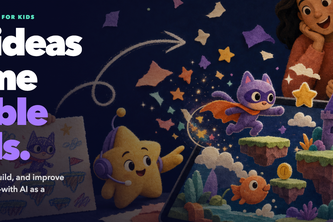
What the company appears to be: ImagineLab is an educational mobile app for elementary-aged children that allows them to create playable games from ideas described through drawing or voice, without requiring any technical skill.
What changed: The project was submitted as a hackathon entry to the OpenAI 2026 hackathon. It is not evidenced to have launched commercially or gained traction beyond its submission.
The single most important open question: Is there evidence of a viable path to commercialization, including customer validation, monetization strategy, and scalability beyond a hackathon prototype?
What The Product Actually Is
- The description states that ImagineLab is an educational mobile and tablet app for elementary-aged children.
- It enables children to turn ideas, drawings, or voice prompts into playable games without coding.
- Children can describe a game through natural language and refine it via conversation.
- Games are generated using AI (powered by OpenAI's API) and run inside an HTML WebView.
- The platform introduces a basic software development workflow: idea → prototype → test → improve.
- It includes both a child-facing app and a parent portal, built with React Native, TypeScript, Expo, Node.js, Fastify, and OpenAI APIs.
Note: This is a self-reported product description. No evidence of actual deployment, user base, or functionality beyond the hackathon prototype exists in the provided information.
Positioning & Claim Evolution
- The author states that ImagineLab helps children "turn dreams into playable games without any technical skill."
- It aims to make game development accessible to non-coders by removing technical barriers.
- The platform is positioned as an educational tool that teaches design, testing, feedback gathering, and iteration skills through playful creation.
- The description claims the app introduces a simple software development workflow to children.
- The team describes their goal as building "an AI studio for kids" — implying a long-term vision beyond this prototype.
Inference: The positioning suggests an educational or creative platform targeting young users with limited technical experience, but no evidence of market traction or adoption exists.
Target Customer & ICP
- The target customer is elementary-aged children.
- Parents are also mentioned as users via the parent portal feature.
- No specific age range within elementary school is given.
- No evidence of segmentation beyond age group or parental involvement.
Not evidenced: There is no indication of whether the team has validated demand from educators, parents, or schools; nor any data on how many children might be interested in such a tool.
Business Model & Pricing Evidence
- The description does not mention pricing, monetization strategy, or business model.
- No evidence of revenue streams, subscriptions, or paid features is provided.
- The project was submitted as a hackathon entry, suggesting no commercial launch has occurred.
Inference: If the platform were to be commercialized, it would likely involve either freemium models, educational licensing, or parental subscriptions — but none are stated.
Technical & Delivery Signals
- Built with React Native, TypeScript, Expo, and Expo Router for mobile UI.
- Backend uses Node.js, Fastify, and TypeScript.
- AI integration powered by OpenAI’s API (Responses API).
- Games run inside an HTML WebView.
- Parent portal and child app are supported in the same system architecture.
- Challenges included balancing creative freedom with safety controls and prompt engineering.
Inference: The tech stack suggests a modern, scalable approach for a mobile-first educational platform. However, no evidence of production deployment or performance metrics is available.
Traction & Maturity Signals
- Submitted to the OpenAI 2026 hackathon.
- No evidence of revenue, customer acquisition, or user engagement beyond submission.
- No mention of pilot programs, beta testing, or market validation.
- The team consists of two members (Jewoo Lee, bohan wang).
Not evidenced: There is no sign of traction, adoption, or growth metrics. The project remains in early-stage prototype form.
Competitive Context
- No evidence of competitors or competitive landscape is provided.
- The description does not reference existing tools for children’s game creation or AI-assisted creativity platforms.
- No mention of similar products in the market, educational or otherwise.
Inference: While there may be other platforms enabling creative expression for kids, none are identified in this self-report.
Open Questions & Risks
- The project is a hackathon submission with no commercial traction or validation.
- Risk of over-reliance on AI APIs (OpenAI) without clear long-term sustainability or control.
- Safety concerns around content generation were noted as a challenge — but no details on how these are addressed.
- Team size is small (2 people), which may limit execution capacity.
- No evidence of product-market fit, scalability plans, or go-to-market strategy.
Inference: Without real-world usage or feedback, the risk of misalignment between intended value and actual utility is high.
Questions the description leaves open
- What specific educational outcomes do you expect from using ImagineLab?
- How are you addressing safety concerns around AI-generated content for children?
- Have you tested the app with real elementary-aged children or educators?
- What is your plan to scale beyond a hackathon prototype?
- Do you have any early adopters or pilot users?
- Are there any existing partnerships with schools, EdTech providers, or parents?
- How do you intend to monetize this platform if it were to be launched commercially?
Overall Assessment
- The project is currently a hackathon submission with no demonstrated traction, revenue, or customer base.
- It shows potential as an educational tool but lacks evidence of viability or commercial readiness.
- The team has built a functional prototype using modern tech stacks and AI integration.
- However, the lack of validation, scalability planning, and business model makes it difficult to assess investment or partnership value at this stage.
Confidence level: Low. This is a self-reported, unverified idea with no evidence of real-world impact or commercialization path.
User Stories BotA demo video on every pull request
Get a demo video on every new feature
GitHub App that watches your pull requests and records a narrated, captioned demo.
Save time on demo prep and make informed decisions faster with a video walkthrough of every new feature.
Source
Submitted to the OpenAI 2026 hackathon on Devpost. Project home on Devpost. Back to the full gallery on Devpost.
This competitive analysis was produced by top-founders.com (opens in a new tab)
Generated by a language model from this project's public Devpost page — its tagline, the author's own write-up and any built-with tags listed there — as captured in August 2026. Short quotations are the author's words. It is an opinion on the idea as a business, not on the people behind it, and it reflects the description as published then. If the project has moved on, request a correction below. The analysis is not independent research and contains no verified traction, revenue or customer data.
An independent guide by KFG International LLC — not affiliated with, endorsed by, or connected to Devpost or OpenAI.