

Archive position — measured, not model output
0 likes on Devpost
2,263 of the 7,850 archived projects have more likes, and 5,587 share exactly 0 — so this project's #6,571 place in the like-ranked listing is a tie-break inside that group, not a ranking.
Projects (log scale)
Likes on Devpost. ▲ marks this project's group.
Show the figures
| Likes | Projects | Share of archive |
|---|---|---|
| 0 | 5,587 | 71.2% |
| 1 | 1,758 | 22.4% |
| 2 | 284 | 3.6% |
| 3–4 | 132 | 1.7% |
| 5–9 | 75 | 1.0% |
| 10+ | 14 | 0.2% |
 User Stories BotA demo video on every pull request
Get a demo video on every new feature
GitHub App that watches your pull requests and records a narrated, captioned demo.
Save time on demo prep and make informed decisions faster with a video walkthrough of every new feature.
Executive Summary
Company: SCIVOYA — a self-reported project submitted to the OpenAI 2026 hackathon.
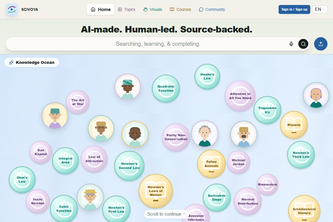
What it appears to be: A platform for hosting, organizing, and reviewing AI-generated knowledge content (videos, visuals, courses) in a searchable, multilingual, community-driven environment. It is described as a "layer after generation" — not a generator itself, but a repository and curation layer for AI-created educational media.
What changed: The project was built during a hackathon and is presented as a working prototype with seeded demo content. No revenue, customers or traction are evidenced. The author states that the prototype includes Topics, Visuals, Courses, Community, source packs, creator profiles, multilingual navigation, and browser-based interactive models.
Single most important open question: Is there a viable commercial model for hosting, curating, and reviewing AI-generated educational content at scale? The description does not indicate how this would be monetized or whether the platform has any real user base or demand beyond demo content.
What The Product Actually Is
The description states that SCIVOYA is:
- A trusted home for AI-made knowledge content.
- A searchable, multilingual knowledge ocean.
- A platform where topics provide video-based explanations.
- A place for visuals that let learners manipulate ideas and variables.
- A system that organizes media into guided learning paths (courses).
- A community-driven space for requests, discussion, correction, and contributor recognition.
It is described as not being another generator but a "layer after generation" — where AI-made knowledge becomes searchable, reviewable, interactive, multilingual, and useful.
The prototype includes Topics, Visuals, Courses, Community, source packs, creator profiles, multilingual navigation, and browser-based interactive models. It was built with Next.js, React, TypeScript, and deployed on Cloudflare.
Evidence: The author’s own write-up and technology tags.
Inference: The platform is conceptualized as a repository for AI-generated educational content, not a generator.
Positioning & Claim Evolution
The description states that SCIVOYA:
- Gives AI-generated knowledge content a trusted, searchable home.
- Is not another generator but the layer after generation.
- Focuses on making AI-made learning content useful through searchability, reviewability, interactivity, and multilingual support.
- Aims to solve the problem of scattered AI-made learning content across chats, folders, and links.
Evidence: The author’s own write-up.
Inference: SCIVOYA positions itself as a curation and hosting layer for AI-generated educational media, not a creation tool. It is described as solving a problem of fragmentation in AI-generated content.
Target Customer & ICP
The description does not explicitly state the target customer or ideal customer profile (ICP).
It implies that SCIVOYA is for:
- Creators of AI-generated knowledge content.
- Learners who want to access structured, searchable, and interactive educational media.
- Communities that support correction, discussion, and contributor recognition.
Evidence: Inferred from the description’s framing of the platform as a home for AI-made content and community-driven review.
Inference: The ICP is likely educators, content creators, learners, or communities interested in structured, searchable, multilingual knowledge media.
Business Model & Pricing Evidence
The description does not state anything about pricing or business model.
It mentions that authentication, uploads, payments, and retrieval-backed Q&A are not yet implemented in the prototype.
Evidence: Not evidenced.
Inference: No commercial model is described. The platform may be intended for monetization through future features like creator payments, subscriptions, or premium content access — but this is not stated.
Technical & Delivery Signals
The description states that:
- SCIVOYA is a working public prototype built with Next.js, React, and TypeScript.
- It was deployed on Cloudflare.
- It includes Topics, Visuals, Courses, Community, source packs, creator profiles, multilingual navigation, and browser-based interactive models.
- The demo content was created using NotebookLM, NoteGPT, Google Gemini Canvas, and ChatGPT Canvas — not by SCIVOYA itself.
- During Build Week, Codex with GPT-5.6 helped inspect and repair the codebase, improve routes and responsive layouts, test interactive experiences, verify deployment, and prepare the demo.
- Product, trust, design, and content decisions remained founder-led.
Evidence: The author’s own write-up and technology tags.
Inference: The platform is built with modern web stack and uses AI tools for development. It is not a production-ready system but a prototype with seeded content.
Traction & Maturity Signals
The description states that:
- SCIVOYA is a working public prototype.
- It includes demo content created with other AI tools, not by SCIVOYA itself.
- Authentication, uploads, payments, and retrieval-backed Q&A are not yet implemented.
- The project was submitted to the OpenAI 2026 hackathon.
Evidence: The author’s own write-up.
Inference: No traction or maturity is evidenced. It is a prototype with no real users, revenue, or adoption data.
Competitive Context
The description does not provide any information about competitors or competitive context.
Evidence: Not evidenced.
Inference: No competitive positioning or market analysis is provided. The author does not reference existing platforms for hosting AI-generated educational content.
Open Questions & Risks
- No commercial model: The business model and monetization strategy are not described.
- Prototype only: The platform is a prototype with seeded demo content, not a production-ready system.
- No traction or users: No evidence of real users, customers, or adoption.
- Founder-led development: The description states that product, trust, design, and content decisions were founder-led — suggesting limited team or external input.
- Unproven demand: The platform is described as solving a problem (fragmentation of AI-generated content), but no evidence of market demand or user need is provided.
Evidence: Inferred from the lack of revenue, customers, or traction data in the description.
Questions the description leaves open
- What is the intended business model for SCIVOYA?
- How do you plan to attract and retain creators and learners?
- What are your plans for authentication, uploads, payments, and Q&A features?
- Do you have any user feedback or market research that supports demand for this platform?
- How will you differentiate SCIVOYA from existing platforms for hosting educational content?
- What is the timeline for moving from prototype to production-ready system?
Overall Assessment
Not evidenced.
The description does not provide sufficient information to assess whether SCIVOYA has investment or partnership potential. It is a prototype submitted to a hackathon with no evidence of traction, revenue, or commercial viability.
Confidence: Low.
Inference: The platform may have conceptual merit as a curation and hosting layer for AI-generated educational content, but without real users, monetization plans, or market validation, it cannot be assessed as a viable investment or partnership opportunity.
User Stories BotA demo video on every pull request
Get a demo video on every new feature
GitHub App that watches your pull requests and records a narrated, captioned demo.
Save time on demo prep and make informed decisions faster with a video walkthrough of every new feature.
Source
Submitted to the OpenAI 2026 hackathon on Devpost. Project home on Devpost. Back to the full gallery on Devpost.
This competitive analysis was produced by top-founders.com (opens in a new tab)
Generated by a language model from this project's public Devpost page — its tagline, the author's own write-up and any built-with tags listed there — as captured in August 2026. Short quotations are the author's words. It is an opinion on the idea as a business, not on the people behind it, and it reflects the description as published then. If the project has moved on, request a correction below. The analysis is not independent research and contains no verified traction, revenue or customer data.
An independent guide by KFG International LLC — not affiliated with, endorsed by, or connected to Devpost or OpenAI.