

Archive position — measured, not model output
0 likes on Devpost
2,263 of the 7,850 archived projects have more likes, and 5,587 share exactly 0 — so this project's #6,572 place in the like-ranked listing is a tie-break inside that group, not a ranking.
Projects (log scale)
Likes on Devpost. ▲ marks this project's group.
Show the figures
| Likes | Projects | Share of archive |
|---|---|---|
| 0 | 5,587 | 71.2% |
| 1 | 1,758 | 22.4% |
| 2 | 284 | 3.6% |
| 3–4 | 132 | 1.7% |
| 5–9 | 75 | 1.0% |
| 10+ | 14 | 0.2% |
 User Stories BotA demo video on every pull request
Get a demo video on every new feature
GitHub App that watches your pull requests and records a narrated, captioned demo.
Save time on demo prep and make informed decisions faster with a video walkthrough of every new feature.
Executive Summary
What the company appears to be
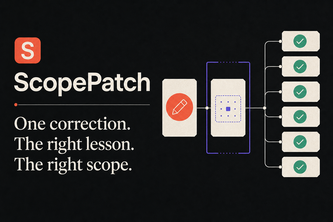
ScopePatch is a governance layer for AI agents that enables safe, testable learning from human feedback. The author describes it as a system that converts human corrections into scoped, regression-tested behavior patches, with an emphasis on preventing overgeneralization and ensuring deterministic validation.
What changed
The project description indicates this is a hackathon submission (OpenAI 2026) with a reference implementation in a meal-planning domain. It presents a conceptual framework for controlled agent learning that includes patch lifecycle management, version control, and human approval workflows.
Single most important open question
Does ScopePatch have any commercial traction or evidence of real-world adoption beyond the hackathon prototype?
Note: This analysis is based entirely on the self-reported project description provided by the caller. No independent verification, revenue data, customer names, or historical evidence are available. All claims in this report are stated as "the author states X" and not proven facts.
What The Product Actually Is
The description states that ScopePatch:
- Converts human corrections into scoped, regression-tested behavior patches.
- Operates as a governance layer for safe agent learning.
- Includes a reference application (weekly Meal Planner) that demonstrates:
- Storing original run, correction, and policy version as evidence
- Multiple explanations for user edits
- Counterfactual questions to distinguish conditional rules from global preferences
- Smallest supported policy change proposals
- Regression testing against positive, negative, boundary, and historical cases
- Deterministic constraint validation (budget, ingredient expiry, calendar conflicts)
- Explicit human approval before persistence
- Immutable policy versions with audit history and rollback support
The system is built using Next.js/Vinext, TypeScript, Zod schemas, SQLite, and integrates with Codex/GPT-5.6 for development assistance.
Inference: The product appears to be a conceptual framework or prototype for managing AI agent learning in a controlled way, not a production-ready SaaS offering.
Positioning & Claim Evolution
The author states that ScopePatch addresses the problem of persistent agents needing to learn from human feedback without creating new risks such as:
- Ignoring corrections
- Overgeneralizing changes (e.g., replacing salmon permanently after one late night)
- Silent behavior change due to broad learning
They position it as a governance layer focused on:
- Correct abstraction
- Scope control
- Regression testing
- Human approval
- Immutable history and rollback
The claim evolution shows a shift from "learning" to "controlled learning" — emphasizing that while models can propose lessons, they cannot approve or persist changes directly.
Inference: The positioning reflects an attempt to solve a real concern in AI agent safety but is presented as a prototype solution rather than a commercial product.
Target Customer & ICP
The description does not identify specific target customers or personas. It mentions:
- A reference application for meal planning
- Potential use cases in coding agents, customer-support agents, and internal business automations
It implies ScopePatch could be used by developers or teams building AI agents who want to ensure safe learning from human feedback.
Inference: The ICP is not clearly defined beyond a general audience of AI agent builders or developers working with LLMs in controlled environments. No evidence of specific customer segments or use cases beyond the hackathon demo.
Business Model & Pricing Evidence
There is no evidence of pricing, revenue models, or monetization strategies in the description.
The author mentions:
- Extracting the engine into an SDK
- Adding pluggable policy stores and evaluation runners
- Supporting team approval policies
But no indication of how this would be sold or priced.
Inference: No business model or pricing evidence is provided. The project seems to be a proof-of-concept, not a commercial offering.
Technical & Delivery Signals
The author states that ScopePatch includes:
- Zod schemas for data validation
- Explicit patch state machine
- Allow-listed JSON policy operations
- Engine-owned IDs and base versions
- Shared candidate-policy executor used for both evaluation and production
- Deterministic domain validation
- SQLite persistence for local development
- Immutable policy versions and append-only audit events
- Optimistic version checks and stale-patch blocking
- Rollback implemented as a new version rather than destructive history rewriting
It was built with Next.js, TypeScript, Codex/GPT-5.6, and other technologies.
Inference: The technical architecture suggests a well-thought-out system for managing AI agent learning with strong controls around data integrity and change management. However, this is a prototype, not a scalable product.
Traction & Maturity Signals
The description states that the project:
- Completed a full correction-to-learning workflow
- Demonstrated scoped clarification through counterfactual questions
- Included positive and protected-behavior regression evaluation
- Had explicit human approval before persistence
- Supported immutable versions, audit history, and rollback
- Included 28 automated core and service tests
- Was rendered in production build with browser and HTTP verification
It was submitted to the OpenAI 2026 hackathon.
Inference: The project shows maturity in terms of architecture and workflow design but lacks evidence of real-world adoption, customer feedback, or commercial traction beyond the hackathon context.
Competitive Context
The description does not mention any competitors or direct market positioning. It focuses on solving a problem related to AI agent learning safety rather than competing with existing tools.
Inference: No competitive landscape is described. The project appears to address a niche area of AI governance without clear alignment to known players in the space.
Open Questions & Risks
Key risks and open questions based on the description:
- Prototype-only: This is a hackathon submission with no evidence of commercial deployment or traction.
- No revenue or customer data: No indication of monetization, users, or market demand.
- Unverified claims: All features are described as "the author states" — none are independently verified.
- Limited scope: The reference application is limited to meal planning; no evidence of broader applicability or scalability.
- Dependency on AI tools: Heavy reliance on Codex/GPT-5.6 for development, which may not be a sustainable long-term solution.
Inference: The project lacks commercial viability indicators and appears to be an experimental concept rather than a viable business.
Questions the description leaves open
- What is the intended path from this prototype to a commercial product?
- Are there any early adopters or pilot customers using ScopePatch in real-world settings?
- How does the system scale beyond a single developer's use case?
- What are the technical limitations of the current architecture that would prevent production deployment?
- Is there a plan for monetization, and if so, how will it be priced?
- How do you intend to validate the effectiveness of the governance layer in practice?
Note: These questions aim to uncover gaps between the prototype and commercial reality.
Overall Assessment
The author states that ScopePatch is a hackathon submission with no evidence of commercial traction or revenue. It presents an interesting concept for AI agent learning safety but lacks:
- Any customer base
- Revenue or pricing models
- Evidence of real-world adoption
- Scalability beyond the prototype
- Clear path to monetization
Inference: This is a conceptual prototype with strong technical design, but not a viable investment or partnership opportunity at this stage. It may have potential as a future product, but current evidence supports only its status as an experimental idea.
User Stories BotA demo video on every pull request
Get a demo video on every new feature
GitHub App that watches your pull requests and records a narrated, captioned demo.
Save time on demo prep and make informed decisions faster with a video walkthrough of every new feature.
Source
Submitted to the OpenAI 2026 hackathon on Devpost. Project home on Devpost. Back to the full gallery on Devpost.
This competitive analysis was produced by top-founders.com (opens in a new tab)
Generated by a language model from this project's public Devpost page — its tagline, the author's own write-up and any built-with tags listed there — as captured in August 2026. Short quotations are the author's words. It is an opinion on the idea as a business, not on the people behind it, and it reflects the description as published then. If the project has moved on, request a correction below. The analysis is not independent research and contains no verified traction, revenue or customer data.
An independent guide by KFG International LLC — not affiliated with, endorsed by, or connected to Devpost or OpenAI.