

Archive position — measured, not model output
0 likes on Devpost
2,263 of the 7,850 archived projects have more likes, and 5,587 share exactly 0 — so this project's #6,574 place in the like-ranked listing is a tie-break inside that group, not a ranking.
Projects (log scale)
Likes on Devpost. ▲ marks this project's group.
Show the figures
| Likes | Projects | Share of archive |
|---|---|---|
| 0 | 5,587 | 71.2% |
| 1 | 1,758 | 22.4% |
| 2 | 284 | 3.6% |
| 3–4 | 132 | 1.7% |
| 5–9 | 75 | 1.0% |
| 10+ | 14 | 0.2% |
 User Stories BotA demo video on every pull request
Get a demo video on every new feature
GitHub App that watches your pull requests and records a narrated, captioned demo.
Save time on demo prep and make informed decisions faster with a video walkthrough of every new feature.
Executive Summary
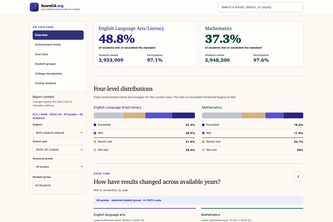
ScoreCA.org is a self-reported public data explorer for California education outcomes, built as a static website using Astro and React. The platform allows users to search for counties, districts, or schools and view official educational data through charts, tables, and contextual notes. It presents data across three checkpoints: grade-11 proficiency, graduate readiness, and college enrollment. The project was developed by two team members (Hanyu Xiao and Julian Xiao) with assistance from AI tools like Codex and GPT-5.6. The description states that the site includes over 36 million records, 14,000 searchable reports, and 18,000 structured data files.
The single most important open question is: What is the actual reach or usage of ScoreCA.org, and how does it engage with its intended audience?
This analysis is based entirely on the self-reported description provided by the authors. No independent verification, revenue, customer data, or traction metrics are available beyond what they state.
What The Product Actually Is
The description states that ScoreCA.org is a public data explorer for California education outcomes. It allows users to search for entities such as counties, districts, or schools and view official published results via charts, tables, and source notes. The platform supports student-group views comparing outcomes by race, ethnicity, economic disadvantage, English-learner status, disability, and other categories where the source data supports it.
It maps educational progress across three checkpoints:
- Grade-11 proficiency (CAASPP)
- Graduate readiness (California College/Career Indicator)
- College enrollment (California College-Going Rate)
The site is built as a static website using Astro and React, with support from AI tools like Codex and GPT-5.6 during development.
Evidence The project description explicitly describes the product’s functionality, structure, and technical stack.
Positioning & Claim Evolution
The authors claim that ScoreCA.org is a "public utility" designed to make California's public school data accessible to families and communities who otherwise cannot interpret raw datasets. They describe it as an effort to transform complex, unstructured spreadsheets into clear visualizations and plain-language context.
They also state that the platform does not focus on a single standardized test but instead maps the educational journey across three key checkpoints: proficiency, readiness, and enrollment.
Inference The positioning appears to be one of civic data transparency and accessibility, aimed at empowering parents, educators, and researchers with clear insights into California’s education system.
Evidence The project description includes these claims directly.
Target Customer & ICP
The description states that ScoreCA.org is intended for families, educators, and researchers who want to understand California's public school data. It also mentions that the platform supports comparisons by demographic groups such as race, ethnicity, economic disadvantage, English-learner status, and disability.
Inference The primary user personas likely include parents seeking information about local schools, educators analyzing performance trends, and researchers studying educational equity.
Evidence The description identifies these audiences and their needs but does not provide specific segmentation or prioritization.
Business Model & Pricing Evidence
Not evidenced.
The description does not mention any pricing model, monetization strategy, or business model. It is presented as a public utility without indication of commercial activity.
Technical & Delivery Signals
ScoreCA.org is built using:
- Static site generator: Astro
- Frontend framework: React
- Development tools: Codex and GPT-5.6
- Language stack: TypeScript, HTML, CSS
The authors describe an off-band data pipeline that generates validated artifacts used by the static site. The implementation involved iterative development stages including planning, scaffolding, integration, interface design, testing, and build verification.
Evidence The description details the technical architecture and tooling used in building the product.
Traction & Maturity Signals
Not evidenced.
There is no mention of user engagement, traffic metrics, or adoption rates. The authors describe the scale of data processed (36 million records) and outputs generated (14,000 reports), but do not report on usage or impact.
Competitive Context
Not evidenced.
The description does not reference existing platforms or competitors in the space of public education data visualization or open data tools for California. No competitive landscape is described.
Open Questions & Risks
- Lack of traction evidence: The platform is described as a prototype or early-stage tool, with no indication of real-world usage or impact.
- No commercial model: There is no evidence of monetization or revenue streams; the product is presented as a public utility.
- Dependency on AI tools: Heavy reliance on AI for development may raise questions about scalability and long-term maintainability if those tools change or become unavailable.
- Data complexity and accuracy risks: The project handles large volumes of diverse datasets with varying schemas, privacy rules, and reporting periods. Any misinterpretation could lead to misleading conclusions.
Questions the description leaves open
- How many unique users does ScoreCA.org have per month?
- What is the source of the data used in ScoreCA.org? Is it updated regularly?
- Are there any known issues with data accuracy or completeness that affect usability?
- Has the platform been tested with actual users (e.g., parents, educators)?
- How do you plan to sustain the project beyond its initial development phase?
- What are your long-term goals for ScoreCA.org? Is it intended to evolve into a commercial product or remain a public tool?
Overall Assessment
Not evidenced.
There is no information provided about funding, valuation, or investment interest in ScoreCA.org. The project is described as a hackathon submission and does not indicate any formal business structure or investor engagement.
User Stories BotA demo video on every pull request
Get a demo video on every new feature
GitHub App that watches your pull requests and records a narrated, captioned demo.
Save time on demo prep and make informed decisions faster with a video walkthrough of every new feature.
Source
Submitted to the OpenAI 2026 hackathon on Devpost. Project home on Devpost. Back to the full gallery on Devpost.
This competitive analysis was produced by top-founders.com (opens in a new tab)
Generated by a language model from this project's public Devpost page — its tagline, the author's own write-up and any built-with tags listed there — as captured in August 2026. Short quotations are the author's words. It is an opinion on the idea as a business, not on the people behind it, and it reflects the description as published then. If the project has moved on, request a correction below. The analysis is not independent research and contains no verified traction, revenue or customer data.
An independent guide by KFG International LLC — not affiliated with, endorsed by, or connected to Devpost or OpenAI.