

Archive position — measured, not model output
0 likes on Devpost
2,263 of the 7,850 archived projects have more likes, and 5,587 share exactly 0 — so this project's #6,575 place in the like-ranked listing is a tie-break inside that group, not a ranking.
Projects (log scale)
Likes on Devpost. ▲ marks this project's group.
Show the figures
| Likes | Projects | Share of archive |
|---|---|---|
| 0 | 5,587 | 71.2% |
| 1 | 1,758 | 22.4% |
| 2 | 284 | 3.6% |
| 3–4 | 132 | 1.7% |
| 5–9 | 75 | 1.0% |
| 10+ | 14 | 0.2% |
 User Stories BotA demo video on every pull request
Get a demo video on every new feature
GitHub App that watches your pull requests and records a narrated, captioned demo.
Save time on demo prep and make informed decisions faster with a video walkthrough of every new feature.
Executive Summary
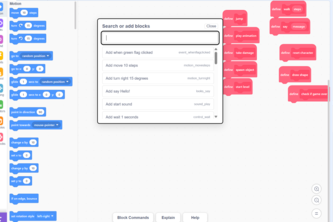
Project: Scratch BrightBlocks
Author's Claim: An accessible coding environment built on Scratch, designed to help children (ages 6–10) who cannot read, as well as visually impaired users. The project integrates voice, AI assistance, and keyboard control into a block-based coding interface. It is intended for educators and STEM workshop facilitators.
What Changed: The author reports that this is an attempt to solve challenges they encountered in their role as a STEM educator — specifically, teaching coding to non-readers and managing large groups of students. The project also emerged from personal experience with a visually impaired child.
Single Most Important Open Question: Is there any evidence of actual usage or adoption by educators or children? The description does not include any data on user engagement, feedback, or impact beyond the author’s own account.
What The Product Actually Is
The description states that Scratch BrightBlocks is an accessible coding environment built on Scratch, integrating voice, AI assistance, and keyboard control. It is described as a tool aimed at making block-based programming more accessible to children who cannot yet read and to visually impaired users.
It was built using the following technologies:
- ChatGPT
- Codex
- CSS
- HTML5
- Node.js
- React
The author notes that it is based on open-source software and will be offered for free, in keeping with open-source principles.
Inference: The product appears to be a prototype or proof-of-concept rather than a fully developed commercial offering. It integrates AI tools (ChatGPT, Codex) into an existing Scratch-based interface.
Positioning & Claim Evolution
The author states that the project was inspired by two main challenges:
- Teaching coding blocks in Scratch to children who cannot read.
- Managing large groups of students during workshops.
Additionally, the author’s personal experience with a visually impaired child led them to consider accessibility for people with visual impairments.
Inference: The positioning evolved from solving a specific classroom problem to broader accessibility concerns — including both non-readers and visually impaired users. However, there is no evidence that this evolution has been tested or validated in real-world settings.
Target Customer & ICP
The author identifies the following target groups:
- Children aged 6–10 years old
- STEM workshop educators
- Visually impaired individuals (specifically those who may use block-based coding)
There is no indication of segmentation beyond these broad categories. No specific customer personas, buyer roles, or decision-makers are described.
Inference: The primary user base appears to be children and educators in informal learning environments such as workshops. There is no evidence of a formal ICP (Ideal Customer Profile) or defined buyer journey.
Business Model & Pricing Evidence
The author states that the tool will be offered for free, aligning with open-source principles. No pricing model, monetization strategy, or revenue streams are mentioned.
Inference: The project is not intended to generate revenue and is presented as a non-profit initiative. There is no evidence of any business model beyond its use in educational settings.
Technical & Delivery Signals
The author reports that the tool was built using:
- ChatGPT
- Codex
- CSS
- HTML5
- Node.js
- React
It is described as a block-based coding environment, extending Scratch. The integration includes voice, AI assistance, and keyboard control.
Inference: The project uses modern web technologies and AI tools to enhance an existing platform (Scratch). However, no details are provided on how these features are implemented or whether they are fully functional.
Traction & Maturity Signals
The author describes the project as a personal initiative, built by one person (Jasen Lakic), with no mention of users, adoption, or feedback. There is no evidence of any traction, such as:
- Number of users
- Feedback from educators or children
- Usage metrics
- Product iterations
Inference: The project appears to be at a very early stage — likely a prototype or hackathon submission — with no demonstrated traction or user engagement.
Competitive Context
The author does not reference any competitors. However, the project is built on Scratch, which is widely used in education and has an established ecosystem. Other tools in this space may include:
- Tynker
- Blockly
- Code.org
But no comparison or differentiation from these tools is made.
Inference: The competitive landscape includes existing block-based coding platforms, but there is no evidence of how Scratch BrightBlocks differentiates itself or competes within it.
Open Questions & Risks
- No verified users or adoption: The project has not been tested in real-world environments.
- Unproven accessibility features: While the author claims to support visually impaired users, there is no evidence of testing or validation.
- Non-commercial nature: The tool is intended to be free and non-profit, which may limit long-term sustainability or scalability.
- Single-person development: The project was built by one individual, suggesting limited resources or team capacity for further development.
- No revenue or monetization strategy: This could be a barrier if the goal is to scale beyond a personal initiative.
Questions the description leaves open
- What specific feedback have you received from educators or children using this tool?
- How do you plan to validate that the AI assistance actually helps without giving away answers?
- Have you tested the voice and keyboard control features with your target users?
- What is the long-term vision for the project beyond its current form?
- Are there any plans to collaborate with schools or educational institutions?
- How do you intend to ensure accessibility for visually impaired users, and what testing has been done?
Overall Assessment
Not evidenced: There is no evidence of a commercial model, revenue, or traction that would support an investment or partnership decision.
Inference: Given the self-reported nature of the description and lack of any measurable impact or user feedback, this project appears to be a personal initiative with limited commercial viability. It may have potential for educational impact but does not present a clear path to scalable or monetizable value.
User Stories BotA demo video on every pull request
Get a demo video on every new feature
GitHub App that watches your pull requests and records a narrated, captioned demo.
Save time on demo prep and make informed decisions faster with a video walkthrough of every new feature.
Source
Submitted to the OpenAI 2026 hackathon on Devpost. Project home on Devpost. Back to the full gallery on Devpost.
This competitive analysis was produced by top-founders.com (opens in a new tab)
Generated by a language model from this project's public Devpost page — its tagline, the author's own write-up and any built-with tags listed there — as captured in August 2026. Short quotations are the author's words. It is an opinion on the idea as a business, not on the people behind it, and it reflects the description as published then. If the project has moved on, request a correction below. The analysis is not independent research and contains no verified traction, revenue or customer data.
An independent guide by KFG International LLC — not affiliated with, endorsed by, or connected to Devpost or OpenAI.