

Archive position — measured, not model output
0 likes on Devpost
2,263 of the 7,850 archived projects have more likes, and 5,587 share exactly 0 — so this project's #6,576 place in the like-ranked listing is a tie-break inside that group, not a ranking.
Projects (log scale)
Likes on Devpost. ▲ marks this project's group.
Show the figures
| Likes | Projects | Share of archive |
|---|---|---|
| 0 | 5,587 | 71.2% |
| 1 | 1,758 | 22.4% |
| 2 | 284 | 3.6% |
| 3–4 | 132 | 1.7% |
| 5–9 | 75 | 1.0% |
| 10+ | 14 | 0.2% |
 User Stories BotA demo video on every pull request
Get a demo video on every new feature
GitHub App that watches your pull requests and records a narrated, captioned demo.
Save time on demo prep and make informed decisions faster with a video walkthrough of every new feature.
Executive Summary
What the company appears to be
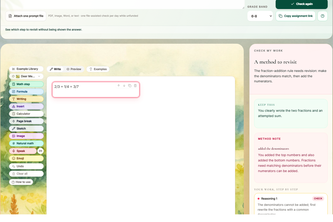
Scratchpad is a self-reported educational tool for K–12 math instruction that allows students to author math stories using structured blocks (equations, tape models, art, etc.) and receive AI-powered feedback on their work. It integrates with GPT-5.6 Sol for checking steps, identifying misconceptions, and coaching students without revealing answers.
What changed
The project evolved from a basic math authoring tool into one that includes an AI-powered "Check my work" feature using GPT-5.6 Sol, enabling real-time feedback on student-created math content including stories and models.
Single most important open question
Is there evidence of actual classroom adoption or usage by students and teachers beyond the author’s own teaching context?
What The Product Actually Is
The description states that Scratchpad is a free, no-login page where students arrange equations, tape models, ten-frames, number lines, long division, proofs, two-way tables, story text, art, and page breaks for long illustrated math stories. Every part remains machine-readable.
It also states that the tool connects to GPT-5.6 Sol to provide feedback on student work, including:
- Step-by-step analysis
- Misconception identification ("added the denominators")
- Feedback tied to exact steps
- Support for both story and calculation-based inputs
- Ability to generate prompts based on grade band and standards
The tool is built using technologies such as React, Node.js, Supabase, Vercel, TailwindCSS, TypeScript, OpenAI API, and Codex.
Inference The product appears to be a web-based math authoring and feedback platform designed for K–12 education. It is not a commercial SaaS offering but rather an open-source or prototype tool built for personal use by the founder.
Positioning & Claim Evolution
The author claims that Scratchpad addresses two core problems in math education:
- Current autograders only check answers, not thinking.
- Worksheets bore students who enjoy math most.
It positions itself as a way to let students "tell stories with math" and provide useful feedback on both the story and its math together.
The evolution described shows a shift from a basic authoring tool to one that incorporates AI for checking work and providing coaching feedback.
Claim
The tool is positioned as a free, no-login educational resource aimed at helping students engage more deeply with mathematical thinking through storytelling.
Target Customer & ICP
The description states that the primary users are:
- Students in K–12 classrooms
- Teachers who want to give detailed feedback on student work
- Tutors or study partners who support learning
It also mentions that the tool supports "every part remains machine-readable" and allows students to write in their own language, including Spanish.
Inference The ICP likely includes educators teaching math in elementary through middle school grades, particularly those interested in integrating storytelling into math instruction.
Business Model & Pricing Evidence
The description explicitly states that Scratchpad is:
- Free
- No login required
- Does not collect student data
There is no mention of any pricing model or monetization strategy. The author notes that funding through prizes, OpenAI credit support, or donations would allow raising file-reading limits while keeping the tool free and login-free.
Claim
The business model is currently non-commercial — it is a free educational tool with no revenue streams.
Technical & Delivery Signals
The project uses:
- GPT-5.6 Sol for feedback generation
- Codex for integration and planning
- React, Node.js, Supabase, Vercel, TailwindCSS, TypeScript, OpenAI API
- Serverless architecture
- LaTeX/KaTeX rendering
- Stable IDs for steps to ensure accurate referencing
It supports:
- Machine-readable components (equations, models)
- Feedback tied to specific steps
- Prompt generation based on grade level and standards
- File reading with rate limits
- Mobile layout considerations
- Accessibility features
Inference The technical stack suggests a lightweight, serverless web application built for educational use. It is not described as scalable or enterprise-grade.
Traction & Maturity Signals
The description does not provide any evidence of:
- Revenue
- Customers
- Adoption metrics
- Usage data
- User base size
- Product maturity beyond prototype stage
It mentions that the author tested "twenty different student pages across four grade bands, all forty-nine Scratchpad formats, and seven complete product flows."
However, this is not sufficient to indicate traction or market validation.
Claim
No evidence of traction or user adoption beyond the author’s own classroom use.
Competitive Context
The description does not mention any competitors. It focuses on solving a gap in current autograders and worksheet-based instruction.
Inference The competitive landscape is unclear, but it likely overlaps with tools for math education, AI-powered grading systems, or storytelling platforms for learning.
Open Questions & Risks
- No revenue model or monetization plan: The tool is free and lacks commercial viability.
- Single founder: Only one team member (Jason Mortensen) is listed.
- Self-funded feature: The AI integration relies on self-funding, which may limit scalability.
- Limited testing scope: Testing was done within the author’s classroom context only.
- Unverified claims: All statements are self-reported and unverified.
Open question
The lack of any commercial or user traction raises questions about long-term viability or market demand.
Questions the description leaves open
- What is the actual classroom usage beyond your own teaching?
- How many students have used the tool outside of your class?
- Are there plans to monetize or scale the product beyond its current prototype stage?
- Has the AI feedback been validated by other educators or researchers?
- What are the technical limitations of the current implementation that could prevent scaling?
Overall Assessment
Not evidenced.
There is no evidence of:
- Revenue
- Customers
- Traction
- Market validation
- Commercial viability
The tool is described as a prototype built for personal use by one individual, with no indication of broader adoption or business development.
Inference This is not a viable investment or partnership opportunity at this time. It may be suitable for educational pilot programs or further development, but lacks commercial due-diligence signals.
User Stories BotA demo video on every pull request
Get a demo video on every new feature
GitHub App that watches your pull requests and records a narrated, captioned demo.
Save time on demo prep and make informed decisions faster with a video walkthrough of every new feature.
Source
Submitted to the OpenAI 2026 hackathon on Devpost. Project home on Devpost. Back to the full gallery on Devpost.
This competitive analysis was produced by top-founders.com (opens in a new tab)
Generated by a language model from this project's public Devpost page — its tagline, the author's own write-up and any built-with tags listed there — as captured in August 2026. Short quotations are the author's words. It is an opinion on the idea as a business, not on the people behind it, and it reflects the description as published then. If the project has moved on, request a correction below. The analysis is not independent research and contains no verified traction, revenue or customer data.
An independent guide by KFG International LLC — not affiliated with, endorsed by, or connected to Devpost or OpenAI.