

Archive position — measured, not model output
0 likes on Devpost
2,263 of the 7,850 archived projects have more likes, and 5,587 share exactly 0 — so this project's #2,652 place in the like-ranked listing is a tie-break inside that group, not a ranking.
Projects (log scale)
Likes on Devpost. ▲ marks this project's group.
Show the figures
| Likes | Projects | Share of archive |
|---|---|---|
| 0 | 5,587 | 71.2% |
| 1 | 1,758 | 22.4% |
| 2 | 284 | 3.6% |
| 3–4 | 132 | 1.7% |
| 5–9 | 75 | 1.0% |
| 10+ | 14 | 0.2% |
 User Stories BotA demo video on every pull request
Get a demo video on every new feature
GitHub App that watches your pull requests and records a narrated, captioned demo.
Save time on demo prep and make informed decisions faster with a video walkthrough of every new feature.
Executive Summary
Company: AnimateMath AI
Self-reported basis: The entire analysis is based on a single project description submitted by the author to the OpenAI 2026 hackathon on Devpost. No independent verification, revenue, customer data or traction evidence is available.
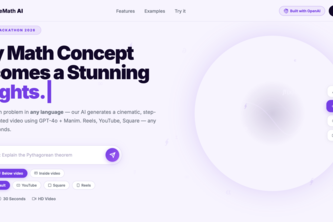
What it appears to be: A tool that converts natural language math prompts into animated educational videos using AI and Manim.
What changed: The author describes a personal journey from self-taught programming to building a product aimed at democratizing mathematical animation creation.
Most important open question: Is there sufficient evidence of demand or early traction to justify further investment or partnership, or is this an unproven idea with no demonstrated market need?
What The Product Actually Is
The description states that AnimateMath AI:
- Transforms text prompts into complete mathematical animations.
- Uses GPT-4o to generate Manim code and educational explanations.
- Renders animations in the cloud.
- Returns ready-to-use MP4 videos in seconds.
- Works without requiring users to know coding, Manim, or LaTeX.
It is described as a web-based tool built with HTML, CSS, JavaScript, Node.js, Express.js, and Manim, using OpenAI’s GPT-4o API.
Inference: The product appears to be a proof-of-concept or early-stage prototype, not yet a commercial offering. It is not evidenced to have launched publicly or gained users.
Positioning & Claim Evolution
The author states that AnimateMath AI was born from a personal need to create educational math animations for their sister’s business and later evolved into an idea to make such tools accessible to everyone without programming knowledge.
Claims include:
- “What if anyone could create beautiful math animations without learning Manim or programming?”
- “Made advanced mathematical visualization accessible to teachers, students, and content creators with no programming experience.”
- “Turned my own learning experience into a product that can help thousands of others.”
Inference: The positioning is educational tooling for non-technical users. It is not evidenced to have evolved from an existing product or market offering.
Target Customer & ICP
The description states:
- Teachers, students, and content creators with no programming experience.
- Users who want to explain math concepts visually.
- A specific audience in Kazakhstan, especially in the Kazakh language.
Inference: The ICP appears to be educators and learners in a localized context (Kazakhstan), though the author mentions plans to expand into multiple languages. No evidence of broader market targeting or customer segmentation beyond this.
Business Model & Pricing Evidence
The description does not state anything about pricing, monetization, or business model.
Not evidenced: There is no mention of subscriptions, freemium tiers, B2B or B2C models, or any commercial strategy.
Technical & Delivery Signals
The project uses:
- GPT-4o for code generation and explanation.
- Manim for rendering animations.
- A Python backend to validate and execute generated code.
- Cloud processing for video rendering.
- A web interface built with HTML, CSS, JavaScript, and Node.js.
- ffmpeg for video processing.
Inference: The tool is described as a working prototype, but no evidence of scalability, reliability, or performance metrics is provided. It was built in a hackathon context and may not be production-ready.
Traction & Maturity Signals
The description states:
- The project was submitted to the OpenAI 2026 hackathon.
- It was built over six months by one person (the founder).
- It has no revenue, customer base, or adoption data.
- The team size is listed as one.
Not evidenced: No evidence of traction, usage, or market validation. The project is described as a prototype with no commercial deployment.
Competitive Context
The description does not mention any competitors or existing solutions in the space of AI-generated math animations or educational video tools.
Not evidenced: No competitive analysis or positioning relative to other tools is provided.
Open Questions & Risks
- Unproven demand: No evidence of market need, customer feedback, or early traction.
- Single-founder risk: The project was built by one person; no team or business structure is evident.
- Technical fragility: Challenges with AI-generated code rendering and LaTeX issues are noted but not resolved in the description.
- Limited scalability: The tool is described as a hackathon prototype, not a scalable product.
- No monetization strategy: No pricing, revenue model, or commercial plan is presented.
Questions the description leaves open
- What specific feedback have you received from teachers, students, or content creators who tried the tool?
- Have you conducted any user testing or surveys to validate demand for this product?
- How do you plan to scale beyond a single-person hackathon prototype?
- What is your roadmap for monetization and pricing?
- Are there any existing partnerships or early adopters in the educational space?
- What are the technical limitations of GPT-4o that prevent full automation, and how do you plan to address them?
Overall Assessment
Not evidenced: There is no evidence of commercial traction, revenue, customer base, or validated market demand.
The project is described as a hackathon prototype built by one person. It is not demonstrated to have reached product-market fit or any form of commercial viability.
Confidence level: Low. The description is self-reported and lacks any verifiable data on users, adoption, or business metrics.
Conclusion: This is an unproven idea with no demonstrated traction or commercial readiness. Further due diligence would require evidence of early user feedback, market validation, or a clear path to monetization.
User Stories BotA demo video on every pull request
Get a demo video on every new feature
GitHub App that watches your pull requests and records a narrated, captioned demo.
Save time on demo prep and make informed decisions faster with a video walkthrough of every new feature.
Source
Submitted to the OpenAI 2026 hackathon on Devpost. Project home on Devpost. Back to the full gallery on Devpost.
This competitive analysis was produced by top-founders.com (opens in a new tab)
Generated by a language model from this project's public Devpost page — its tagline, the author's own write-up and any built-with tags listed there — as captured in August 2026. Short quotations are the author's words. It is an opinion on the idea as a business, not on the people behind it, and it reflects the description as published then. If the project has moved on, request a correction below. The analysis is not independent research and contains no verified traction, revenue or customer data.
An independent guide by KFG International LLC — not affiliated with, endorsed by, or connected to Devpost or OpenAI.