

Archive position — measured, not model output
0 likes on Devpost
2,263 of the 7,850 archived projects have more likes, and 5,587 share exactly 0 — so this project's #2,647 place in the like-ranked listing is a tie-break inside that group, not a ranking.
Projects (log scale)
Likes on Devpost. ▲ marks this project's group.
Show the figures
| Likes | Projects | Share of archive |
|---|---|---|
| 0 | 5,587 | 71.2% |
| 1 | 1,758 | 22.4% |
| 2 | 284 | 3.6% |
| 3–4 | 132 | 1.7% |
| 5–9 | 75 | 1.0% |
| 10+ | 14 | 0.2% |
 User Stories BotA demo video on every pull request
Get a demo video on every new feature
GitHub App that watches your pull requests and records a narrated, captioned demo.
Save time on demo prep and make informed decisions faster with a video walkthrough of every new feature.
Executive Summary
What the company appears to be
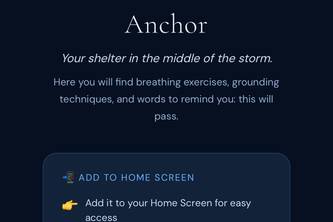
Anchor is a self-reported web application built during an OpenAI hackathon, designed to provide calm, grounding support during panic attacks. It offers breathing guidance, affirmations, and explanations of panic attack symptoms, using AI tools (Codex, GPT) for development and content structuring.
What changed
The project was submitted as a hackathon entry in 2026. No evidence suggests it has moved beyond prototype or gained traction since then.
Single most important open question
Is there any evidence of user adoption, revenue, or product-market fit beyond the author’s personal experience and self-reported development?
What The Product Actually Is
The description states:
- Anchor is a simple web app.
- It provides guided breathing exercises, grounding techniques, calming affirmations, and explanations of panic attack symptoms.
- It is built using Codex, GPT, Next.js, React, TailwindCSS, TypeScript, Netlify, OpenAI, and other modern web technologies.
Inference The product appears to be a lightweight, AI-assisted mental health support tool, likely intended for use during acute anxiety or panic episodes. It is not described as a full-fledged SaaS platform or marketplace.
Positioning & Claim Evolution
The description states:
- Anchor is positioned as "Your AI anchor during panic attacks".
- It aims to offer calm, grounding exercises, breathing guidance, and personalized support when you need it most.
- It is described as a supportive tool, not a replacement for professional help.
Inference The positioning is centered on emotional support during crisis moments, with an emphasis on accessibility and simplicity. The claim of being “personalized” is not substantiated by evidence, but the author implies customization may be part of future development.
Target Customer & ICP
The description states:
- The app is intended for people who experience panic attacks or anxiety.
- It is designed to help users slow down, breathe, and feel grounded during difficult moments.
- It is aimed at those who may feel overwhelmed or alone.
Inference The target customer is likely individuals with personal experience of panic attacks or anxiety, possibly including those seeking low-barrier mental health support. No evidence of segmentation or targeting specific demographics beyond this.
Business Model & Pricing Evidence
The description states:
- Anchor is described as a web app, not a paid service.
- It is built for personal use and supportive purposes.
- There is no mention of pricing, subscriptions, or monetization.
Inference No evidence of a business model or pricing structure exists in the description. The project appears to be a personal or hackathon effort with no commercial intent described.
Technical & Delivery Signals
The description states:
- Built using Codex, GPT, Next.js, React, TailwindCSS, TypeScript, Netlify, OpenAI.
- AI tools were used for content structuring, code development, and interface refinement.
- The app is a web app, not a mobile or desktop product.
Inference The technical stack suggests a modern, lightweight web-based experience. The use of AI in development indicates an experimental or prototype approach, but no evidence of scalability or production-grade infrastructure.
Traction & Maturity Signals
The description states:
- It was built during the OpenAI 2026 hackathon.
- It is a working web app, but no evidence of user adoption or usage metrics.
- The author notes that it’s a personal project and not yet a product for sale.
Inference There is no evidence of traction, revenue, or customer base. The project appears to be in early-stage development with no signs of market validation or commercialization.
Competitive Context
The description states:
- No mention of competitors or similar tools.
- It is described as a personal tool and not a product in a competitive marketplace.
Inference No evidence of competitive landscape or positioning against other mental health apps or tools exists. The project does not appear to be part of an existing market category.
Open Questions & Risks
The description states:
- It is a personal project, built during a hackathon.
- No evidence of commercialization, funding, or team expansion.
- No mention of user feedback, testing, or clinical validation.
Inference
Key risks include:
- Lack of product-market fit or traction.
- No commercial viability or scalability.
- Potential ethical concerns around providing mental health support without professional oversight.
- No evidence of a sustainable business model or team behind the project.
Questions the description leaves open
- What is your definition of “personalized support,” and how do you plan to implement it?
- Have you tested this with users beyond yourself, and what feedback have you received?
- Are there any plans for clinical validation or partnerships with mental health professionals?
- How do you intend to scale beyond a single-person development effort?
- What are your thoughts on monetization or commercialization, if any?
Overall Assessment
The description states:
- Anchor is a personal project built during a hackathon.
- It is not described as a product with traction, revenue, or team.
- The author has no stated intention to commercialize it.
Inference There is no evidence of investment or partnership readiness. The project is in an early stage and lacks commercial viability, traction, or a clear path to market. It does not appear to be a viable target for funding or strategic partnerships at this time.
User Stories BotA demo video on every pull request
Get a demo video on every new feature
GitHub App that watches your pull requests and records a narrated, captioned demo.
Save time on demo prep and make informed decisions faster with a video walkthrough of every new feature.
Source
Submitted to the OpenAI 2026 hackathon on Devpost. Project home on Devpost. Back to the full gallery on Devpost.
This competitive analysis was produced by top-founders.com (opens in a new tab)
Generated by a language model from this project's public Devpost page — its tagline, the author's own write-up and any built-with tags listed there — as captured in August 2026. Short quotations are the author's words. It is an opinion on the idea as a business, not on the people behind it, and it reflects the description as published then. If the project has moved on, request a correction below. The analysis is not independent research and contains no verified traction, revenue or customer data.
An independent guide by KFG International LLC — not affiliated with, endorsed by, or connected to Devpost or OpenAI.