

Archive position — measured, not model output
0 likes on Devpost
2,263 of the 7,850 archived projects have more likes, and 5,587 share exactly 0 — so this project's #2,649 place in the like-ranked listing is a tie-break inside that group, not a ranking.
Projects (log scale)
Likes on Devpost. ▲ marks this project's group.
Show the figures
| Likes | Projects | Share of archive |
|---|---|---|
| 0 | 5,587 | 71.2% |
| 1 | 1,758 | 22.4% |
| 2 | 284 | 3.6% |
| 3–4 | 132 | 1.7% |
| 5–9 | 75 | 1.0% |
| 10+ | 14 | 0.2% |
 User Stories BotA demo video on every pull request
Get a demo video on every new feature
GitHub App that watches your pull requests and records a narrated, captioned demo.
Save time on demo prep and make informed decisions faster with a video walkthrough of every new feature.
Executive Summary
What the company appears to be
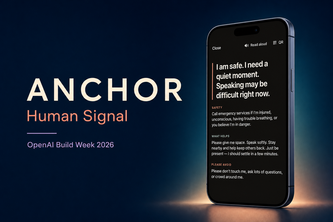
Anchor — Human Signal is a self-reported project submitted to the OpenAI 2026 hackathon. The description states it aims to help people understand how to support others when words become difficult, using AI-powered tools.
What changed
There is no evidence of prior activity or evolution beyond this single submission. The project appears to be a prototype or proof-of-concept built for a hackathon.
The single most important open question
Is there any indication that the team intends to build a product with real user adoption, or is this purely an experimental or exploratory effort?
What The Product Actually Is
The description states: “When words become difficult, Anchor helps the people around you understand how to help.” This implies a tool that interprets emotional or communication signals from individuals and translates them into actionable support suggestions for others.
However, no technical specification or functional details are provided. The author declares the use of technologies such as codex, gpt-4o-mini-tts, gpt-5.6, iOS, Node.js, OpenAI API, Swift, SwiftUI, Xcode — but does not explain how these components interact to form a product.
Evidence
- Tagline: “When words become difficult, Anchor helps the people around you understand how to help.”
- Technology stack declared: codex, gpt-4o-mini-tts, gpt-5.6, iOS, Node.js, OpenAI API, Swift, SwiftUI, Xcode
Inference The product likely involves AI interpretation of user input (possibly voice or text) and delivery of support suggestions via an iOS app.
Positioning & Claim Evolution
The author states a single claim: that Anchor helps people understand how to help others when words become difficult. This is a broad, emotionally resonant positioning statement but lacks specificity about the target audience, use case, or differentiation from existing tools.
There is no evidence of prior positioning or evolution in messaging beyond this one-line tagline.
Evidence
- Tagline: “When words become difficult, Anchor helps the people around you understand how to help.”
Inference The project may be positioned as a mental health or emotional support tool, but this is not substantiated by any further detail.
Target Customer & ICP
There is no evidence of a defined customer profile or ideal customer profile (ICP). The tagline implies a general audience — people who struggle with communication and need help understanding others’ needs. However, no segmentation or persona details are provided.
Evidence
- Tagline: “When words become difficult, Anchor helps the people around you understand how to help.”
Inference The target may include caregivers, family members, or support professionals, but this is speculative.
Business Model & Pricing Evidence
There is no evidence of a business model or pricing strategy. The project description does not mention monetization, subscriptions, licensing, or any revenue mechanism.
Evidence
- No mention of pricing, monetization, or business model
Inference If the product is commercialized, it may be a freemium or B2C model, but this is not evidenced.
Technical & Delivery Signals
The author declares that the project was built using: codex, gpt-4o-mini-tts, gpt-5.6, iOS, Node.js, OpenAI API, Swift, SwiftUI, Xcode. This suggests a hybrid AI-native and mobile application approach.
However, no details are given about architecture, scalability, or delivery mechanisms beyond the tech stack.
Evidence
- Built with: codex, gpt-4o-mini-tts, gpt-5.6, iOS, Node.js, OpenAI API, Swift, SwiftUI, Xcode
Inference The product likely involves AI processing of user input and delivery via a mobile interface, but no functional or architectural details are provided.
Traction & Maturity Signals
There is no evidence of traction, adoption, or maturity. The project was submitted to a hackathon and has no documented usage, customers, or growth metrics.
Evidence
- Submitted to OpenAI 2026 hackathon
- No mention of users, customers, or product usage
Inference The project is likely in early development or prototype stage.
Competitive Context
There is no evidence of competitive analysis or awareness of existing tools. The description does not reference competitors, similar products, or market positioning.
Evidence
- No mention of competitors or market context
Inference If the product is intended for emotional support or communication assistance, it may compete with mental health apps or AI chatbots, but this is unconfirmed.
Open Questions & Risks
- Unproven concept: The idea lacks evidence of user testing or validation.
- No business model: No indication of how the product will generate revenue.
- Limited team: Only one team member is mentioned, raising questions about execution capacity.
- Hackathon origin: The project was built for a hackathon — no indication it has evolved into a scalable product.
Evidence
- Team size: 1
- Submitted to hackathon
- No traction or revenue
Questions the description leaves open
- What specific problem are you solving, and how do you know users have this problem?
- How does the AI interpret emotional signals? Is there a defined input/output mechanism?
- What is your plan for scaling beyond the hackathon prototype?
- Are you planning to monetize this product, and if so, how?
- What are the privacy and ethical implications of interpreting user emotional data?
Overall Assessment
There is insufficient evidence to assess whether this project is a viable investment or partnership opportunity. It is a self-reported hackathon submission with no demonstrated traction, business model, or customer validation.
Evidence
- No revenue, customers, or product usage
- No business model or monetization strategy
- Only one team member
Inference This appears to be an early-stage idea or prototype. It is not evidenced as a commercial opportunity at this time.
User Stories BotA demo video on every pull request
Get a demo video on every new feature
GitHub App that watches your pull requests and records a narrated, captioned demo.
Save time on demo prep and make informed decisions faster with a video walkthrough of every new feature.
Source
Submitted to the OpenAI 2026 hackathon on Devpost. Project home on Devpost. Back to the full gallery on Devpost.
This competitive analysis was produced by top-founders.com (opens in a new tab)
Generated by a language model from this project's public Devpost page — its tagline and any built-with tags listed there, since the author published no write-up — as captured in August 2026. Short quotations are the author's words. It is an opinion on the idea as a business, not on the people behind it, and it reflects the description as published then. If the project has moved on, request a correction below. The analysis is not independent research and contains no verified traction, revenue or customer data.
An independent guide by KFG International LLC — not affiliated with, endorsed by, or connected to Devpost or OpenAI.