

Archive position — measured, not model output
1 like on Devpost
505 of the 7,850 archived projects have more likes, and 1,758 share exactly 1 — so this project's #683 place in the like-ranked listing is a tie-break inside that group, not a ranking.
Projects (log scale)
Likes on Devpost. ▲ marks this project's group.
Show the figures
| Likes | Projects | Share of archive |
|---|---|---|
| 0 | 5,587 | 71.2% |
| 1 | 1,758 | 22.4% |
| 2 | 284 | 3.6% |
| 3–4 | 132 | 1.7% |
| 5–9 | 75 | 1.0% |
| 10+ | 14 | 0.2% |
 User Stories BotA demo video on every pull request
Get a demo video on every new feature
GitHub App that watches your pull requests and records a narrated, captioned demo.
Save time on demo prep and make informed decisions faster with a video walkthrough of every new feature.
Executive Summary
What the company appears to be
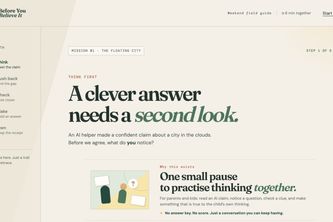
Before-You-Believe is a self-reported family-oriented educational tool designed to guide children through critical thinking using AI-generated reasoning missions. The app uses GPT-5.6 to generate structured, five-step reasoning prompts (Think → Push Back → Check → Make → Own) that encourage pause and reflection rather than immediate acceptance of AI answers. It is built as a browser-based application with no data leaving the user's device during use.
What changed
The project was submitted as part of an OpenAI hackathon, indicating it is in early development or prototype form. The author describes building a weekend project to address a personal concern about how children interact with AI — specifically, that they often accept AI answers without questioning them. This tool aims to slow down the AI interaction and place emphasis on parental involvement and child reasoning.
Single most important open question
Is there any evidence of traction, revenue, or customer adoption beyond the author’s own development and demonstration? The description states no such data exists.
Note: All findings are based solely on the self-reported, unverified project description provided by the caller. No external verification or historical data is available.
What The Product Actually Is
The description states that Before-You-Believe is a 5–7 minute, five-step reasoning canvas:
- Think → Push Back → Check → Make → Own
It uses GPT-5.6 to generate live reasoning missions in real time based on parent-entered topics and age bands.
Key technical components include:
- A Vercel serverless function calling the OpenAI Responses API with gpt-5.6
- Strict JSON schema constraints (eight required fields including three evidence cards)
- Browser-based rendering using HTML, CSS, JavaScript
- AI-generated material to question, not assessments or scores
- Child’s working answer is never sent to GPT-5.6
- No database or authentication service; relies on signed HTTP-only cookies for access control
Inference: The product appears to be a browser-based prototype with no backend persistence or user accounts.
Positioning & Claim Evolution
The author claims the app is intended to help families pause before believing AI answers, encouraging critical thinking over passive acceptance. It positions itself as an alternative to “AI + kids” tools that make the model the authority.
Key positioning elements:
- No judgment or scoring from AI
- Focus on parental involvement and child reasoning
- Emphasis on slowing down AI interaction
- Child’s work remains local; no data leaves browser session
Claim: The app is designed to guide children through structured questioning rather than provide ready-made answers.
Inference: This reflects a shift from traditional AI-assisted learning tools toward more reflective, conversational pedagogy.
Target Customer & ICP
The description states that the target audience includes:
- Parents who want to support their children’s critical thinking
- Families seeking ways to engage with AI thoughtfully
It also mentions:
- Age bands are specified by parents when entering a topic
- The tool is meant for use during family time, not as a standalone educational platform
Inference: The ICP likely centers around tech-savvy parents interested in mindful AI use and child development.
Business Model & Pricing Evidence
There is no evidence of pricing or business model in the description. The project is presented as a hackathon submission with no mention of monetization, subscriptions, or paid features.
Not evidenced: No indication of revenue streams, pricing tiers, or commercial intent beyond personal use.
Technical & Delivery Signals
The app is built using:
- Static HTML/CSS/JavaScript
- Node.js and Vercel serverless functions
- OpenAI GPT-5.6 via the Responses API
- Strict JSON schema validation
- Signed HTTP-only cookies for access control
- 31 unit tests + Playwright browser smoke test
Notable technical decisions:
- Child’s answer is never sent to the model
- AI output is constrained with strict schema and effort: 'low'
- No database or auth service used
- Bundled “Floating City” mission ensures demo reliability
Inference: The app is built for minimal infrastructure, low-risk deployment, and user privacy.
Traction & Maturity Signals
The description does not provide any evidence of traction, customers, or adoption beyond the author’s own development. It was submitted to a hackathon and has no stated user base, revenue, or usage metrics.
Not evidenced: No data on users, retention, engagement, or product maturity beyond prototype stage.
Competitive Context
The description does not reference competitors or existing tools in the space of AI-assisted education for children. It implies that most “AI + kids” tools make the model the authority, which suggests a niche market gap — though no specific competitor names or offerings are mentioned.
Inference: The app may be positioned to differentiate itself from mainstream AI tutoring platforms by focusing on reflection over output.
Open Questions & Risks
- No traction or revenue evidence: The project is presented as a hackathon submission with no signs of commercial viability.
- Limited scalability: Reliance on single developer and lack of backend infrastructure raises questions about long-term sustainability.
- Unverified claims: The author’s own account lacks independent verification, which is standard for early-stage projects but increases risk.
- No database or auth system: While privacy-focused, this may limit future expansion or user tracking capabilities.
Inference: The project is likely in a very early stage and not yet ready for market-scale deployment.
Questions the description leaves open
- What specific parental feedback has been gathered during development?
- How does the team plan to scale beyond a single developer and prototype?
- Are there any plans to collect or store user data, even temporarily?
- Has the team considered how to onboard non-technical parents into using the tool?
- What is the roadmap for monetization if any?
- How will the app handle edge cases in reasoning missions (e.g., ambiguous topics)?
- Is there a plan to validate the effectiveness of the five-step canvas on actual children?
Overall Assessment
The project is described as a hackathon submission and lacks evidence of traction, revenue, or customer adoption. It is presented as an experimental tool focused on parental engagement and child reasoning, built with minimal infrastructure.
Assessment: Not ready for investment or partnership at this time. The idea shows promise in addressing a gap in AI education but requires further development, testing, and validation before it can be considered viable for commercial use.
User Stories BotA demo video on every pull request
Get a demo video on every new feature
GitHub App that watches your pull requests and records a narrated, captioned demo.
Save time on demo prep and make informed decisions faster with a video walkthrough of every new feature.
Source
Submitted to the OpenAI 2026 hackathon on Devpost. Project home on Devpost. Back to the full gallery on Devpost.
This competitive analysis was produced by top-founders.com (opens in a new tab)
Generated by a language model from this project's public Devpost page — its tagline, the author's own write-up and any built-with tags listed there — as captured in August 2026. Short quotations are the author's words. It is an opinion on the idea as a business, not on the people behind it, and it reflects the description as published then. If the project has moved on, request a correction below. The analysis is not independent research and contains no verified traction, revenue or customer data.
An independent guide by KFG International LLC — not affiliated with, endorsed by, or connected to Devpost or OpenAI.