

Archive position — measured, not model output
0 likes on Devpost
2,263 of the 7,850 archived projects have more likes, and 5,587 share exactly 0 — so this project's #2,639 place in the like-ranked listing is a tie-break inside that group, not a ranking.
Projects (log scale)
Likes on Devpost. ▲ marks this project's group.
Show the figures
| Likes | Projects | Share of archive |
|---|---|---|
| 0 | 5,587 | 71.2% |
| 1 | 1,758 | 22.4% |
| 2 | 284 | 3.6% |
| 3–4 | 132 | 1.7% |
| 5–9 | 75 | 1.0% |
| 10+ | 14 | 0.2% |
 User Stories BotA demo video on every pull request
Get a demo video on every new feature
GitHub App that watches your pull requests and records a narrated, captioned demo.
Save time on demo prep and make informed decisions faster with a video walkthrough of every new feature.
Executive Summary
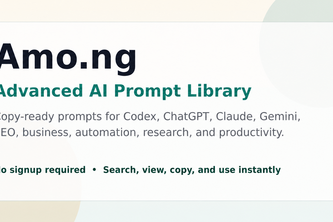
What the company appears to be: Amo.ng AI Prompt Workflow Assistant is a self-reported free public tool that helps users translate vague work problems into structured AI workflows using expert prompts. It claims to support multiple AI tools (ChatGPT, Claude, Gemini, Codex) and emphasizes safety through structured steps, evidence-based output, and human review gates.
What changed: The project was initially described as a prompt library built on Laravel. For the OpenAI Build Week hackathon, it is being extended with an AI Prompt Workflow Assistant that guides users from problem description to prompt matching and safe execution across AI platforms.
Single most important open question: Is there any evidence of user adoption or traction beyond the author's self-reported claims?
Note: This analysis is based solely on the self-reported project description provided by the caller. No independent verification, revenue data, customer base, or usage metrics are available. All statements reflect the author’s own account and should be treated as claims, not facts.
What The Product Actually Is
- The description states that Amo.ng AI Prompt Workflow Assistant is a tool designed to help users move from a vague work problem to a practical AI workflow.
- It supports tasks such as:
- “My GitHub Actions workflow is failing.”
- “I need to review a pull request before merging.”
- “My WordPress site is slow.”
- “I need to audit lead routing in my CRM.”
- “I want to review a spreadsheet model before a financial decision.”
- The assistant helps users:
- Understand the type of problem they are solving.
- Match the problem to relevant expert prompts.
- Choose the right AI tool (ChatGPT, Claude, Gemini, Codex).
- Follow a safe workflow with evidence, assumptions, review gates, and verification steps.
- Open and copy the prompt for immediate use.
- The system is built on Laravel and uses GPT-5.6 for prompt matching, workflow guidance, and user task interpretation.
- It is described as a public, searchable, copy-first resource where users do not need to create an account.
Inference: Based on the description, Amo.ng appears to be a developer-facing tool that attempts to bridge the gap between real-world work problems and AI prompt engineering. However, there is no evidence of actual product usage or user feedback beyond the author’s own account.
Positioning & Claim Evolution
- The project was originally described as a public prompt library for practical work across coding, business, SEO, automation, analytics, education, marketing, and AI governance.
- For OpenAI Build Week, it is being extended with an AI Prompt Workflow Assistant, which adds functionality to guide users through problem-solving workflows.
- The author claims that the tool addresses a core issue: people often start with the wrong prompt or use AI without structure.
- The positioning emphasizes:
- Practicality over generality.
- Safety in AI usage.
- Structured workflows for AI tasks.
- Public accessibility (no sign-up required).
- The long-term goal is to make Amo.ng a free public resource for practical AI work.
Claim vs Fact: These are self-reported claims by the author. There is no evidence of market validation, user feedback, or competitive positioning beyond what is stated in the description.
Target Customer & ICP
- The description states that Amo.ng targets:
- Developers
- Founders
- Marketers
- Operators
- Educators
- Analysts
- Teams adopting AI safely
- It also mentions support for tasks like:
- Code-related issues (GitHub Actions, pull request reviews)
- WordPress performance
- CRM lead routing
- Financial decision-making
- The tool is described as being designed for practical AI work, suggesting a focus on professionals who use AI tools regularly but lack structured guidance.
Not evidenced: No specific customer segments or personas are defined. There is no evidence of segmentation, targeting strategy, or user interviews.
Business Model & Pricing Evidence
- The description states that Amo.ng is a free public tool.
- Users do not need to create an account to use the prompt library.
- There is no mention of monetization strategies, paid features, subscriptions, or pricing tiers.
- The project is presented as a public resource aimed at helping users adopt AI more safely and effectively.
Inference: If this remains free and public, it likely does not have a traditional business model. However, the lack of clarity on monetization leaves open questions about sustainability or future plans.
Technical & Delivery Signals
- Built with:
- Laravel (PHP framework)
- GPT-5.6 for AI reasoning
- Codex for code inspection and implementation
- Cloudflare, MySQL, HTML, CSS, JavaScript, Tailwind CSS, PHP, OpenAI APIs
- The system is designed to be:
- Simple
- Public
- Searchable
- Copy-first
- It connects to existing prompt records and integrates with tools like ChatGPT, Claude, Gemini, and Codex.
- Uses draft/publish logic, sitemap behavior, and admin workflows from the original Laravel-based prompt library.
Not evidenced: No details on technical architecture beyond stack usage. No evidence of scalability, performance metrics, or delivery mechanisms beyond the author’s own account.
Traction & Maturity Signals
- The project is described as a public prompt library.
- It was submitted to the OpenAI 2026 hackathon, indicating early-stage development.
- There is no evidence of:
- User base or active usage
- Revenue or funding rounds
- Customer testimonials or case studies
- Product maturity indicators (e.g., version history, feature roadmap)
- The author notes that the biggest challenge was not generating prompts but helping users find the right ones.
Absence of evidence: No traction data is provided. The project appears to be in a pre-launch or early development phase.
Competitive Context
- The description does not mention direct competitors.
- It positions itself as a tool for:
- Prompt engineering
- Workflow design
- Safe AI usage
- It supports multiple AI platforms (ChatGPT, Claude, Gemini, Codex), which suggests it may compete with or complement tools like:
- PromptPerfect
- PromptBase
- LangChain
- AutoGen
- Various prompt engineering platforms
Not evidenced: No competitive analysis, market positioning, or differentiation from existing tools is provided.
Open Questions & Risks
- The project is described as a single-person effort (team size: 1).
- It lacks any evidence of traction, revenue, or user adoption.
- There is no indication of how the tool will scale beyond the author’s own use case.
- The reliance on GPT-5.6 and Codex raises questions about:
- Dependency on external AI models
- Cost of operation
- Long-term viability if those APIs change
- The lack of monetization strategy or clear path to product-market fit is a concern.
- The tool is described as free and public, which may limit future revenue opportunities.
Inference: A single-person project with no traction or monetization model raises questions about long-term sustainability and scalability.
Questions the description leaves open
- What specific user problems are you solving, and how do you know?
- How many users have interacted with the tool so far?
- Are there any early adopters or feedback from real users?
- What is your plan for monetization or scaling beyond a public resource?
- How do you ensure prompt quality and safety in a public library?
- What are the technical dependencies, and how do you manage them?
- How does this project differ from existing prompt libraries or workflow tools?
- Do you have any data on prompt usage patterns or user behavior?
Note: These questions aim to uncover gaps in the self-reported description.
Overall Assessment
- The project is described as a free public tool built by one person, with no evidence of traction, revenue, or customer base.
- It targets professionals using AI for practical tasks but lacks validation or market feedback.
- There is no indication of a clear business model or monetization strategy.
- The tool appears to be in an early development stage (submitted to a hackathon).
- Given the lack of evidence of product-market fit, user adoption, or financial viability, there is no compelling reason to invest or partner at this time.
Confidence Level: Low. This analysis is based entirely on self-reported information with no external corroboration or traction data.
User Stories BotA demo video on every pull request
Get a demo video on every new feature
GitHub App that watches your pull requests and records a narrated, captioned demo.
Save time on demo prep and make informed decisions faster with a video walkthrough of every new feature.
Source
Submitted to the OpenAI 2026 hackathon on Devpost. Project home on Devpost. Back to the full gallery on Devpost.
This competitive analysis was produced by top-founders.com (opens in a new tab)
Generated by a language model from this project's public Devpost page — its tagline, the author's own write-up and any built-with tags listed there — as captured in August 2026. Short quotations are the author's words. It is an opinion on the idea as a business, not on the people behind it, and it reflects the description as published then. If the project has moved on, request a correction below. The analysis is not independent research and contains no verified traction, revenue or customer data.
An independent guide by KFG International LLC — not affiliated with, endorsed by, or connected to Devpost or OpenAI.