

Archive position — measured, not model output
0 likes on Devpost
2,263 of the 7,850 archived projects have more likes, and 5,587 share exactly 0 — so this project's #4,602 place in the like-ranked listing is a tie-break inside that group, not a ranking.
Projects (log scale)
Likes on Devpost. ▲ marks this project's group.
Show the figures
| Likes | Projects | Share of archive |
|---|---|---|
| 0 | 5,587 | 71.2% |
| 1 | 1,758 | 22.4% |
| 2 | 284 | 3.6% |
| 3–4 | 132 | 1.7% |
| 5–9 | 75 | 1.0% |
| 10+ | 14 | 0.2% |
 User Stories BotA demo video on every pull request
Get a demo video on every new feature
GitHub App that watches your pull requests and records a narrated, captioned demo.
Save time on demo prep and make informed decisions faster with a video walkthrough of every new feature.
Executive Summary
What the company appears to be
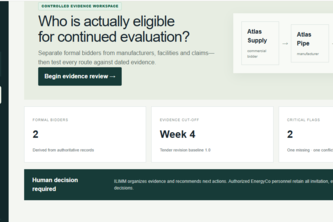
ILIMM is an AI-powered operating layer for Indonesia’s line-pipe industry, designed to map demand, suppliers, compliance, capacity, and evidence. It builds a governed Single Source of Truth (SSOT) for procurement-related data and supports verification of supplier claims against regulatory standards like PTK-007, API 5L, TKDN, and local-content requirements.
What changed
The project was built as an MVP using Codex and GPT-5.6, with a focus on evidence reconciliation, conflict detection, and human review controls. It includes a Next.js interface, SQLite-backed data model, and versioned claims architecture. The author states that the system can be reused for other procurement categories.
The single most important open question
Is there any evidence of real-world use or integration with actual procurement processes in Indonesia’s line-pipe industry?
Note
This analysis is based entirely on self-reported information from the project description and does not include any third-party verification, historical data, revenue, customer names, or traction metrics. All claims are attributed to the author's own account.
What The Product Actually Is
The description states that ILIMM is an AI-powered operating layer for Indonesia’s line-pipe industry. It helps users:
- Establish a governing Single Source of Truth (SSOT);
- Identify formal tender participants;
- Distinguish roles such as manufacturer, processor, agent, distributor;
- Map authorization chains between bidders and manufacturers;
- Evaluate evidence against regulatory standards (PTK-007, API 5L, TKDN);
- Detect missing, conflicting, expired, or unauthorized evidence;
- Generate clarification and verification actions;
- Preserve human approval for final procurement decisions.
It also includes a governed workflow that can be reused across other strategic procurement categories.
The system was built using:
- Codex as the primary development environment,
- GPT-5.6 as the intelligence and orchestration layer,
- Next.js interface,
- SQLite-backed data model,
- Versioned claims and historical evidence tracking,
- Predicate-specific source-authority rules,
- Deterministic procurement guardrails,
- Conflict detection, expiry handling, joint-verification task generation,
- Human-review controls.
Inference The product is described as a structured platform for managing procurement-related evidence in a regulated industry. It is not a general-purpose AI tool but a domain-specific solution tailored to line-pipe procurement in Indonesia.
Positioning & Claim Evolution
The author positions ILIMM as:
- “The AI operating layer for Indonesia’s line-pipe industry”;
- A system that turns fragmented evidence into one governed market landscape;
- A reusable workflow for other procurement categories.
It is framed as a governed, human-in-the-loop approach to procurement intelligence — not an autonomous decision engine.
Claim
ILIMM applies AI to make the physical supply chain more transparent, auditable, efficient, and investable.
Inference The positioning reflects an intent to solve inefficiencies in procurement by centralizing evidence and automating parts of verification while retaining human oversight. It is not positioned as a general-purpose procurement platform but as a specialized tool for line-pipe industries with strict compliance requirements.
Target Customer & ICP
The description states that ILIMM targets:
- Production Sharing Contractors;
- Pipeline vendors;
- Manufacturers and processors;
- Agents and distributors;
- SKK Migas (Indonesia’s national oil regulator);
- Government and local-content authorities;
- Inspection bodies;
- Investors.
It also mentions future modules for:
- Procurement Strategy Copilot;
- PSC demand and inventory integration;
- Supplier-risk intelligence;
- Investment and supply-demand analysis.
Inference The ICP appears to be procurement teams within the oil and gas sector in Indonesia, particularly those involved in line-pipe projects requiring compliance with local content and regulatory standards. It is not described as targeting small businesses or general-purpose buyers.
Business Model & Pricing Evidence
There is no evidence of a business model or pricing structure in the description.
Not evidenced
Technical & Delivery Signals
The system was built using:
- GPT-5.6 as the intelligence and orchestration layer;
- Next.js for the interface;
- Node.js backend;
- SQLite for data storage;
- TypeScript;
- React frontend;
- Codex as the primary development environment.
It includes features like:
- Versioned claims and historical evidence;
- Predicate-specific source-authority rules;
- Deterministic procurement guardrails;
- Conflict detection, expiry handling, joint-verification task generation;
- Human-review controls;
- Anonymized synthetic tender data.
Inference The technical stack suggests a lightweight MVP built for internal use or demonstration. It is not described as scalable or production-ready beyond the MVP stage.
Traction & Maturity Signals
The description states:
- The MVP was built and passed automated tests (27 out of 27);
- Passed lint, database migration, disclosure scan;
- Built without exposing confidential information;
- Preserved original working MVP while adding governance features.
However, there is no mention of:
- Live integrations with procurement systems or regulators;
- Real-world use cases or pilot programs;
- Customers or users beyond the development team;
- Revenue or monetization efforts.
Not evidenced
Competitive Context
The description does not provide any information about competitors or existing solutions in the market for procurement intelligence, evidence management, or compliance automation in Indonesia’s line-pipe industry.
Not evidenced
Open Questions & Risks
- No real-world use or integration: The system is described as an MVP and has no evidence of being used in live procurement processes.
- Limited scope of integrations: Live integrations with regulators, CIVD, APDN, PSC inventory, etc., are noted as not yet operational.
- Unverified claims about AI capabilities: While GPT-5.6 is mentioned, there’s no demonstration or evidence of its performance in real-world procurement tasks.
- No customer or market traction: No mention of users, partners, or adoption beyond the team.
- Self-contained solution: The system appears to be built for internal use and not designed for external scaling or API access.
Inference ILIMM is a proof-of-concept with strong governance features but lacks evidence of commercial viability or real-world application.
Questions the description leaves open
- Has the system been tested in any actual procurement process or with real suppliers?
- What are the specific regulatory requirements that it currently supports, and how are they validated?
- Are there any existing partnerships or agreements with SKK Migas or other regulators?
- How is data privacy and security managed, especially when handling sensitive procurement information?
- Is there a plan to integrate with live systems like CIVD, APDN, or PSC inventories?
- What are the key assumptions about user behavior in procurement workflows that the system is built on?
- How does the team plan to scale beyond the MVP and into broader procurement categories?
Overall Assessment
The description indicates ILIMM is a proof-of-concept with strong governance features, but no evidence of real-world traction or commercialization.
Assessment Not ready for investment or partnership at this stage. The system shows potential in addressing compliance and procurement inefficiencies in Indonesia’s line-pipe industry, but lacks demonstrated use cases, customers, or integration with live systems. It is positioned as a tool for future development rather than an operational solution.
Confidence Level Low — based on self-reported evidence only.
User Stories BotA demo video on every pull request
Get a demo video on every new feature
GitHub App that watches your pull requests and records a narrated, captioned demo.
Save time on demo prep and make informed decisions faster with a video walkthrough of every new feature.
Source
Submitted to the OpenAI 2026 hackathon on Devpost. Project home on Devpost. Back to the full gallery on Devpost.
This competitive analysis was produced by top-founders.com (opens in a new tab)
Generated by a language model from this project's public Devpost page — its tagline, the author's own write-up and any built-with tags listed there — as captured in August 2026. Short quotations are the author's words. It is an opinion on the idea as a business, not on the people behind it, and it reflects the description as published then. If the project has moved on, request a correction below. The analysis is not independent research and contains no verified traction, revenue or customer data.
An independent guide by KFG International LLC — not affiliated with, endorsed by, or connected to Devpost or OpenAI.