

Archive position — measured, not model output
0 likes on Devpost
2,263 of the 7,850 archived projects have more likes, and 5,587 share exactly 0 — so this project's #2,634 place in the like-ranked listing is a tie-break inside that group, not a ranking.
Projects (log scale)
Likes on Devpost. ▲ marks this project's group.
Show the figures
| Likes | Projects | Share of archive |
|---|---|---|
| 0 | 5,587 | 71.2% |
| 1 | 1,758 | 22.4% |
| 2 | 284 | 3.6% |
| 3–4 | 132 | 1.7% |
| 5–9 | 75 | 1.0% |
| 10+ | 14 | 0.2% |
 User Stories BotA demo video on every pull request
Get a demo video on every new feature
GitHub App that watches your pull requests and records a narrated, captioned demo.
Save time on demo prep and make informed decisions faster with a video walkthrough of every new feature.
Executive Summary
What the company appears to be
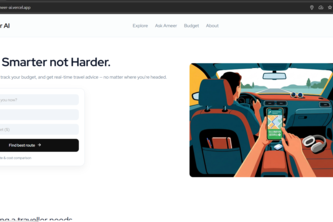
Ameer AI is a self-reported travel planning and budgeting agent built as a hackathon project. The description states it allows users to plan trips with real-time budgeting, integrates social features for sharing experiences, and uses Go, React, and MongoDB.
What changed
This is a single-person hackathon submission that has not yet launched commercially or demonstrated traction. The author describes building a functional prototype including authentication, data storage, and deployment, but no evidence of revenue, users, or product-market fit exists.
The single most important open question
Is there any evidence that Ameer AI has moved beyond the prototype stage to generate actual user engagement or monetization?
Note: This analysis is based entirely on the self-reported, unverified description provided by the author. No independent verification of claims, traction, customers, revenue, or product-market fit exists.
What The Product Actually Is
- The description states Ameer AI is a trip budgeting agent that allows users to travel and budget in real time.
- It takes destination, dates, and budget as inputs and returns a trip plan that fits within the specified constraints.
- Beneath the budgeting core, it also functions as a full travel app with social features: users can explore shared experiences, submit their own, and follow other travelers.
- The product is described as a social product rather than a standalone calculator.
Inference: The author implies this is a hybrid tool combining AI-driven trip planning with community-based content sharing. However, no evidence of actual functionality beyond the prototype stage is provided.
Positioning & Claim Evolution
- The project claims to be a "trip budgeting agent" that reasons about travel like a well-traveled friend.
- It positions itself as more than just a calculator — it's embedded in a social product where users can share and discover experiences.
- The author notes that the app was built for a hackathon, suggesting an early-stage prototype with no commercial traction.
Inference: The positioning evolved from a simple budgeting tool to a full social travel platform. However, there is no evidence of how this evolved in practice or whether it has been tested with users beyond the team.
Target Customer & ICP
- The description states that Ameer AI targets users who want to plan trips with real-time budgeting.
- It implies a user base interested in both travel planning and social sharing of experiences.
- Users are likely travelers looking for structured, budget-conscious trip ideas.
Not evidenced: No specific customer segments, personas, or ICP data are provided. The author does not describe how they identified or validated their target audience.
Business Model & Pricing Evidence
- There is no evidence of pricing structure, monetization strategy, or business model in the description.
- The app appears to be a prototype with no indication of paid features or revenue streams.
Inference: If Ameer AI were to scale, it might consider freemium models or premium features for advanced planning tools. However, this is speculative and not supported by any evidence.
Technical & Delivery Signals
- Built using Go (backend), React + TypeScript (frontend), MongoDB, Google Maps API.
- Deployed on Vercel (frontend) and Render (backend).
- Authentication handled via Google OAuth with cookie management.
- Supabase Storage used for image uploads.
- The team encountered issues with auth, CORS, and credential hygiene during development.
Inference: The technical stack suggests a modern full-stack approach. However, the mention of security incidents and credential leaks indicates that infrastructure maturity is still in early stages.
Traction & Maturity Signals
- The project was submitted to the OpenAI 2026 hackathon.
- It includes a working prototype with authentication, data storage, and deployment.
- The author mentions overcoming a major security incident (leaked credentials) and fixing auth bugs.
- No evidence of user adoption, revenue, or product-market fit is present.
Not evidenced: There are no metrics, user counts, or usage data to indicate traction or maturity beyond the prototype phase.
Competitive Context
- The description does not mention competitors directly.
- It implies a niche in travel planning with real-time budgeting and social features.
- Competitors in this space may include platforms like TripIt, Google Trips, or Airbnb’s trip planning tools.
Inference: Ameer AI appears to target a segment of travelers seeking both structured planning and community input. However, no competitive analysis or differentiation strategy is described.
Open Questions & Risks
- The project is a single-person hackathon submission with no evidence of traction or commercial viability.
- Security vulnerabilities were encountered during development (leaked keys, CORS issues).
- No revenue model, pricing, or monetization plan is evident.
- The team size is listed as one person, raising questions about scalability and long-term maintenance.
Inference: The lack of commercial traction, user engagement, or business model raises significant concerns about viability. The security incidents also suggest potential operational risks if not fully addressed.
Questions the description leaves open
- What specific problem are you solving for travelers that existing tools don’t?
- Have you validated your idea with real users beyond the prototype stage?
- How do you plan to monetize this product, and what is your go-to-market strategy?
- What are the key assumptions behind your product design, and how have they been tested?
- Can you walk us through your current user journey and any feedback received from early testers?
Overall Assessment
- Not evidenced: There is no evidence of revenue, customer traction, or commercial viability.
- The project is a prototype built by one person for a hackathon.
- No indication of product-market fit, scalability, or long-term strategy exists.
Assessment: At this stage, Ameer AI is not ready for investment or partnership consideration. It lacks the foundational signals required to assess commercial potential.
User Stories BotA demo video on every pull request
Get a demo video on every new feature
GitHub App that watches your pull requests and records a narrated, captioned demo.
Save time on demo prep and make informed decisions faster with a video walkthrough of every new feature.
Source
Submitted to the OpenAI 2026 hackathon on Devpost. Project home on Devpost. Back to the full gallery on Devpost.
This competitive analysis was produced by top-founders.com (opens in a new tab)
Generated by a language model from this project's public Devpost page — its tagline, the author's own write-up and any built-with tags listed there — as captured in August 2026. Short quotations are the author's words. It is an opinion on the idea as a business, not on the people behind it, and it reflects the description as published then. If the project has moved on, request a correction below. The analysis is not independent research and contains no verified traction, revenue or customer data.
An independent guide by KFG International LLC — not affiliated with, endorsed by, or connected to Devpost or OpenAI.