

Archive position — measured, not model output
0 likes on Devpost
2,263 of the 7,850 archived projects have more likes, and 5,587 share exactly 0 — so this project's #4,594 place in the like-ranked listing is a tie-break inside that group, not a ranking.
Projects (log scale)
Likes on Devpost. ▲ marks this project's group.
Show the figures
| Likes | Projects | Share of archive |
|---|---|---|
| 0 | 5,587 | 71.2% |
| 1 | 1,758 | 22.4% |
| 2 | 284 | 3.6% |
| 3–4 | 132 | 1.7% |
| 5–9 | 75 | 1.0% |
| 10+ | 14 | 0.2% |
 User Stories BotA demo video on every pull request
Get a demo video on every new feature
GitHub App that watches your pull requests and records a narrated, captioned demo.
Save time on demo prep and make informed decisions faster with a video walkthrough of every new feature.
Executive Summary
What the company appears to be
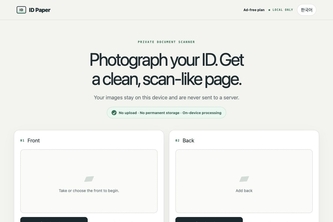
ID Paper is a self-reported mobile-first web application that allows users to capture both sides of an ID card, correct perspective, and export a clean, print-ready PDF or image — all without cloud upload or OCR.
What changed
The author reports building this tool in response to a perceived gap in existing scanner apps: the need for a faster, more private workflow that avoids account creation, cloud uploads, and intrusive ads. It is presented as a privacy-focused solution with local processing.
The single most important open question
Is there any evidence of user adoption or product-market fit beyond the author's own development experience?
What The Product Actually Is
The description states that ID Paper is a tool for turning photos of both sides of an ID card into a clean, print-ready A4 or Letter PDF or image. It uses browser-based image processing and does not require cloud upload or OCR.
- The workflow includes:
- Capturing or selecting the front and back of an ID
- Automatic edge detection and correction
- Manual adjustment of corners if needed
- Arranging both sides on a print-ready page
- Exporting as PDF or image
- All processing is done locally on the user's device.
- It is built as a mobile-first web app, potentially deployable as an Android app.
Evidence Self-reported. No independent verification of functionality or performance.
Positioning & Claim Evolution
The author positions ID Paper as a faster and more private alternative to existing scanner apps. The key claims are:
- No account required
- No cloud upload
- No OCR
- Local processing only
- Designed for administrative tasks in stores, offices, and everyday use
The project evolved from a personal need identified by the author — needing a better way to copy ID cards — to a technical solution using AI tools like OpenAI Codex.
Evidence Self-reported. The description does not include any claims about market traction, user feedback, or competitive positioning beyond its own stated goals.
Target Customer & ICP
The description states that ID Paper is intended for people in stores, offices, and everyday administrative tasks who need to copy both sides of an ID card onto a single sheet of paper.
It is designed for users who want a fast, private workflow without account creation or cloud upload.
Evidence Self-reported. No evidence of specific customer segments, personas, or usage data.
Business Model & Pricing Evidence
The author states that the app will support optional, privacy-friendly monetization after the core experience is stable.
There is no mention of current pricing, revenue streams, or business model details beyond this future intention.
Evidence Self-reported. No evidence of any monetization strategy or actual sales.
Technical & Delivery Signals
The project is built as a mobile-first web application using:
- Browser-based image processing
- OpenCV.js for edge detection and perspective correction
- PDF generation capabilities
- PWA (Progressive Web App) support planned
- Cloudflare hosting
- Android packaging planned
It uses modules for:
- Image capture/import
- Edge detection
- Manual corner adjustment
- Perspective correction
- Layout (A4/US Letter)
- Export (PDF/image)
- Privacy and memory cleanup
The author used OpenAI Codex to assist in planning, implementing, and debugging the interface and workflows.
Evidence Self-reported. No evidence of production deployment or performance data.
Traction & Maturity Signals
There is no evidence of user adoption, revenue, customer base, or product maturity beyond the author’s own development work.
The project was submitted to a hackathon and has not yet been released for public use.
Evidence Not evidenced. No data on usage, retention, or market response.
Competitive Context
The description does not mention competitors or how ID Paper compares to existing scanner apps or document management tools.
It implies that current solutions are inadequate due to:
- Account requirements
- Cloud upload
- Intrusive ads
- General-purpose design (not tailored for ID cards)
Evidence Self-reported. No competitive analysis, market sizing, or benchmarking data provided.
Open Questions & Risks
- No product-market fit evidence: The project is a hackathon submission with no traction.
- Unproven technical execution: While the author claims to use advanced tools like OpenCV.js and Codex, there’s no demonstration of performance or reliability.
- Monetization ambiguity: Future plans for monetization are vague and not yet implemented.
- Limited team size: Only one developer is involved, which raises concerns about scalability and long-term maintenance.
Evidence Inferred from lack of evidence. Not directly stated but implied by the project’s current state.
Questions the description leaves open
- What specific problems are users experiencing with existing ID scanning tools?
- Have you tested the app on multiple devices or platforms?
- How do you plan to validate the accuracy of automatic edge detection across different lighting and backgrounds?
- What is your timeline for launching a public version?
- Are there any potential legal or privacy issues related to local image processing?
- What are the key assumptions behind your monetization strategy?
Overall Assessment
The project is currently in an early development stage, submitted as part of a hackathon. There is no evidence of revenue, customers, or product-market fit.
Confidence level Low — based entirely on self-reported information with no external validation.
Assessment Not ready for investment or partnership at this time. The idea shows potential but lacks traction and maturity. Further development and user testing are required before any strategic move can be justified.
User Stories BotA demo video on every pull request
Get a demo video on every new feature
GitHub App that watches your pull requests and records a narrated, captioned demo.
Save time on demo prep and make informed decisions faster with a video walkthrough of every new feature.
Source
Submitted to the OpenAI 2026 hackathon on Devpost. Project home on Devpost. Back to the full gallery on Devpost.
This competitive analysis was produced by top-founders.com (opens in a new tab)
Generated by a language model from this project's public Devpost page — its tagline, the author's own write-up and any built-with tags listed there — as captured in August 2026. Short quotations are the author's words. It is an opinion on the idea as a business, not on the people behind it, and it reflects the description as published then. If the project has moved on, request a correction below. The analysis is not independent research and contains no verified traction, revenue or customer data.
An independent guide by KFG International LLC — not affiliated with, endorsed by, or connected to Devpost or OpenAI.