

Archive position — measured, not model output
0 likes on Devpost
2,263 of the 7,850 archived projects have more likes, and 5,587 share exactly 0 — so this project's #6,556 place in the like-ranked listing is a tie-break inside that group, not a ranking.
Projects (log scale)
Likes on Devpost. ▲ marks this project's group.
Show the figures
| Likes | Projects | Share of archive |
|---|---|---|
| 0 | 5,587 | 71.2% |
| 1 | 1,758 | 22.4% |
| 2 | 284 | 3.6% |
| 3–4 | 132 | 1.7% |
| 5–9 | 75 | 1.0% |
| 10+ | 14 | 0.2% |
 User Stories BotA demo video on every pull request
Get a demo video on every new feature
GitHub App that watches your pull requests and records a narrated, captioned demo.
Save time on demo prep and make informed decisions faster with a video walkthrough of every new feature.
Executive Summary
What the company appears to be
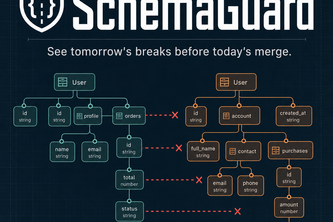
SchemaGuard is a tool for API schema change review, designed to help backend engineers identify breaking changes before merging code. The author states it analyzes OpenAPI 3.x documents and provides compatibility risk estimates, decision alternatives, and Codex prompts to guide safe release strategies.
What changed
The project description reflects a self-reported development effort focused on building an AI-assisted tool for API schema validation and change impact analysis. It was submitted as part of the OpenAI 2026 hackathon.
Single most important open question
Is there any evidence of real-world usage or adoption by developers, or traction in the form of customers, revenue, or product-market fit beyond the author’s own demonstration?
What The Product Actually Is
The description states that SchemaGuard:
- Takes a base and proposed OpenAPI 3.x document,
- Runs deterministic break rules over component schemas (rename, remove, type narrow, required-add, enum-remove),
- Builds an Evidence Package with findings, known consumers (fixtures), and a Compatibility Risk Estimate,
- Prepares Decision Alternatives and a Decision Confidence Matrix,
- Supports What-if functionality to simulate safer strategies,
- Emits a Codex handoff prompt grounded only in that evidence.
It also states the tool is built using GPT-5.6 via Codex, but enforces strict allowlists on outputs to prevent untrusted model responses.
Inference The product appears to be a developer-facing tool for API schema change review and risk mitigation, integrating AI for decision support while maintaining deterministic logic as its core.
Positioning & Claim Evolution
The author states:
- The tool answers the question: “what is the safest way to ship this?”
- It is described as “that review — before merge.”
- It aims to solve silent API breakage that occurs outside of a PR’s immediate scope.
- The product is positioned as a staff engineer-level assistant.
Inference SchemaGuard positions itself as a pre-merge API change validation tool, targeting backend engineers who want to reduce risk in API evolution. It evolved from a hackathon project into a focused solution for API schema safety.
Target Customer & ICP
The description states:
- The target user is a backend engineer.
- The problem it solves is silent API breakage that affects mobile apps or other consumers outside the PR’s scope.
- It supports engineers reviewing changes in CI environments.
Inference The primary customer appears to be backend developers working on APIs, especially those involved in CI/CD pipelines and API governance. The ICP seems to be engineers who manage API schemas and are concerned with breaking changes.
Business Model & Pricing Evidence
Not evidenced.
Explanation
There is no mention of pricing, monetization strategy, or business model in the description.
Technical & Delivery Signals
The description states:
- Built with: ai, codex, developertools, gpt-5.6, next.js, node.js, openai, openapi, react, typescript, vercel, zod.
- Uses deterministic rules for break detection and model use only in prompt building.
- Enforces trust boundaries via allowlists on finding IDs and recommendation types.
- Includes a zero-setup judge path with no secrets or model keys.
- Supports streaming milestones during analysis.
Inference The tool is built as a web-based application using modern frontend/backend stacks, integrating AI for prompt generation but not for core logic. It emphasizes trust in deterministic logic over model outputs.
Traction & Maturity Signals
Not evidenced.
Explanation
There is no evidence of revenue, customers, or adoption beyond the author’s own demonstration and project submission to a hackathon.
Competitive Context
Not evidenced.
Explanation
No mention of competitors or market positioning in the description. The author does not reference existing tools for API schema validation or change impact analysis.
Open Questions & Risks
- Unverified claims: All statements are self-reported and unverified.
- No traction or adoption: No evidence of customers, revenue, or usage beyond the author’s own demo.
- Limited scope: The tool is described as a hackathon project with no indication of long-term development or scalability plans.
- AI dependency with constraints: While the tool uses AI, it enforces strict controls on model outputs — this may limit its utility if the constraints are too rigid.
- No commercialization path: No evidence of monetization strategy or business model.
Questions the description leaves open
- What is the actual use case for SchemaGuard in a real engineering team?
- How does it integrate into existing CI/CD pipelines?
- Are there any early adopters or users beyond the author’s own testing?
- Has the tool been tested with real-world OpenAPI specs from production systems?
- What are the plans for scaling beyond the current demo and hackathon prototype?
Overall Assessment
Not evidenced.
Explanation
There is no evidence of any investment or partnership interest in SchemaGuard, nor any indication that it has progressed beyond a prototype stage. The description is entirely self-reported and lacks any commercial or traction data.
User Stories BotA demo video on every pull request
Get a demo video on every new feature
GitHub App that watches your pull requests and records a narrated, captioned demo.
Save time on demo prep and make informed decisions faster with a video walkthrough of every new feature.
Source
Submitted to the OpenAI 2026 hackathon on Devpost. Project home on Devpost. Back to the full gallery on Devpost.
This competitive analysis was produced by top-founders.com (opens in a new tab)
Generated by a language model from this project's public Devpost page — its tagline, the author's own write-up and any built-with tags listed there — as captured in August 2026. Short quotations are the author's words. It is an opinion on the idea as a business, not on the people behind it, and it reflects the description as published then. If the project has moved on, request a correction below. The analysis is not independent research and contains no verified traction, revenue or customer data.
An independent guide by KFG International LLC — not affiliated with, endorsed by, or connected to Devpost or OpenAI.