

Archive position — measured, not model output
1 like on Devpost
505 of the 7,850 archived projects have more likes, and 1,758 share exactly 1 — so this project's #668 place in the like-ranked listing is a tie-break inside that group, not a ranking.
Projects (log scale)
Likes on Devpost. ▲ marks this project's group.
Show the figures
| Likes | Projects | Share of archive |
|---|---|---|
| 0 | 5,587 | 71.2% |
| 1 | 1,758 | 22.4% |
| 2 | 284 | 3.6% |
| 3–4 | 132 | 1.7% |
| 5–9 | 75 | 1.0% |
| 10+ | 14 | 0.2% |
 User Stories BotA demo video on every pull request
Get a demo video on every new feature
GitHub App that watches your pull requests and records a narrated, captioned demo.
Save time on demo prep and make informed decisions faster with a video walkthrough of every new feature.
Executive Summary
What the company appears to be
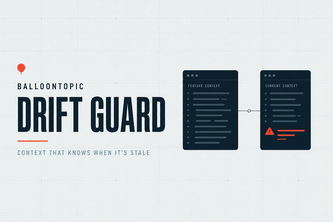
BalloonTopic Drift Guard is a local-first command-line tool designed for developers working across multiple Git branches and features simultaneously. It provides structured context memory for AI coding agents (like Cursor, Codex, Claude Code) by capturing and validating feature-related information tied to Git history.
What changed
The project evolved from an internal tool built for personal use into a hackathon submission that introduces "Drift Guard" — a mechanism to detect when saved AI context becomes stale due to changes in the base branch. It was originally conceived as a Cursor skill and later restructured for OpenAI Build Week.
Single most important open question
Is there evidence of real-world usage or adoption beyond the author's own workflow, or any indication that others are actively using this tool?
Note: This analysis is based entirely on the self-reported project description provided by the author. No independent verification, traction data, revenue figures, customer names, or third-party sources were included.
What The Product Actually Is
The description states:
- BalloonTopic Drift Guard is a local-first Python CLI.
- It integrates with Git and uses local JSON topic files to store feature context.
- It supports three core commands:
capture,resume, andexplain. - It leverages GPT-5.6 via the OpenAI Responses API for structured output.
- It does not require backend infrastructure, accounts, or cloud storage.
- Topic data is stored in
.balloontopic/directory, which is gitignored by default.
Inference: The tool functions as a lightweight context manager between Git and AI coding agents. It is not a replacement for Git or project management platforms but rather an extension of them.
Positioning & Claim Evolution
The description states:
- Originally created to solve the author’s own workflow pain points.
- Evolved from a Cursor skill into a more formalized tool during OpenAI Build Week.
- The goal was to provide “feature memory that does not only remember where I stopped, but checks whether what it remembers is still true.”
Inference: The positioning has shifted from solving an internal problem to presenting a solution for developers working across multiple projects and interruptions. The evolution reflects a move toward a more structured, AI-integrated approach.
Target Customer & ICP
The description states:
- The tool targets developers who work on multiple Git branches and features at once.
- It is intended for use with coding agents like Cursor, Codex, Claude Code.
- It supports developers who need to switch tasks frequently and want to avoid losing context or relying on outdated AI summaries.
Inference: The primary ICP appears to be technical professionals working in fast-paced development environments, particularly those using AI-assisted coding tools. There is no evidence of targeting enterprise customers, non-developers, or specific verticals.
Business Model & Pricing Evidence
The description states:
- No business model or pricing information is provided.
- The tool is open-source and self-hosted.
- It requires no API keys or cloud services for basic operation.
- The author mentions installing it as a Cursor skill via symbolic link.
Not evidenced: There is no indication of monetization, subscription plans, or paid features. The tool seems to be designed for personal or small team use without commercial intent.
Technical & Delivery Signals
The description states:
- Built with Python, Bash, Git, and OpenAI API.
- Uses structured JSON schemas for GPT-5.6 outputs.
- Implements strict input constraints to prevent unsupported file paths.
- Includes unit tests and a demo script (
run_demo.py). - Supports macOS, Linux, and Windows (via WSL or Git Bash).
- Can be installed as a Cursor skill.
Inference: The tool is lightweight, portable, and designed for developer workflows. It emphasizes local execution and minimal dependencies.
Traction & Maturity Signals
The description states:
- The author built it for personal use before the hackathon.
- It was submitted to OpenAI Build Week.
- A demo exists that shows how drift detection works.
- Unit tests are included.
- There is a GitHub repository with source code and documentation.
Not evidenced: No evidence of user adoption, customer feedback, or real-world usage beyond the author’s own workflow. No metrics on downloads, active users, or engagement are provided.
Competitive Context
The description states:
- It is not a replacement for Git or project management platforms.
- It aims to bridge the gap between Git and AI coding agents.
- It focuses on context preservation and drift detection, not general task tracking or collaboration tools.
Inference: The competitive space includes tools like Cursor, Codex, Claude Code, and other AI-assisted development environments. However, there is no mention of direct competitors or market positioning beyond its niche use case.
Open Questions & Risks
The description states:
- The tool is local-first, with no cloud infrastructure.
- It relies heavily on Git history for drift detection.
- It uses GPT-5.6, which may introduce latency or dependency risks.
- It was built by a single person (Radhakishan Jangid).
Key Risks:
- Single-person ownership: No team or organizational support implies limited scalability or long-term maintenance.
- Limited platform support: Only supports macOS, Linux, and Windows through WSL.
- Dependency on AI models: Reliance on GPT-5.6 could pose risks if access or performance changes.
- No commercial traction: No evidence of adoption beyond the author’s own use.
Questions the description leaves open
- What is the actual frequency and scale of your personal usage?
- Have you tested this tool in a multi-developer team setting?
- Are there any plans to support additional AI models or APIs beyond GPT-5.6?
- How do you plan to handle drift detection for features that span multiple repositories?
- Is there any interest from other developers in using or contributing to the project?
- What are your thoughts on expanding beyond local-first design?
Overall Assessment
The description states:
- The tool is a personal project with no commercial traction.
- It was built for internal use and later refined for a hackathon.
- There is no evidence of revenue, customers, or product-market fit.
Assessment:
Not evidenced. This appears to be an early-stage prototype or personal tool with no demonstrated commercial viability or market demand. The author’s own usage does not constitute traction. Any potential investment or partnership value would depend on future development and adoption — which is not evident in the current description.
User Stories BotA demo video on every pull request
Get a demo video on every new feature
GitHub App that watches your pull requests and records a narrated, captioned demo.
Save time on demo prep and make informed decisions faster with a video walkthrough of every new feature.
Source
Submitted to the OpenAI 2026 hackathon on Devpost. Project home on Devpost. Back to the full gallery on Devpost.
This competitive analysis was produced by top-founders.com (opens in a new tab)
Generated by a language model from this project's public Devpost page — its tagline, the author's own write-up and any built-with tags listed there — as captured in August 2026. Short quotations are the author's words. It is an opinion on the idea as a business, not on the people behind it, and it reflects the description as published then. If the project has moved on, request a correction below. The analysis is not independent research and contains no verified traction, revenue or customer data.
An independent guide by KFG International LLC — not affiliated with, endorsed by, or connected to Devpost or OpenAI.