

Archive position — measured, not model output
0 likes on Devpost
2,263 of the 7,850 archived projects have more likes, and 5,587 share exactly 0 — so this project's #6,555 place in the like-ranked listing is a tie-break inside that group, not a ranking.
Projects (log scale)
Likes on Devpost. ▲ marks this project's group.
Show the figures
| Likes | Projects | Share of archive |
|---|---|---|
| 0 | 5,587 | 71.2% |
| 1 | 1,758 | 22.4% |
| 2 | 284 | 3.6% |
| 3–4 | 132 | 1.7% |
| 5–9 | 75 | 1.0% |
| 10+ | 14 | 0.2% |
 User Stories BotA demo video on every pull request
Get a demo video on every new feature
GitHub App that watches your pull requests and records a narrated, captioned demo.
Save time on demo prep and make informed decisions faster with a video walkthrough of every new feature.
Executive Summary
What the company appears to be
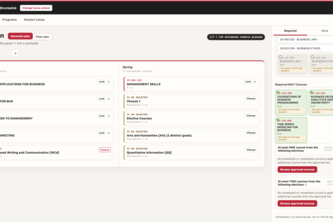
ScheduleRU is a self-reported tool designed to automate and simplify college course scheduling for students at public universities, particularly targeting those using legacy systems. It claims to support multi-program planning, filtering of class combinations, and integration with university data sources.
What changed
The project was initiated by an incoming Rutgers University student during a hackathon (Codex 2026) after observing widespread frustration with existing scheduling processes among peers. It evolved from a personal solution into a tool intended for broader deployment across multiple universities.
Single most important open question
Is there evidence of actual university adoption or integration, or is this a concept that remains unproven in real-world use?
Note: This analysis is based entirely on the self-reported project description provided by the authors. No independent verification, traction data, revenue figures, or customer feedback are available.
What The Product Actually Is
The description states that ScheduleRU is a tool that:
- Auto-schedules four-year academic plans
- Filters through over 500 class combinations per semester
- Supports multiple programs of study and double majors/minors
- Allows users to plan around a wishlist of courses without committing to full programs
- Includes quality-of-life features
It was built using cloudflare, css, html5, javascript, node.js, git, github, and reportedly with assistance from AI tools like Codex.
Inference: The product appears to be a web-based scheduling application aimed at students navigating complex university course structures. It is not evidenced to have any revenue model or monetization strategy beyond its initial development phase.
Positioning & Claim Evolution
The author positions ScheduleRU as:
- A solution to "legacy scheduling systems" at colleges
- A way to reduce the time spent on scheduling from hours to minutes
- A tool that supports students in planning for double majors and minors
- An alternative to fragmented, outdated tools used by universities
It evolved from a personal problem-solving effort into a scalable idea with ambitions to integrate into university systems.
Claim: The author claims that the tool was developed during a hackathon and has already gained traction among ~400 Rutgers students via word-of-mouth. However, no independent validation or data on usage is provided.
Target Customer & ICP
The description states:
- Primary users are college students, especially those at large public universities like Rutgers
- The tool supports students who want to pursue double majors or minors
- It targets individuals planning four-year academic paths
Inference: Based on the author's own experience and stated goals, the primary ICP is incoming or current undergraduate students at large state schools with complex course requirements.
Business Model & Pricing Evidence
No evidence of a business model or pricing strategy is provided in the description. The authors mention no revenue streams, subscriptions, or monetization plans.
Claim: There is no indication that ScheduleRU has begun generating revenue or intends to do so through paid services.
Technical & Delivery Signals
The project was built using:
- Frontend: HTML5, CSS
- Backend: Node.js
- Infrastructure: Cloudflare
- Version control: Git, GitHub
- Development process: AI-assisted workflows (Codex)
It reportedly involved scraping thousands of prerequisites and managing complex logic for course sequencing.
Inference: The technical stack suggests a basic web application with backend logic. The use of AI tools implies a rapid development approach but does not indicate scalability or robustness in production environments.
Traction & Maturity Signals
The description states:
- ~400 students signed up to use the product within two weeks of development
- A waitlist has been started
- The team is in talks with Rutgers University for beta testing and implementation
- Plans to expand to other universities (e.g., Michigan, Georgia Tech, UC system)
However, no actual user data, retention metrics, or adoption rates are shared.
Claim: While there is anecdotal evidence of interest and early engagement, there is no verified traction or measurable impact on student outcomes.
Competitive Context
The description does not provide any information about competitors or existing solutions in the market. It focuses solely on the problem of legacy scheduling systems and how ScheduleRU addresses it.
Inference: The competitive landscape remains unknown; however, given the nature of the tool, it likely competes with university-provided scheduling tools or third-party platforms that offer similar functionality.
Open Questions & Risks
- Unverified traction: No independent data on user numbers, engagement, or adoption.
- No revenue model: No indication of how the product will generate income.
- Limited technical maturity: Built in a short timeframe during a hackathon; no evidence of long-term stability or scalability.
- Dependency on AI tools: Reliance on AI for development may not translate into sustainable engineering practices.
- University integration claims: The claim of being in talks with Rutgers lacks confirmation.
Open Question: Lack of concrete evidence regarding product-market fit, user behavior, or real-world deployment.
Questions the description leaves open
- What specific data sources are used to build and validate the scheduling logic?
- How many students have actually used the tool beyond the initial group of ~400?
- Has Rutgers University confirmed any formal interest in integrating ScheduleRU into their system?
- Are there any technical limitations or known bugs that affect real-world usage?
- What is the plan for handling different university systems and data formats?
- How will the product evolve beyond its current scope (e.g., club recommendations, etc.)?
Overall Assessment
Not evidenced.
Note: The description provides no information on financials, team traction, or strategic positioning that would support an investment or partnership decision. The project remains in a pre-product-market-fit phase with unverified claims of adoption and interest.
User Stories BotA demo video on every pull request
Get a demo video on every new feature
GitHub App that watches your pull requests and records a narrated, captioned demo.
Save time on demo prep and make informed decisions faster with a video walkthrough of every new feature.
Source
Submitted to the OpenAI 2026 hackathon on Devpost. Project home on Devpost. Back to the full gallery on Devpost.
This competitive analysis was produced by top-founders.com (opens in a new tab)
Generated by a language model from this project's public Devpost page — its tagline, the author's own write-up and any built-with tags listed there — as captured in August 2026. Short quotations are the author's words. It is an opinion on the idea as a business, not on the people behind it, and it reflects the description as published then. If the project has moved on, request a correction below. The analysis is not independent research and contains no verified traction, revenue or customer data.
An independent guide by KFG International LLC — not affiliated with, endorsed by, or connected to Devpost or OpenAI.