

Archive position — measured, not model output
0 likes on Devpost
2,263 of the 7,850 archived projects have more likes, and 5,587 share exactly 0 — so this project's #6,497 place in the like-ranked listing is a tie-break inside that group, not a ranking.
Projects (log scale)
Likes on Devpost. ▲ marks this project's group.
Show the figures
| Likes | Projects | Share of archive |
|---|---|---|
| 0 | 5,587 | 71.2% |
| 1 | 1,758 | 22.4% |
| 2 | 284 | 3.6% |
| 3–4 | 132 | 1.7% |
| 5–9 | 75 | 1.0% |
| 10+ | 14 | 0.2% |
 User Stories BotA demo video on every pull request
Get a demo video on every new feature
GitHub App that watches your pull requests and records a narrated, captioned demo.
Save time on demo prep and make informed decisions faster with a video walkthrough of every new feature.
Executive Summary
The company described as "sadclaw" is a self-reported peer-support platform built around fictional identity and small, moderated moments of care. The author states that it is a privacy-first web app designed to replace popularity mechanics with gentle interaction. It uses a fictional-character identity system, human moderation, and structured data models to create a space where users can share one honest sentence without public visibility or pressure.
The project appears to be a single-person effort built during a hackathon. There is no evidence of revenue, customers, or traction beyond the author's own description. The product is described as a complete, responsive web app with anonymous authentication and moderation workflows, but no external validation or usage data exists.
The single most important open question is: What is the actual demand for this kind of support space, and how will it scale beyond a hackathon prototype?
This analysis is based entirely on self-reported information from the project description. No independent verification or historical data is available.
What The Product Actually Is
- The description states that sadclaw is a privacy-first peer-support space.
- It is built as a responsive HTML, CSS, and JavaScript web app.
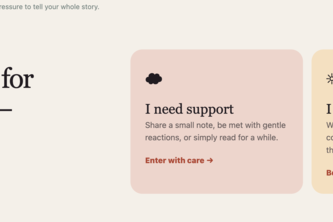
- Users can create profiles using fictional identities, such as “Today, I’m Frodo.”
- Users can share small notes at their own pace.
- Companions can leave optional supportive reactions like “Glad you told us” or “Here with you.”
- There are no follower counts, public comments, direct-message pressure, or rankings of pain.
- It includes an opt-in weekly Gathering, a private circle of small kindnesses around one person who chooses to receive it.
- Posts are created in a pending state and only become visible after human review.
- The system uses Supabase for anonymous authentication, profile persistence, posts, reactions, and row-level security.
- An optional Supabase Edge Function using GPT-5.6 is used to triage moderation labels but does not make final safety decisions.
This is a self-reported product built as a hackathon submission with no evidence of external adoption or commercial use.
Positioning & Claim Evolution
- The description states that sadclaw began with the question: “what if someone could arrive under a fictional identity, share one honest sentence, and feel witnessed without having to compete for attention?”
- It positions itself as an alternative to online spaces that ask people to be visible before they can be cared for, which it describes as places of comparison, unwanted advice, and pressure to explain pain perfectly.
- The author claims the product is built around “gentle, bounded interactions”.
- It reframes the “weekly spotlight” as an opt-in, private Gathering instead of a leaderboard.
- The goal is to create a space where care is not a contest.
These are claims about intent and positioning. No evidence exists that this approach has been validated or adopted by users beyond the author’s own experience.
Target Customer & ICP
- The description states that sadclaw is for people who need support, particularly those who may be struggling.
- It targets individuals who might feel pressure in traditional online spaces and want to arrive under a fictional identity.
- Users are described as needing emotional distance and control over their disclosures.
- The platform is designed for people who prefer small, moderated moments of care rather than public or competitive interactions.
No evidence of actual customer segments or personas is provided. The ICP is inferred from the author’s stated intent and user flow.
Business Model & Pricing Evidence
- No pricing information, monetization strategy, or business model is described.
- The description does not mention any revenue streams, subscriptions, or paid features.
- It is unclear whether sadclaw intends to be a free service, a paid product, or a non-commercial initiative.
Not evidenced.
Technical & Delivery Signals
- Built with HTML, CSS, JavaScript, and Ember.js.
- Uses a custom visual system called midnight, parchment.
- Implements Supabase for authentication, data storage, and row-level security.
- Posts are created in a pending state and reviewed before publication.
- An optional Supabase Edge Function using GPT-5.6 is used to triage moderation labels but does not make final decisions.
- Uses Codex to accelerate development from concept to deployment.
- The product is described as a complete, polished, responsive web app.
These are technical claims made by the author. No evidence of scalability, performance, or production use is provided.
Traction & Maturity Signals
- The project was submitted to the OpenAI 2026 hackathon, indicating it is a prototype.
- It was built by a single team member (Rishabh Verma).
- The author states that they built a complete, polished, responsive product experience rather than a single mockup.
- There is no evidence of user adoption, retention, or engagement metrics.
- No mention of customer acquisition, usage data, or growth.
Not evidenced.
Competitive Context
- The description does not name any competitors or reference existing peer-support platforms.
- It positions itself as an alternative to spaces that ask people to be visible before they can be cared for, which may include social media or public forums.
- No evidence of competitive analysis, market size, or positioning relative to other mental health or support tools is provided.
Not evidenced.
Open Questions & Risks
- The product is described as a single-person hackathon project, with no indication of team expansion or commercialization plans.
- It relies heavily on human moderation, which may not scale and could be resource-intensive.
- The use of GPT-5.6 in moderation is noted, but the system is explicitly designed to avoid irreversible AI decisions — this raises questions about how AI will evolve or be integrated in future versions.
- There is no evidence of user testing with mental health professionals or people with lived experience, despite the author’s stated intention to do so.
- The platform is built around a fictional identity model, which may not resonate with all users or be scalable.
Questions the description leaves open
- What specific user needs are you trying to meet, and how did you identify them?
- How do you plan to scale moderation beyond a single person?
- What is your strategy for validating the demand for this type of support space?
- Have you conducted any usability testing with mental health professionals or people with lived experience?
- Are there any plans to monetize or sustain the platform beyond its current prototype?
- How do you intend to onboard users and build community around the fictional identity model?
Overall Assessment
- The project is a self-reported hackathon prototype built by one person.
- It has no evidence of traction, revenue, or customer validation.
- It is positioned as a privacy-first peer-support platform, but there is no indication of market demand or commercial viability.
- The author’s stated goals are aligned with creating a gentler online space, but the lack of external validation makes it difficult to assess whether this approach will scale or attract users.
Not evidenced.
This project appears to be an early-stage concept with strong intent but no demonstrated product-market fit or commercial traction. It is not ready for investment or partnership without further development and evidence of user engagement.
User Stories BotA demo video on every pull request
Get a demo video on every new feature
GitHub App that watches your pull requests and records a narrated, captioned demo.
Save time on demo prep and make informed decisions faster with a video walkthrough of every new feature.
Source
Submitted to the OpenAI 2026 hackathon on Devpost. Project home on Devpost. Back to the full gallery on Devpost.
This competitive analysis was produced by top-founders.com (opens in a new tab)
Generated by a language model from this project's public Devpost page — its tagline, the author's own write-up and any built-with tags listed there — as captured in August 2026. Short quotations are the author's words. It is an opinion on the idea as a business, not on the people behind it, and it reflects the description as published then. If the project has moved on, request a correction below. The analysis is not independent research and contains no verified traction, revenue or customer data.
An independent guide by KFG International LLC — not affiliated with, endorsed by, or connected to Devpost or OpenAI.