

Archive position — measured, not model output
1 like on Devpost
505 of the 7,850 archived projects have more likes, and 1,758 share exactly 1 — so this project's #610 place in the like-ranked listing is a tie-break inside that group, not a ranking.
Projects (log scale)
Likes on Devpost. ▲ marks this project's group.
Show the figures
| Likes | Projects | Share of archive |
|---|---|---|
| 0 | 5,587 | 71.2% |
| 1 | 1,758 | 22.4% |
| 2 | 284 | 3.6% |
| 3–4 | 132 | 1.7% |
| 5–9 | 75 | 1.0% |
| 10+ | 14 | 0.2% |
 User Stories BotA demo video on every pull request
Get a demo video on every new feature
GitHub App that watches your pull requests and records a narrated, captioned demo.
Save time on demo prep and make informed decisions faster with a video walkthrough of every new feature.
Executive Summary
What the company appears to be
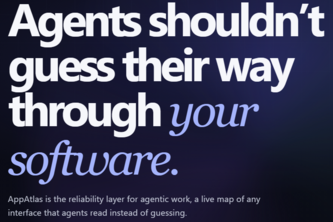
AppAtlas is a self-reported tool that builds navigable graphs of web applications from screenshots, turning UI elements into first-class nodes with selectors. It claims to enable AI agents to navigate unfamiliar software using a "map" instead of guessing, and exposes this map via an MCP server.
What changed
The author states they built the system using Codex on GPT-5.6, with an evaluation harness written before implementation. They claim to have solved key technical challenges like silent failures, control-level granularity in graphs, and semantic search alignment for embedding models.
Single most important open question
Does AppAtlas actually work as described? The description lacks evidence of real-world testing or validation beyond the author's own claims — no customers, no usage data, no performance metrics outside of internal evaluation.
What The Product Actually Is
The description states that AppAtlas:
- Crawls web applications and builds a navigable graph.
- Captures both pages and individual controls (e.g., toggles, fields) as nodes.
- Uses selectors to operate these elements directly.
- Serves this graph over an MCP server for AI agents.
- Includes analytics features like dead ends or user question tracking.
It is described as being built with:
- Crawler: Playwright
- Graph engine: NetworkX
- Retrieval method: Hybrid TF-IDF and embeddings
- Backend: FastAPI
- Frontend: React + Vite
- Tooling stack includes: Codex, GPT-5.6 Terra, cytoscape.js, mcp, openai-codex, scikit-learn, numpy, sqlite, tailwindcss, typescript, uvicorn, vite
Inference The product appears to be a proof-of-concept or prototype built in a hackathon context, likely not yet production-ready. It is described as an experimental system with no evidence of deployment or integration.
Positioning & Claim Evolution
The author claims:
- AI agents currently struggle to navigate unknown interfaces.
- AppAtlas provides a "map" that allows agents to avoid guesswork.
- The system supports both keyword and semantic retrieval.
- Agents can call tools autonomously without needing access to the app itself.
- It enables “zero integration” for any application.
There is no evidence of prior positioning or evolution in claims — only one version of the narrative presented by the author.
Inference This is a self-described innovation aimed at solving agent navigation problems, but it has not been validated through real-world use cases or comparisons to existing tools.
Target Customer & ICP
The description states:
- The target is teams who hand more work to agents.
- These are teams using internal tools, dashboards, and admin panels.
- It aims to help with agent-driven software interaction in general-purpose applications.
No specific customer segments, personas, or use cases beyond “teams” are defined.
Inference The ICP seems to be early-stage developers or product teams experimenting with AI agents, but there is no clear segmentation or targeting strategy evidenced.
Business Model & Pricing Evidence
There is no mention of pricing, monetization, or business model in the description. The author does not state whether this is a freemium offering, SaaS, or open-source project.
Inference No commercial structure is evident from the self-reported content.
Technical & Delivery Signals
The description states:
- Built using Codex on GPT-5.6 Terra.
- Evaluation harness written before search logic.
- Uses Playwright for crawling and NetworkX for graphing.
- Supports hybrid retrieval (TF-IDF + embeddings).
- Backend built with FastAPI, frontend with React/Vite.
- MCP server exposes four tools: answer_question, find_workflow, search_interface, analyze_interface.
Inference The technical stack suggests a prototype or experimental build. There is no evidence of scalability, reliability, or production-grade infrastructure.
Traction & Maturity Signals
The description states:
- Built in one hackathon.
- Uses an evaluation harness to measure accuracy and recall.
- Has a demo agent that calls tools autonomously.
- Includes analytics side for interface insights.
However, there is no evidence of:
- Customers or users
- Revenue or monetization
- Product adoption or usage metrics
- Deployment or integration in real systems
Inference The project shows early development maturity but lacks any traction signals. It appears to be a proof-of-concept with limited validation.
Competitive Context
The description does not reference competitors or similar products. It is unclear whether AppAtlas is positioned against existing UI mapping, agent navigation, or interface automation tools.
Inference No competitive positioning or landscape analysis is evident in the self-reported content.
Open Questions & Risks
- Unverified claims: All technical and functional assertions are self-reported.
- No real-world testing: No evidence of actual deployment or user feedback.
- Prototype nature: Built in a hackathon, likely not production-ready.
- Silent failures: The author notes issues with silent errors that degrade performance without detection.
- Tooling dependency: Relies heavily on Codex and GPT-5.6 Terra — not scalable or independent.
- Lack of commercial viability: No pricing, monetization, or customer data.
Inference This is a speculative tool with no demonstrated value proposition beyond its own claims.
Questions the description leaves open
- What specific problems are you solving for users? How do you know they exist?
- Have you tested AppAtlas on real applications? If so, what were the results?
- Is there any evidence of adoption or feedback from early users?
- What is your plan to move beyond a hackathon prototype into a usable product?
- Can you demonstrate how AppAtlas integrates with actual AI agents in practice?
- How do you intend to scale this beyond one developer’s environment?
Overall Assessment
The description states that AppAtlas was built for the OpenAI 2026 hackathon and is a self-reported prototype. There is no evidence of traction, revenue, or customer validation.
Inference This is an unproven concept with no demonstrated commercial viability. It may be a promising idea in need of further development, but as presented, it lacks the foundation for investment or partnership consideration.
User Stories BotA demo video on every pull request
Get a demo video on every new feature
GitHub App that watches your pull requests and records a narrated, captioned demo.
Save time on demo prep and make informed decisions faster with a video walkthrough of every new feature.
Source
Submitted to the OpenAI 2026 hackathon on Devpost. Project home on Devpost. Back to the full gallery on Devpost.
This competitive analysis was produced by top-founders.com (opens in a new tab)
Generated by a language model from this project's public Devpost page — its tagline, the author's own write-up and any built-with tags listed there — as captured in August 2026. Short quotations are the author's words. It is an opinion on the idea as a business, not on the people behind it, and it reflects the description as published then. If the project has moved on, request a correction below. The analysis is not independent research and contains no verified traction, revenue or customer data.
An independent guide by KFG International LLC — not affiliated with, endorsed by, or connected to Devpost or OpenAI.