

Archive position — measured, not model output
1 like on Devpost
505 of the 7,850 archived projects have more likes, and 1,758 share exactly 1 — so this project's #611 place in the like-ranked listing is a tie-break inside that group, not a ranking.
Projects (log scale)
Likes on Devpost. ▲ marks this project's group.
Show the figures
| Likes | Projects | Share of archive |
|---|---|---|
| 0 | 5,587 | 71.2% |
| 1 | 1,758 | 22.4% |
| 2 | 284 | 3.6% |
| 3–4 | 132 | 1.7% |
| 5–9 | 75 | 1.0% |
| 10+ | 14 | 0.2% |
 User Stories BotA demo video on every pull request
Get a demo video on every new feature
GitHub App that watches your pull requests and records a narrated, captioned demo.
Save time on demo prep and make informed decisions faster with a video walkthrough of every new feature.
Executive Summary
Company: applyfree
Self-reported basis: The analysis is based entirely on the project description supplied by the caller — its name, tagline, the author's own write-up, and any technology tags. No archived history, third-party sources or independent verification are available.
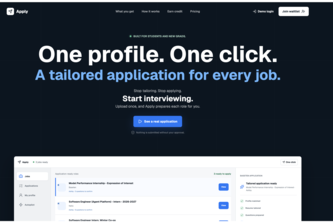
What it appears to be: A browser automation tool that uses AI to complete job applications on behalf of users. It is described as an “AI-powered job application service” that automates repetitive tasks during the job application process.
What changed: The project was submitted to the OpenAI 2026 hackathon, suggesting it is a prototype or early-stage product.
Single most important open question: Is there any evidence of user adoption, revenue, or traction beyond the author’s self-description?
What The Product Actually Is
The description states that applyfree is an AI-powered job application service. It allows users to provide their profile and a job URL, after which it automatically navigates the application, fills known information, uploads the correct resume, handles validation, and reaches the final Review page.
It only requires user input when human involvement is necessary — such as logging in, completing MFA or CAPTCHA, answering unknown personal questions, or approving the final submission.
The system uses a three-stage architecture:
- AI explores unfamiliar applications by reading screenshots and deciding browser actions.
- It converts this exploration into a deterministic runner using stable identifiers.
- The runner completes future applications via Chrome DevTools Protocol without reusing AI for each click.
Evidence: The author describes the product’s functionality, architecture, and use of technologies like Python, Node.js, Playwright, and CDP.
Inference: The system is built to reduce manual effort in job applications by combining AI exploration with deterministic execution.
Positioning & Claim Evolution
The tagline is: “one click job apply agent”.
The author states that the product aims to combine the intelligence of AI with the reliability of deterministic software, addressing issues like repetitive and frustrating application processes.
It positions itself as a solution between cheap but fragile automation scripts and expensive but unpredictable AI-driven agents.
Evidence: The description includes the tagline and the stated intent to improve job application workflows.
Inference: The product is positioned as a hybrid automation tool that balances cost, reliability, and intelligence.
Target Customer & ICP
The author states that applyfree is intended for job seekers who apply to internships and face repetitive, frustrating application processes.
It targets users who want to automate the filling of known information in job applications but may still need human input for login, CAPTCHA, or unknown questions.
Evidence: The description mentions that it helps candidates with repetitive tasks and that users must return when human involvement is needed.
Inference: The target customer is likely a job seeker applying to multiple roles, especially internships, where automation can reduce time spent on routine steps.
Business Model & Pricing Evidence
The author states that the intended business model is simple: users pay per successfully completed application.
There is no mention of pricing tiers, subscription models, or other monetization methods beyond this single payment structure.
Evidence: The description explicitly states the intended business model.
Inference: The product is likely designed to be used on a per-application basis, suggesting a transactional or usage-based pricing model.
Technical & Delivery Signals
The system uses:
- AI for initial exploration of unfamiliar applications
- A deterministic runner built from AI exploration
- Chrome DevTools Protocol (CDP) for execution
- Technologies like Python, Node.js, Playwright, Next.js
It is described as having a three-stage architecture that transitions from AI-driven exploration to deterministic execution.
Evidence: The author describes the technical stack and architecture in detail.
Inference: The product uses a hybrid approach combining AI for discovery with deterministic automation for execution, which may reduce long-term costs and improve reliability.
Traction & Maturity Signals
The project was submitted to the OpenAI 2026 hackathon, indicating it is likely a prototype or early-stage idea.
There is no evidence of revenue, customers, user adoption, or product maturity beyond this submission.
Evidence: The description states that it was built for a hackathon and includes no data on usage, traction, or monetization.
Inference: The project is in an early stage and lacks any demonstrated market traction or commercial viability.
Competitive Context
The author does not mention competitors or the broader marketplace.
They describe the problem as being between traditional automation scripts (cheap but fragile) and fully AI-driven agents (expensive and unpredictable).
Evidence: No competitor names, market size, or competitive positioning are provided.
Inference: The product is positioned to address a gap in the job application automation space, but no competitive landscape is described.
Open Questions & Risks
- No revenue or customer data: There is no evidence of any monetization or user base.
- Early-stage prototype: Submitted to a hackathon, suggesting it is not yet a mature product.
- Unproven business model: The pricing model (pay per application) has not been tested in the market.
- AI cost concerns: The initial AI exploration phase may be expensive and inefficient if not optimized.
- Limited scope: It only handles known information and requires human input for certain steps, limiting its automation potential.
Evidence: These are inferred from the lack of traction, early-stage submission, and unverified claims.
Questions the description leaves open
- What is the current state of the product? Is it in active development or a prototype?
- Have you tested the product with real users or job applications?
- How do you plan to scale the AI exploration phase to handle diverse application platforms?
- What are your plans for monetization beyond per-application fees?
- Are there any legal or ethical concerns around automating job applications (e.g., platform terms of service)?
- What is the expected cost per application, and how does that compare to user willingness to pay?
Overall Assessment
Not evidenced: There is no evidence of revenue, customer traction, or market validation beyond the author’s self-description.
The project appears to be a hackathon submission with an early-stage idea. It has not demonstrated any commercial viability, user adoption, or product maturity.
Confidence level: Low — based on minimal evidence and lack of independent verification.
Assessment: Not ready for investment or partnership. Requires further development, traction, and market validation before it can be considered a viable business.
User Stories BotA demo video on every pull request
Get a demo video on every new feature
GitHub App that watches your pull requests and records a narrated, captioned demo.
Save time on demo prep and make informed decisions faster with a video walkthrough of every new feature.
Source
Submitted to the OpenAI 2026 hackathon on Devpost. Project home on Devpost. Back to the full gallery on Devpost.
This competitive analysis was produced by top-founders.com (opens in a new tab)
Generated by a language model from this project's public Devpost page — its tagline, the author's own write-up and any built-with tags listed there — as captured in August 2026. Short quotations are the author's words. It is an opinion on the idea as a business, not on the people behind it, and it reflects the description as published then. If the project has moved on, request a correction below. The analysis is not independent research and contains no verified traction, revenue or customer data.
An independent guide by KFG International LLC — not affiliated with, endorsed by, or connected to Devpost or OpenAI.