

Archive position — measured, not model output
0 likes on Devpost
2,263 of the 7,850 archived projects have more likes, and 5,587 share exactly 0 — so this project's #4,537 place in the like-ranked listing is a tie-break inside that group, not a ranking.
Projects (log scale)
Likes on Devpost. ▲ marks this project's group.
Show the figures
| Likes | Projects | Share of archive |
|---|---|---|
| 0 | 5,587 | 71.2% |
| 1 | 1,758 | 22.4% |
| 2 | 284 | 3.6% |
| 3–4 | 132 | 1.7% |
| 5–9 | 75 | 1.0% |
| 10+ | 14 | 0.2% |
 User Stories BotA demo video on every pull request
Get a demo video on every new feature
GitHub App that watches your pull requests and records a narrated, captioned demo.
Save time on demo prep and make informed decisions faster with a video walkthrough of every new feature.
Executive Summary
What the company appears to be:
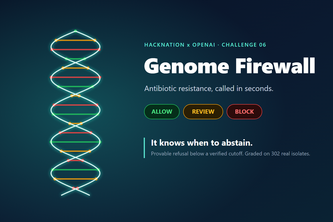
HonestG Genome Firewall is a self-reported bioinformatics tool designed to support clinical decisions on antibiotic resistance by analyzing bacterial genome sequences. It claims to offer a more honest and calibrated approach than standard models, using techniques like lineage-based cross-validation, class-balanced regression, and a no-answer threshold to avoid false confidence.
What changed:
The project was submitted as part of the OpenAI 2026 hackathon. The author describes building a system that prioritizes transparency over performance metrics, focusing on avoiding misleading predictions through calibrated abstention and clear rationale generation.
Single most important open question:
Is there evidence of real-world application or validation beyond the author's own testing environment?
What The Product Actually Is
The description states that HonestG Genome Firewall is a tool that takes an assembled bacterial genome (e.g., K. pneumoniae) and returns one of three outputs for each antibiotic: ALLOW, BLOCK, or REVIEW. Each result includes:
- A calibrated confidence level
- The specific genes responsible
- A plain-language rationale
It uses:
- AMRFinderPlus via Docker
- Logistic regression with class-balanced training
- A threshold-based no-call mechanism (i.e., it refuses to predict below a certain confidence)
- A Clopper-Pearson error bound for each drug’s prediction accuracy
- GPT-5-mini for rationale generation, with a deterministic fallback
The system is built in Python using libraries like scikit-learn, Streamlit, and Plotly. It processes real data from NCBI's BV-BRC database (302 K. pneumoniae genomes) and includes cross-species testing on E. coli.
Inference: The tool appears to be a proof-of-concept or prototype rather than a production-ready product, given its hackathon context and lack of customer or deployment details.
Positioning & Claim Evolution
The author positions HonestG Genome Firewall as a decision-support system, not a diagnostic tool. It emphasizes:
- Transparency in uncertainty
- Avoidance of false confidence via calibrated abstention
- A "no-answer guarantee" that prevents guessing when evidence is insufficient
Key claims include:
- It provably refuses to guess (i.e., emits no-call when below threshold)
- Uses lineage-based splits to prevent data leakage
- Provides bounded error estimates per drug
- Generates plain-language rationales using GPT-5-mini with fallback logic
Inference: The positioning reflects a shift from typical ML models that prioritize accuracy over honesty, suggesting a focus on trustworthiness and interpretability.
Target Customer & ICP
The description does not explicitly name target customers or define an Ideal Customer Profile (ICP). However, it implies:
- Clinicians or lab technicians who need rapid, reliable antibiotic resistance testing
- Healthcare institutions seeking better decision support tools for managing resistant infections
It is framed as a clinical decision-support tool, but no explicit end-user segment or institutional buyer profile is described.
Inference: The likely users are medical professionals working in infectious disease diagnostics or microbiology labs. However, the lack of customer data makes this speculative.
Business Model & Pricing Evidence
There is no evidence provided regarding:
- Revenue model
- Pricing structure
- Monetization strategy
- Customer acquisition plans
The project is described as a hackathon submission and lacks any indication of commercial viability or monetization efforts.
Inference: No business model or pricing information is evident from the description.
Technical & Delivery Signals
The system uses:
- AMRFinderPlus (via Docker)
- Logistic regression with class-balanced training
- Platt calibration
- Cross-validation using whole MLST lineages to prevent data leakage
- A deterministic intrinsic-resistance gate (e.g., K. pneumoniae is intrinsically ampicillin-resistant)
- GPT-5-mini for rationale generation, with offline fallback
It includes:
- Per-drug confidence thresholds (\tau_d)
- Clopper-Pearson bounds on error rates
- Three output categories: ALLOW, BLOCK, REVIEW
- A “confirm with standard lab testing” banner on all results
Inference: The technical stack suggests a lightweight, reproducible prototype built for transparency and interpretability. It is not described as scalable or integrated into existing workflows.
Traction & Maturity Signals
There is no evidence of:
- Customers
- Revenue
- Product adoption
- Market traction
- Deployment in clinical settings
The project is presented as a hackathon submission, with no mention of pilot programs, partnerships, or real-world use cases.
Inference: No signs of maturity or traction beyond the author’s own development and testing.
Competitive Context
The description does not reference:
- Competing products
- Market landscape
- Direct competitors in AMR diagnostics or bioinformatics tools
It focuses on the novelty of its honesty thesis rather than comparing itself to existing solutions.
Inference: The competitive context is unknown, but it likely operates within the broader field of antimicrobial resistance (AMR) testing and genomics-based diagnostics.
Open Questions & Risks
- Unproven clinical utility: No evidence that the tool has been tested in real-world clinical settings.
- Limited validation: Only one developer (Louis Vanhove) is mentioned, with no team or external validation.
- Prototype nature: Submitted as a hackathon project; unclear if it's intended for production use.
- Dependency on GPT-5-mini: Reliance on an LLM for rationale generation introduces potential inconsistency and opacity.
- No commercialization plan: No indication of how the tool would be monetized or scaled.
Inference: The risk of misalignment between the author’s vision and real-world application is high due to lack of external validation, clinical integration, or scalability planning.
Questions the description leaves open
- Has the system been validated in any clinical setting?
- What are the performance metrics on actual patient samples?
- How does the tool integrate into current lab workflows?
- Are there plans to expand beyond K. pneumoniae or include more species?
- What is the timeline for moving from prototype to production-ready version?
- How will the system handle edge cases or novel resistance mechanisms not present in training data?
- Is there any interest from hospitals, clinics, or health authorities in piloting this tool?
Overall Assessment
Not evidenced: There is no evidence of revenue, customers, traction, or a clear path to monetization.
The project is described as a hackathon submission with no indication of commercial intent or progress toward market readiness. The author’s focus on honesty and interpretability is compelling but does not signal a viable business model or scalable product.
Confidence Level: Low — based entirely on self-reported information without external corroboration.
User Stories BotA demo video on every pull request
Get a demo video on every new feature
GitHub App that watches your pull requests and records a narrated, captioned demo.
Save time on demo prep and make informed decisions faster with a video walkthrough of every new feature.
Source
Submitted to the OpenAI 2026 hackathon on Devpost. Project home on Devpost. Back to the full gallery on Devpost.
This competitive analysis was produced by top-founders.com (opens in a new tab)
Generated by a language model from this project's public Devpost page — its tagline, the author's own write-up and any built-with tags listed there — as captured in August 2026. Short quotations are the author's words. It is an opinion on the idea as a business, not on the people behind it, and it reflects the description as published then. If the project has moved on, request a correction below. The analysis is not independent research and contains no verified traction, revenue or customer data.
An independent guide by KFG International LLC — not affiliated with, endorsed by, or connected to Devpost or OpenAI.