

Archive position — measured, not model output
1 like on Devpost
505 of the 7,850 archived projects have more likes, and 1,758 share exactly 1 — so this project's #613 place in the like-ranked listing is a tie-break inside that group, not a ranking.
Projects (log scale)
Likes on Devpost. ▲ marks this project's group.
Show the figures
| Likes | Projects | Share of archive |
|---|---|---|
| 0 | 5,587 | 71.2% |
| 1 | 1,758 | 22.4% |
| 2 | 284 | 3.6% |
| 3–4 | 132 | 1.7% |
| 5–9 | 75 | 1.0% |
| 10+ | 14 | 0.2% |
 User Stories BotA demo video on every pull request
Get a demo video on every new feature
GitHub App that watches your pull requests and records a narrated, captioned demo.
Save time on demo prep and make informed decisions faster with a video walkthrough of every new feature.
Executive Summary
What the company appears to be
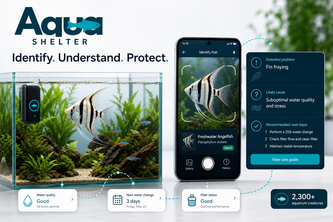
AquaShelter is a self-reported connected aquarium-care platform for fishkeepers and aquarium shops, built as a hackathon submission. The author states it combines an Android app with a PHP/MySQL web platform, using AI tools like GPT-5.6 and Codex during development.
What changed
The project was submitted to the OpenAI 2026 hackathon. No evidence of prior existence or commercial activity is provided.
Single most important open question
Is there any evidence of actual user adoption, revenue, or traction beyond the author’s own description?
What The Product Actually Is
The description states that AquaShelter is a connected aquarium-care platform for fishkeepers and aquarium shops. It includes:
- Management of aquariums, creatures, water conditions, and maintenance tasks.
- Reminders for care due.
- Fish identification from photo.
- A catalog with 2,232 fish and over 2,300 aquarium creatures (plants, corals, invertebrates).
- Guided fish-health workflow including symptom recording, diagnosis history, and treatment guidance.
- Synchronization between Android app and web platform for tanks, tasks, notifications, profiles, credits, and health cases.
- Support for both individual users and aquarium shops.
The product is described as not replacing a qualified aquatic veterinarian.
Evidence
- Author’s own write-up
- Technology stack: Android, PHP, MySQL, REST APIs
Inference This appears to be a hybrid mobile-web application with AI-assisted features for fish health guidance and task management.
Positioning & Claim Evolution
The author claims AquaShelter was inspired by personal loss due to neglecting aquarium care. The platform is positioned as a tool to prevent such losses through structured reminders, identification, and health guidance.
It also positions itself as a solution for both individual fishkeepers and aquarium shops, allowing shop owners to manage their tanks and follow connected customer tanks.
Evidence
- Inspiration from personal loss
- Claims about preventing user error
- Mention of support for shops
Inference The positioning evolved from a personal tool into a broader platform for community and commercial use, though no evidence supports either adoption or market traction.
Target Customer & ICP
The description states that AquaShelter targets:
- Fishkeepers (individuals)
- Aquarium shops
It allows both types of users to manage tanks, tasks, and health cases, with the shop version enabling oversight of connected customer tanks.
Evidence
- Explicit mention of targeting fishkeepers and aquarium shops
- Functionality for managing customer tanks from a shop perspective
Inference There is no evidence of actual segmentation or ICP validation beyond stated intent.
Business Model & Pricing Evidence
No explicit business model or pricing information is provided in the description. The author mentions billing credits, but does not describe how these are monetized or whether there are paid features.
Evidence
- Reference to “billing credits”
- No mention of subscriptions, freemium tiers, or monetization strategy
Inference The business model remains unclear and unverified.
Technical & Delivery Signals
The product is built using:
- Native Android app
- PHP/MySQL web platform
- REST APIs for communication between mobile and web
- AI tools (Codex, GPT-5.6) used during development
- Authenticated API integration
- Responsive layouts and offline handling
- Automated testing workflows
Evidence
- Technology stack listed in description
- Claims about API use, authentication, synchronization
- Use of Codex and GPT-5.6 for engineering tasks
Inference The technical architecture suggests a functional MVP with backend integration, but no evidence of production deployment or scalability.
Traction & Maturity Signals
There is no evidence of user adoption, revenue, customer base, or product maturity beyond the hackathon submission.
The author states they are planning to publish on Google Play and expand the catalog, implying this is a work-in-progress.
Evidence
- No mention of users, customers, or sales
- No data on usage, retention, or monetization
Inference This is an early-stage product with no demonstrated traction or market validation.
Competitive Context
No competitive landscape or competitor analysis is provided in the description. The author does not reference existing platforms for aquarium care or fish health guidance.
Evidence
- No mention of competitors
- No comparison to other tools or services
Inference The competitive context is unknown and unverified.
Open Questions & Risks
- Unverified claims: All statements are self-reported, with no independent verification.
- No traction or revenue: No evidence of users, customers, or monetization.
- AI dependency: Heavy reliance on AI tools during development raises questions about long-term maintainability and scalability.
- Limited team size: Only one member listed, which may limit execution capacity.
- Unproven market fit: No evidence that the product solves a real market need beyond personal experience.
Evidence
- Self-reported nature of all claims
- Lack of user data or revenue metrics
Questions the description leaves open
- What is your actual user base, if any?
- How do you plan to monetize the platform beyond billing credits?
- Have you validated demand for this product in the market?
- What are the technical challenges you've faced in scaling the backend or mobile app?
- Are there any legal or regulatory considerations related to health guidance for fish?
- How do you intend to expand the creature database and improve accuracy of health diagnostics?
Overall Assessment
Not evidenced.
The description provides no information about financials, traction, or commercial viability. It is a self-reported hackathon project with no evidence of revenue, users, or product-market fit.
Confidence Level Low This analysis is based entirely on the author’s own account, which lacks corroboration or independent validation.
User Stories BotA demo video on every pull request
Get a demo video on every new feature
GitHub App that watches your pull requests and records a narrated, captioned demo.
Save time on demo prep and make informed decisions faster with a video walkthrough of every new feature.
Source
Submitted to the OpenAI 2026 hackathon on Devpost. Project home on Devpost. Back to the full gallery on Devpost.
This competitive analysis was produced by top-founders.com (opens in a new tab)
Generated by a language model from this project's public Devpost page — its tagline, the author's own write-up and any built-with tags listed there — as captured in August 2026. Short quotations are the author's words. It is an opinion on the idea as a business, not on the people behind it, and it reflects the description as published then. If the project has moved on, request a correction below. The analysis is not independent research and contains no verified traction, revenue or customer data.
An independent guide by KFG International LLC — not affiliated with, endorsed by, or connected to Devpost or OpenAI.