

Archive position — measured, not model output
1 like on Devpost
505 of the 7,850 archived projects have more likes, and 1,758 share exactly 1 — so this project's #614 place in the like-ranked listing is a tie-break inside that group, not a ranking.
Projects (log scale)
Likes on Devpost. ▲ marks this project's group.
Show the figures
| Likes | Projects | Share of archive |
|---|---|---|
| 0 | 5,587 | 71.2% |
| 1 | 1,758 | 22.4% |
| 2 | 284 | 3.6% |
| 3–4 | 132 | 1.7% |
| 5–9 | 75 | 1.0% |
| 10+ | 14 | 0.2% |
 User Stories BotA demo video on every pull request
Get a demo video on every new feature
GitHub App that watches your pull requests and records a narrated, captioned demo.
Save time on demo prep and make informed decisions faster with a video walkthrough of every new feature.
Executive Summary
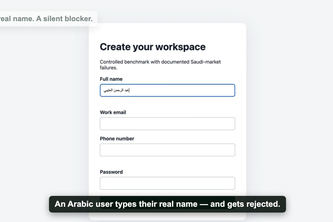
The description states that "Arabic Market Blocker Agent" is a tool designed to audit web forms for Arabic-market readiness by simulating signup flows using both English and Arabic browser personas. It claims to identify form validation issues that prevent Arabic users from completing signups, generating evidence and regression tests for each finding.
What changed: The author describes this as an automated version of a freelance service they previously offered, built during a hackathon.
The single most important open question — the commercial due-diligence read: Is there a viable market need for this tool beyond the author's own freelance work?
The description is self-reported and unverified. No evidence of revenue, customers, or traction is provided. The tool appears to be built as a proof-of-concept with limited commercial application.
What The Product Actually Is
- The description states that it is an AI-powered tool that audits web forms for Arabic-market readiness.
- It runs real browser sessions twice — once in English (en-US) and once with an Arabic persona (Saudi Arabia or UAE).
- It fills the same form with realistic values, including Arabic names, +966 phone numbers, and Arabic-Indic numerals.
- It compares results between the two sessions to identify "market-specific blockers."
- Findings include screenshots, DOM locators, error messages, and ready-to-run Playwright regression tests.
- The tool uses GPT-5.6 for adaptive planning during audits.
Not evidenced: No information on pricing, customer base, or commercial deployment details.
Positioning & Claim Evolution
- The description positions the tool as a solution to silent form validation issues that exclude 400M+ Arabic speakers.
- It claims to automate a freelance service the author previously ran.
- The tool is described as capable of identifying whether a form issue is specific to Arabic users or a general problem.
- It emphasizes honesty in reporting: it will not label a general form issue as an Arabic blocker.
- The project was submitted to the OpenAI 2026 hackathon, suggesting a focus on innovation and proof-of-concept.
Not evidenced: No claims about market traction, adoption, or competitive positioning beyond its own description.
Target Customer & ICP
- The description states that the tool is for companies with web forms that may block Arabic users.
- It targets developers or product teams who want to ensure their signup flows are accessible to Arabic speakers.
- The author notes that the tool was built from a freelance service, implying a B2B audience.
Not evidenced: No specific customer personas, use cases, or target industries are detailed. No evidence of existing customers or market segmentation.
Business Model & Pricing Evidence
- The description does not state any pricing model or business model.
- It is described as a tool built during a hackathon and deployed for demonstration purposes.
- There is no mention of monetization, licensing, or subscription models.
Not evidenced: No evidence of revenue streams, pricing tiers, or commercial viability.
Technical & Delivery Signals
- Built with React, Express.js, Node.js, Playwright, and GPT-5.6.
- Uses a pipeline that includes URL safety gate, isolated browser execution, DOM extraction, GPT-5.6 planner, evidence verification, and test generation.
- The tool is described as flow-agnostic and capable of adding new markets with minimal effort (e.g., one JSON file for UAE).
- It includes a fallback mechanism for when the GPT planner times out.
- The system enforces server-side no-submission of real forms to prevent ethical issues.
Not evidenced: No information on scalability, performance metrics, or deployment architecture beyond the development stack.
Traction & Maturity Signals
- The project was submitted to a hackathon (OpenAI 2026).
- It claims a precision/recall of 1.0 on a seeded benchmark with 2 ground-truth blockers.
- Verified against real external sites, including LambdaTest's demo store.
- 21/21 tests passing, MIT licensed, and live and reproducible.
- The tool is described as being able to add new markets in under an hour.
Not evidenced: No evidence of customer adoption, revenue, or usage beyond the author’s own testing.
Competitive Context
- The description does not mention any direct competitors.
- It implies a niche market for form validation tools that consider internationalization and localization.
- It is positioned as an automated version of a freelance service, suggesting potential indirect competition from freelancers or consulting firms offering similar audits.
Not evidenced: No competitive landscape analysis or market positioning against existing tools.
Open Questions & Risks
- The tool is described as a hackathon project with no commercial traction or revenue.
- It relies heavily on GPT-5.6, which may not be scalable or cost-effective for widespread use.
- The tool only observes form behavior and does not submit real data, limiting its utility for some types of audits.
- No evidence of a sustainable business model or customer base.
- The author is a single individual (team size: 1), raising questions about scalability.
Not evidenced: No data on market demand, user feedback, or long-term viability beyond the project’s current state.
Questions the description leaves open
- What specific companies or industries are you targeting with this tool?
- How do you plan to monetize this product beyond your own freelance work?
- Have you identified any existing tools or services that perform similar functions?
- What is the expected cost of running this tool at scale, particularly with GPT-5.6?
- Are there any legal or ethical concerns around auditing third-party forms without explicit permission?
- How do you plan to expand beyond Arabic markets and form types?
Overall Assessment
The description states that the tool was built during a hackathon and is currently in a proof-of-concept stage.
Not evidenced: No evidence of commercial viability, traction, or investment interest.
The tool appears to be an innovative idea with potential but lacks any demonstrated market demand or business model. It is not clear whether this represents a viable product or service that could attract customers or investors beyond the author’s own freelance work.
User Stories BotA demo video on every pull request
Get a demo video on every new feature
GitHub App that watches your pull requests and records a narrated, captioned demo.
Save time on demo prep and make informed decisions faster with a video walkthrough of every new feature.
Source
Submitted to the OpenAI 2026 hackathon on Devpost. Project home on Devpost. Back to the full gallery on Devpost.
This competitive analysis was produced by top-founders.com (opens in a new tab)
Generated by a language model from this project's public Devpost page — its tagline, the author's own write-up and any built-with tags listed there — as captured in August 2026. Short quotations are the author's words. It is an opinion on the idea as a business, not on the people behind it, and it reflects the description as published then. If the project has moved on, request a correction below. The analysis is not independent research and contains no verified traction, revenue or customer data.
An independent guide by KFG International LLC — not affiliated with, endorsed by, or connected to Devpost or OpenAI.