

Archive position — measured, not model output
0 likes on Devpost
2,263 of the 7,850 archived projects have more likes, and 5,587 share exactly 0 — so this project's #4,536 place in the like-ranked listing is a tie-break inside that group, not a ranking.
Projects (log scale)
Likes on Devpost. ▲ marks this project's group.
Show the figures
| Likes | Projects | Share of archive |
|---|---|---|
| 0 | 5,587 | 71.2% |
| 1 | 1,758 | 22.4% |
| 2 | 284 | 3.6% |
| 3–4 | 132 | 1.7% |
| 5–9 | 75 | 1.0% |
| 10+ | 14 | 0.2% |
 User Stories BotA demo video on every pull request
Get a demo video on every new feature
GitHub App that watches your pull requests and records a narrated, captioned demo.
Save time on demo prep and make informed decisions faster with a video walkthrough of every new feature.
Executive Summary
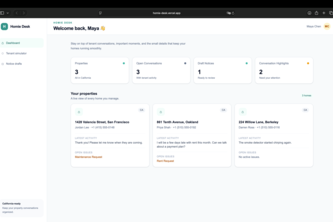
The company appears to be a single-person project (Vishakha Kumari) submitted to the OpenAI 2026 hackathon. The product, Homie Desk, is described as an AI-powered property management assistant that helps landlords organize tenant conversations, simulate tenant interactions, and generate professional notice drafts from one unified workspace.
The author states this is a prototype built with Next.js, React, TypeScript, Tailwind CSS, and Google Gemini API, using OpenAI Codex and GPT-5.6 for development assistance. It was deployed publicly with production-ready documentation.
Key commercial due-diligence read
The project description provides no evidence of revenue, customers, or traction beyond the author's own claims. There is no indication of market validation, product-market fit, or business model implementation. The single most important open question is whether this represents a viable commercial product or service, or merely an experimental prototype.
Confidence level Low — based entirely on self-reported evidence with no independent verification.
What The Product Actually Is
The description states that Homie Desk is:
- An AI-powered property management assistant
- Designed to help landlords manage tenant communication more efficiently
- A single workspace for organizing conversations, simulating tenant interactions, and generating notice drafts
- Built using Next.js, React, TypeScript, Tailwind CSS, and Google Gemini API
- Powered by OpenAI Codex and GPT-5.6 during development
Inference The product is a web-based application that integrates AI to streamline landlord tasks around tenant communication.
Not evidenced No information on actual functionality beyond stated features, no screenshots, no user interface details, no technical architecture diagrams, no API endpoints or data flows.
Positioning & Claim Evolution
The author states:
- Homie Desk aims to solve the problem of switching between multiple tools for managing rental properties
- It offers a "unified workspace" for tenant conversations, simulations, and notice generation
- The goal is to reduce time spent on daily tasks by organizing information and automating drafting
Inference This positions Homie Desk as a productivity tool for landlords, focusing on reducing friction in communication workflows.
Not evidenced No evidence of prior positioning or evolution of claims. No mention of competitors or differentiation strategies. No indication of how the product addresses broader market needs beyond what is described.
Target Customer & ICP
The description states:
- The target user is "landlords"
- It helps with "tenant conversations, simulate tenant interactions, and generate professional notice drafts"
Inference The primary customer segment appears to be individual landlords or small property owners who manage rental units.
Not evidenced No evidence of specific customer personas, segmentation criteria, or buyer intent. No indication of whether the tool targets large property managers or solo landlords. No mention of geographic scope or tenant demographics.
Business Model & Pricing Evidence
The description does not provide any information about:
- Revenue model
- Pricing structure
- Monetization strategy
- Customer acquisition costs
- Unit economics
Inference There is no evidence of a defined business model beyond the author’s own claims.
Not evidenced No pricing data, subscription tiers, or monetization mechanisms are mentioned. The project is presented as a prototype, not a commercial offering.
Technical & Delivery Signals
The description states:
- Built with Next.js, React, TypeScript, Tailwind CSS
- AI features powered by Google Gemini API
- Development tools included OpenAI Codex and GPT-5.6
- Deployed publicly with production-ready documentation
- Challenges included API integration and deployment consistency
Inference The application is a modern web app built using current frontend and backend technologies, with AI components integrated via APIs.
Not evidenced No information on scalability, performance metrics, data privacy measures, or infrastructure architecture. No evidence of robustness or long-term maintainability.
Traction & Maturity Signals
The description states:
- The project was submitted to the OpenAI 2026 hackathon
- It is a complete AI-assisted property management application
- It has been deployed publicly with documentation
- Future improvements include multi-user authentication, persistent history, calendar/email integration, dashboard analytics, and multi-property collaboration
Inference This is an early-stage prototype that has reached a minimum viable product (MVP) level.
Not evidenced No evidence of user adoption, customer feedback, or usage statistics. No indication of whether the tool was tested with real users or used in practice. No evidence of traction metrics such as active users, retention rates, or revenue.
Competitive Context
The description does not mention:
- Competitors
- Market size
- Competitive advantages
- Differentiation from existing solutions
Inference The author did not position Homie Desk within a competitive landscape.
Not evidenced No evidence of market analysis, competitive benchmarking, or awareness of existing tools in the property management space.
Open Questions & Risks
Key risks and open questions based on the description:
- Single-person development: Only one team member is mentioned, raising concerns about scalability and depth of expertise.
- Prototype nature: The project is described as a hackathon submission and MVP — no commercial traction or validation.
- Unverified claims: All features and benefits are self-reported without external corroboration.
- Limited technical detail: No information on data handling, security, or system architecture.
- No monetization strategy: No indication of how the product will generate revenue.
Inference The project lacks commercial viability indicators and may not be ready for market entry or investment.
Questions the description leaves open
- What specific problems are landlords facing that this tool solves?
- Have you tested the tool with actual landlords or property managers?
- How do you plan to monetize the product?
- What is your roadmap beyond the MVP?
- Are there any legal or compliance considerations related to tenant communication and notice generation?
- How will you scale beyond a single developer?
- What are your assumptions about user behavior and adoption?
Overall Assessment
Assessment Not evidenced.
The description provides no evidence of commercial viability, traction, or business model implementation. It is a self-reported prototype submitted to a hackathon, with no indication of market validation or product-market fit.
Confidence level Very low — this is not a commercial entity but rather an experimental project with no demonstrated value proposition beyond the author’s own claims.
Inference If this were to evolve into a commercial offering, significant work would be required in validating demand, building out features, and establishing a sustainable business model.
User Stories BotA demo video on every pull request
Get a demo video on every new feature
GitHub App that watches your pull requests and records a narrated, captioned demo.
Save time on demo prep and make informed decisions faster with a video walkthrough of every new feature.
Source
Submitted to the OpenAI 2026 hackathon on Devpost. Project home on Devpost. Back to the full gallery on Devpost.
This competitive analysis was produced by top-founders.com (opens in a new tab)
Generated by a language model from this project's public Devpost page — its tagline, the author's own write-up and any built-with tags listed there — as captured in August 2026. Short quotations are the author's words. It is an opinion on the idea as a business, not on the people behind it, and it reflects the description as published then. If the project has moved on, request a correction below. The analysis is not independent research and contains no verified traction, revenue or customer data.
An independent guide by KFG International LLC — not affiliated with, endorsed by, or connected to Devpost or OpenAI.