

Archive position — measured, not model output
0 likes on Devpost
2,263 of the 7,850 archived projects have more likes, and 5,587 share exactly 0 — so this project's #6,499 place in the like-ranked listing is a tie-break inside that group, not a ranking.
Projects (log scale)
Likes on Devpost. ▲ marks this project's group.
Show the figures
| Likes | Projects | Share of archive |
|---|---|---|
| 0 | 5,587 | 71.2% |
| 1 | 1,758 | 22.4% |
| 2 | 284 | 3.6% |
| 3–4 | 132 | 1.7% |
| 5–9 | 75 | 1.0% |
| 10+ | 14 | 0.2% |
 User Stories BotA demo video on every pull request
Get a demo video on every new feature
GitHub App that watches your pull requests and records a narrated, captioned demo.
Save time on demo prep and make informed decisions faster with a video walkthrough of every new feature.
Executive Summary
The company appears to be a solo project, SafeAgent: AI Action Verification Platform, built by Muhammad Akash Awan as part of the OpenAI 2026 hackathon. The author states that it is an AI Action Verification Platform designed to sit between AI agents and operating systems, verifying actions before execution, assessing risk, preparing recovery plans, and enforcing deterministic safety controls.
The project is self-reported and unverified; no revenue, customers, or traction data are provided. It is positioned as a tool for AI agent safety, particularly in environments where AI agents can execute potentially destructive commands on user machines.
The single most important open question is: What is the actual scope of SafeAgent’s integration with AI agents, and how does it scale beyond a hackathon prototype?
What The Product Actually Is
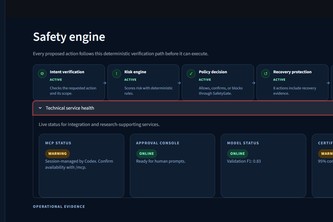
The description states that SafeAgent is an AI Action Verification Platform that sits between AI agents and the operating system. It verifies user intent, analyzes risk, prepares recovery where possible, and controls execution.
It uses a hybrid safety engine combining:
- Deterministic security rules (authoritative for destructive actions like recursive deletion or force-pushes)
- Machine learning (for uncertain cases)
- Intent verification layer
- Rollback Guardian for recovery planning
The platform is built in Python with MCP integration, allowing AI agents to request execution through SafeAgent as a command gateway.
Inference: The product appears to be a proof-of-concept prototype for AI agent safety, not yet a commercial offering. It is described as a command gateway that enforces safety before execution.
Positioning & Claim Evolution
The author claims that AI agents are becoming powerful enough to edit repositories, run scripts, install packages, and delete files, which creates a new safety problem.
They state:
- Simple blocklists are insufficient.
- SafeAgent makes AI execution safer without reducing agent utility.
- It turns AI execution from a black box into a visible, reviewable workflow.
- LLMs can explain actions, but safety decisions remain controlled, deterministic, and explainable.
Inference: The positioning is that of a safety control layer for AI agents, aimed at mitigating risks in environments where AI agents interact with operating systems or development tools. It is not positioned as a general-purpose AI platform but as a verification and risk mitigation tool.
Target Customer & ICP
The description does not explicitly name target customers or define an ideal customer profile (ICP). However, it implies:
- AI agent developers or users who are concerned about safety in execution environments.
- Organizations using AI agents that can interact with operating systems or development tools.
It is unclear if the platform targets end-users, enterprise developers, or internal tooling teams.
Inference: The ICP likely includes developers or enterprises using AI agents in environments where destructive actions are possible. However, no explicit customer segmentation or persona data is provided.
Business Model & Pricing Evidence
There is no evidence of a business model or pricing structure in the description.
The author states that the platform is built for the OpenAI 2026 hackathon and that they plan to support more agent platforms and improve model calibration. No mention of monetization, licensing, or pricing models is made.
Inference: The project is currently a prototype with no commercial business model evident. It is not clear whether it will be offered as SaaS, open-source, or part of a larger product suite.
Technical & Delivery Signals
The platform is built in Python, with integration via MCP (Model Control Protocol), allowing AI agents to request execution through SafeAgent.
Key technical components include:
- Hybrid safety engine (deterministic + ML)
- Intent verification layer
- Rollback Guardian for recovery planning
- Security dashboard showing verification history and risk evidence
The author mentions:
- Reducing ML false positives
- Improving intent matching
- Implementing policy blocking for remote execution patterns
- End-to-end testing with a judge-friendly dashboard
Inference: The technical architecture is proof-of-concept level, built for a hackathon. It is not clear how it would scale or integrate into existing AI agent platforms beyond the prototype.
Traction & Maturity Signals
There is no evidence of traction, customers, or adoption in the description.
The project is described as a solo effort by one individual (Muhammad Akash Awan) and submitted to a hackathon. No revenue, usage metrics, or user feedback are provided.
Inference: The platform is at an early stage—likely a prototype or MVP—and lacks any measurable traction or market validation.
Competitive Context
The description does not mention competitors or existing solutions in the AI safety space.
However, it implies that current solutions (e.g., blocklists) are insufficient, and SafeAgent aims to offer a hybrid approach combining deterministic controls with ML risk prediction.
Inference: The competitive landscape is unclear. It may be positioned against tools that provide basic access control or command filtering for AI agents, but no specific competitors are named.
Open Questions & Risks
- Solo development: Only one team member is listed, which raises concerns about scalability and long-term maintenance.
- Prototype-only: The platform is described as a hackathon submission with no commercial viability or traction.
- No evidence of integration or adoption: No mention of partnerships, integrations, or real-world usage.
- Unproven ML calibration: The author mentions improving model calibration but does not provide data on performance or accuracy.
- Unclear monetization strategy: No indication of how the platform will be monetized or sold.
Inference: The project is at a very early stage and lacks commercial viability, scalability, or market traction. Risks include lack of resources, unclear path to product-market fit, and absence of any business model.
Questions the description leaves open
- What specific AI agent platforms does SafeAgent currently support, and how is integration achieved?
- How does the hybrid safety engine handle false positives in ML risk scoring?
- What are the current limitations of the intent verification layer, and how are they being addressed?
- Is there a plan to move beyond the hackathon prototype into a commercial product or service?
- How does SafeAgent compare to existing tools for AI agent safety in terms of performance, usability, and adoption?
- What is the roadmap for expanding support for more rollback providers and command types?
Overall Assessment
Not evidenced: No financial data, revenue, or investment history are provided.
The project is described as a hackathon submission, built by one person, with no evidence of traction, customers, or commercial viability. It is not clear whether it is intended to be a product, open-source tool, or part of a larger platform.
Inference: At this stage, the project is not suitable for investment or partnership consideration. It lacks the maturity, traction, and business model necessary for commercial evaluation. It may have potential as a prototype or proof-of-concept but requires significant development to become viable.
User Stories BotA demo video on every pull request
Get a demo video on every new feature
GitHub App that watches your pull requests and records a narrated, captioned demo.
Save time on demo prep and make informed decisions faster with a video walkthrough of every new feature.
Source
Submitted to the OpenAI 2026 hackathon on Devpost. Project home on Devpost. Back to the full gallery on Devpost.
This competitive analysis was produced by top-founders.com (opens in a new tab)
Generated by a language model from this project's public Devpost page — its tagline, the author's own write-up and any built-with tags listed there — as captured in August 2026. Short quotations are the author's words. It is an opinion on the idea as a business, not on the people behind it, and it reflects the description as published then. If the project has moved on, request a correction below. The analysis is not independent research and contains no verified traction, revenue or customer data.
An independent guide by KFG International LLC — not affiliated with, endorsed by, or connected to Devpost or OpenAI.